
Bubble.io vs Custom Code: The Real Cost (Is Bubble Worth It Anymore?)
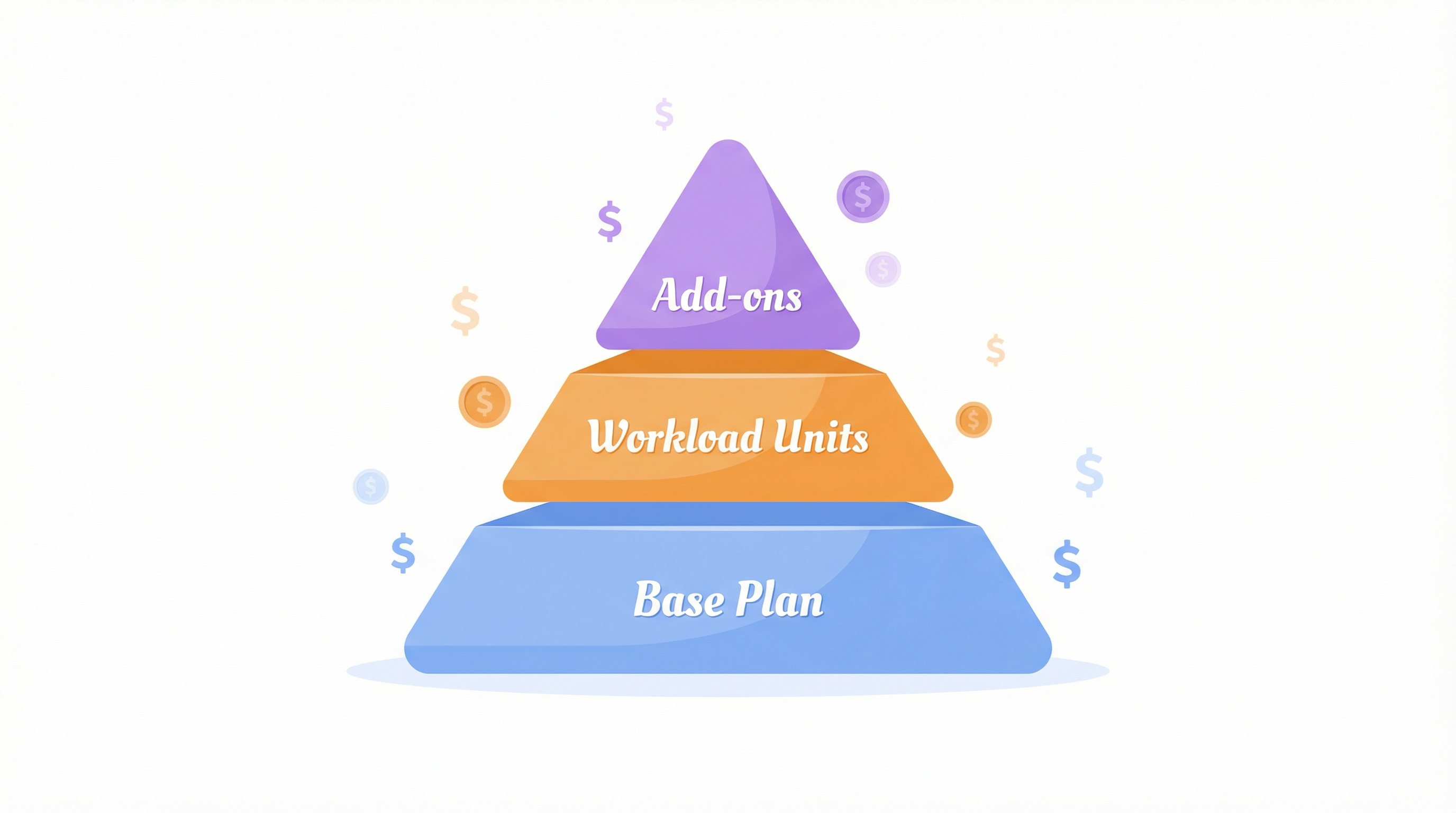
$28 a month.
That's what eric10 was paying when they started building on Bubble. A reasonable price for a no-code platform that let them launch without hiring developers. A price that made sense.
Then things changed.
"I was paying $28/month when I started. Now I'm sitting at $225." — eric10, Bubble Forum
$225 a month. For an app with only 10-15 daily users.
Not 10,000 users. Not even 1,000. Fifteen people using the app each day, and the monthly bill had grown 8x from where it started.
This isn't an isolated story. It's a pattern that's become impossible to ignore. Bubble founders who started with affordable pricing are watching their bills climb month after month, wondering when—or if—it will stop.
"when successful, running on Bubble is 10-100 times more expensive than running on self written code" — sem, Bubble Forum
10 to 100 times more expensive. That's not a typo. That's the actual math that founders are discovering the hard way—after they've already invested years building on the platform.
This post is going to do something uncomfortable. We're going to look at the real numbers. Not the marketing numbers. Not the "it depends" hedge that lets everyone avoid the truth. The actual, spreadsheet-honest comparison of what it costs to run on Bubble versus what it costs to run the same app on custom code.
And then you can decide: is Bubble still worth it for your app?
The Hidden Cost Structure of Bubble
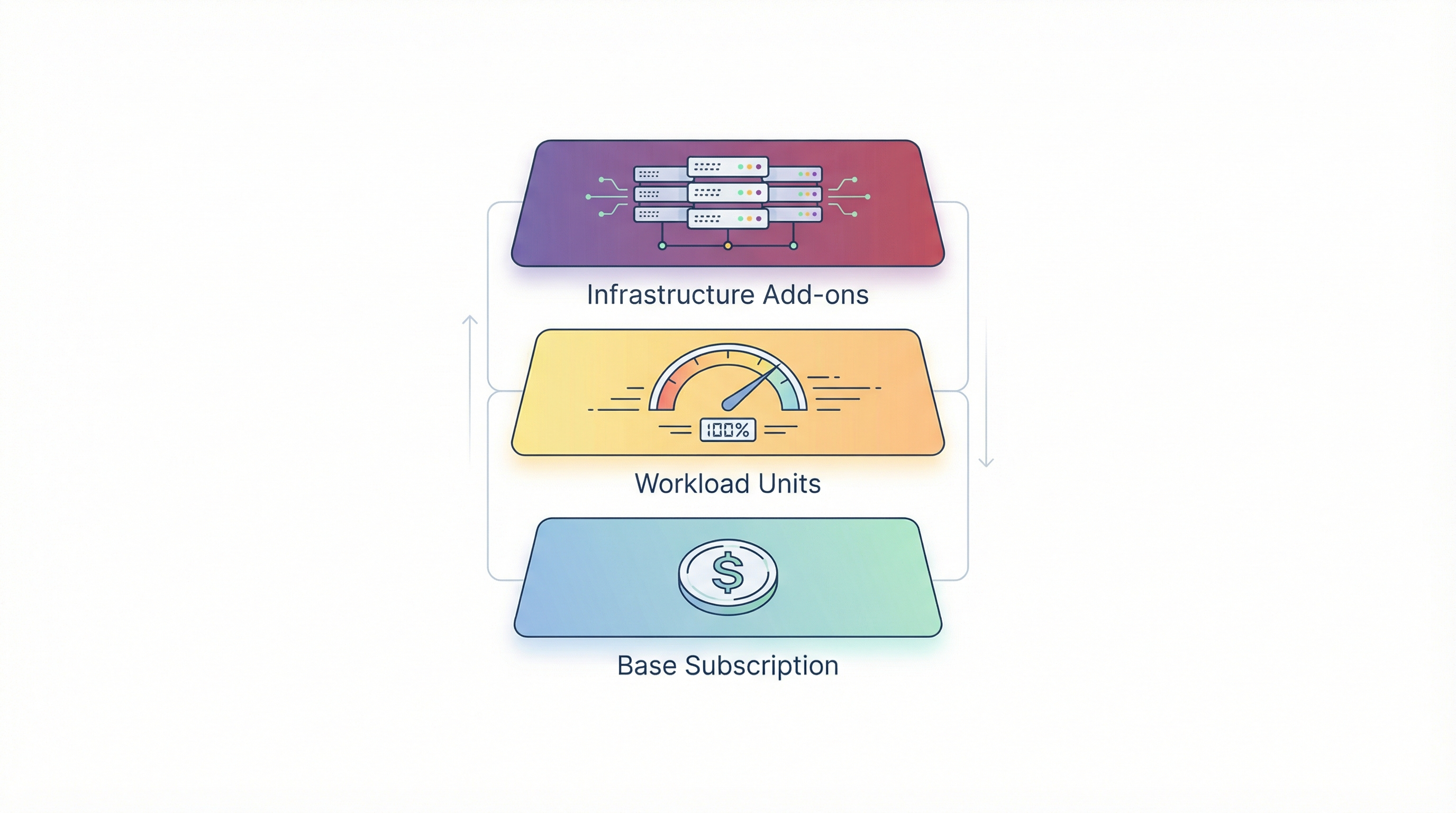
Before we compare costs, we need to understand how Bubble actually charges you. Because on the surface, it looks simple: pick a plan, pay monthly. But the reality is more complex—and more expensive—than most founders realize.
The Three Layers of Bubble Pricing
Layer 1: Base Subscription
This is the number you see on the pricing page:
- Starter: $32/month (billed monthly) or $29/month (billed annually)
- Growth: $134/month (billed monthly) or $119/month (billed annually)
- Team: $379/month (billed monthly) or $349/month (billed annually)
- Enterprise: Custom pricing
Simple enough. But this is just the entry fee.
Layer 2: Workload Units (WU)
Every action in your Bubble app consumes workload units. And when you exceed your plan's allocation, you pay overage fees.
What consumes WUs? Everything:
- Database searches
- Page loads
- Workflow executions
- API calls
- Conditional evaluations
- Backend workflows
- Scheduled tasks
"Everything costs workloads. Conditional statements? Workloads. Navigating a page? Workloads. Searching the database? Workloads. API calls? Workloads." — Bubble Forum
Each plan includes a monthly WU allocation:
- Starter: 175,000 WU
- Growth: 500,000 WU
- Team: 2,000,000 WU
Exceed these limits, and you're billed automatically for overages. The overage rates are where things get expensive—and unpredictable.
Layer 3: Infrastructure Add-ons
Growing apps often need:
- Additional capacity units for concurrent users
- Dedicated server clusters
- Priority support
- Additional editors/collaborators
Each adds to the monthly bill.
Why Costs Become Unpredictable
Here's the problem: Workload usage scales with your app's success. More users mean more page loads, more database queries, more workflows executing. The things that indicate your business is working—user engagement, feature usage, active sessions—are the same things that drive your Bubble bill higher.
This creates a perverse incentive structure. Your costs grow with your revenue... but faster. The margin compression is real.
"I can't even confidently forecast workload fees for clients because of stuff like this." — 23cubed, Bubble Forum
When you can't forecast costs, you can't plan. When you can't plan, you can't scale confidently. When you can't scale confidently, your business suffers.
The Real Numbers: A Case Study Breakdown
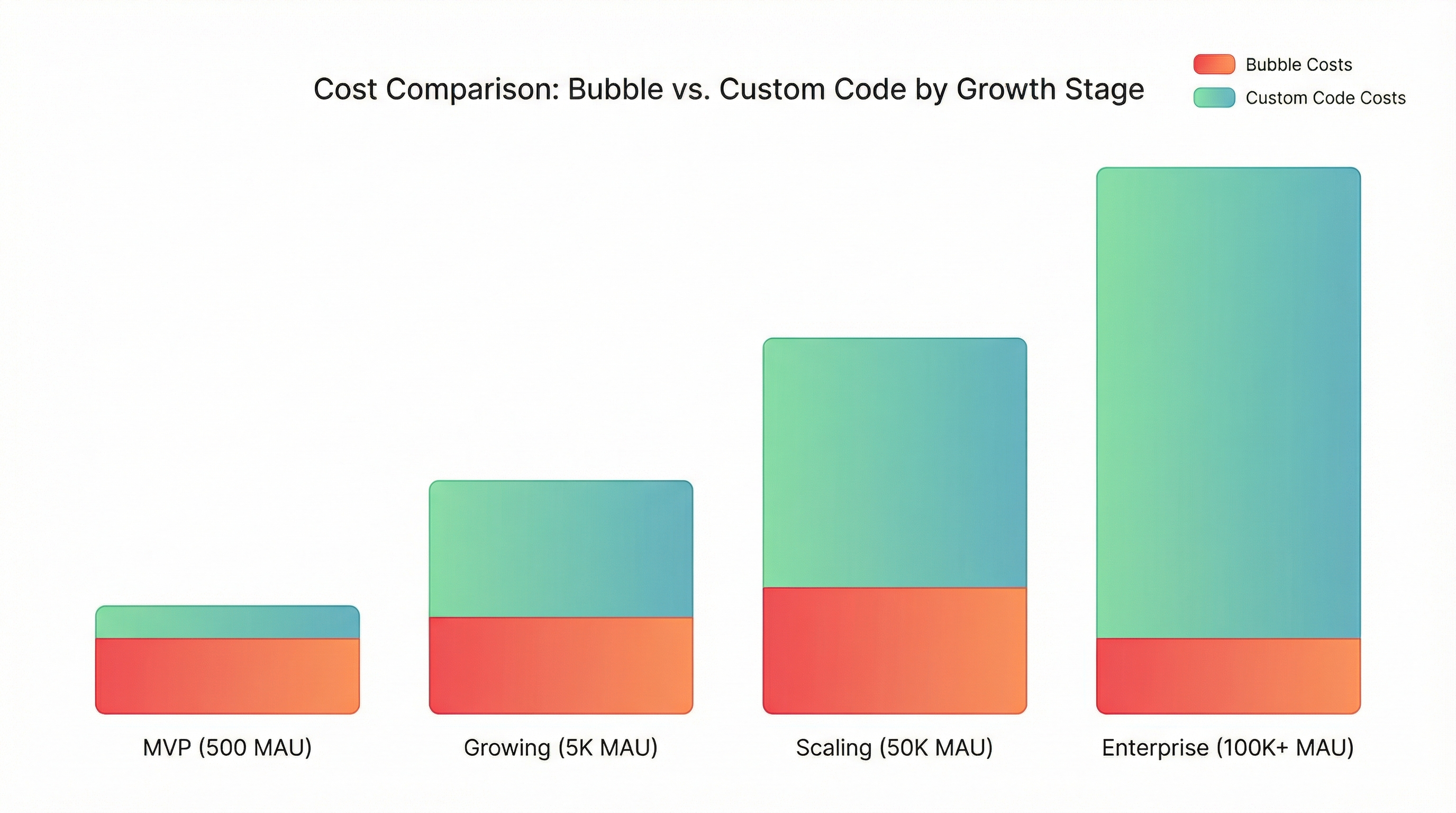
Let's model actual scenarios. We'll compare Bubble costs against equivalent custom code hosting for apps at different stages.
Scenario 1: Early-Stage MVP (100-500 Monthly Active Users)
Typical Bubble app:
- 10 pages
- User authentication
- Basic database operations
- 1-2 API integrations
- Simple workflows
Bubble Costs (Annual):
- Plan: Growth ($119/month × 12) = $1,428/year
- WU usage: Typically within allocation at this scale
- Total: ~$1,428-$1,600/year
Custom Code Costs (Annual):
- Hosting: Vercel Free/Hobby tier = $0-$240/year
- Database: Supabase Free tier or $25/month = $0-$300/year
- Auth: Included with Supabase or use Auth0 free tier = $0
- Total: ~$0-$540/year
Difference: Custom code saves $888-$1,600/year
Verdict: At this stage, Bubble's premium is modest. The speed advantage of staying on Bubble might justify the extra cost—if you're still iterating rapidly.
Scenario 2: Growing App (1,000-5,000 Monthly Active Users)
Typical Bubble app:
- 15-25 pages
- Complex user roles and permissions
- Frequent database operations
- Multiple API integrations
- Background workflows
Bubble Costs (Annual):
- Plan: Team ($349/month × 12) = $4,188/year
- WU overages: Often $100-$500/month at this scale = $1,200-$6,000/year
- Additional capacity: Often needed = $600-$2,400/year
- Total: ~$6,000-$12,500/year
Custom Code Costs (Annual):
- Hosting: Vercel Pro ($20/month × 12) = $240/year
- Database: Supabase Pro ($25/month × 12) = $300/year
- Supplementary services (email, storage, etc.): ~$600/year
- Total: ~$1,140/year
Difference: Custom code saves $4,860-$11,360/year
Verdict: The gap widens significantly. At this scale, you're paying for Bubble's convenience with thousands of dollars annually.
Scenario 3: Scaling App (10,000-50,000 Monthly Active Users)
Typical Bubble app:
- 30+ pages
- Heavy database utilization
- Real-time features
- Complex backend workflows
- Multiple third-party integrations
Bubble Costs (Annual):
- Plan: Team or Enterprise = $4,188-$15,000/year
- WU overages: Often severe = $6,000-$30,000/year
- Capacity and infrastructure: $3,600-$12,000/year
- Total: ~$14,000-$57,000/year
Custom Code Costs (Annual):
- Hosting: Vercel Pro or AWS = $1,200-$3,600/year
- Database: Supabase/RDS with scaling = $1,200-$4,800/year
- Caching, CDN, supplementary services: $1,200-$3,600/year
- Total: ~$3,600-$12,000/year
Difference: Custom code saves $10,400-$45,000/year
Verdict: The math becomes brutal. At scale, Bubble costs can exceed custom code by 4-10x annually.
Scenario 4: Enterprise/High-Traffic (100,000+ Monthly Active Users)
At this scale, the comparison becomes almost absurd:
Bubble Costs (Annual): $50,000-$200,000+/year (enterprise pricing, massive WU consumption, dedicated infrastructure)
Custom Code Costs (Annual): $12,000-$48,000/year (properly architected, auto-scaling infrastructure)
Difference: Custom code saves $38,000-$152,000/year
The "10-100x" Math Explained
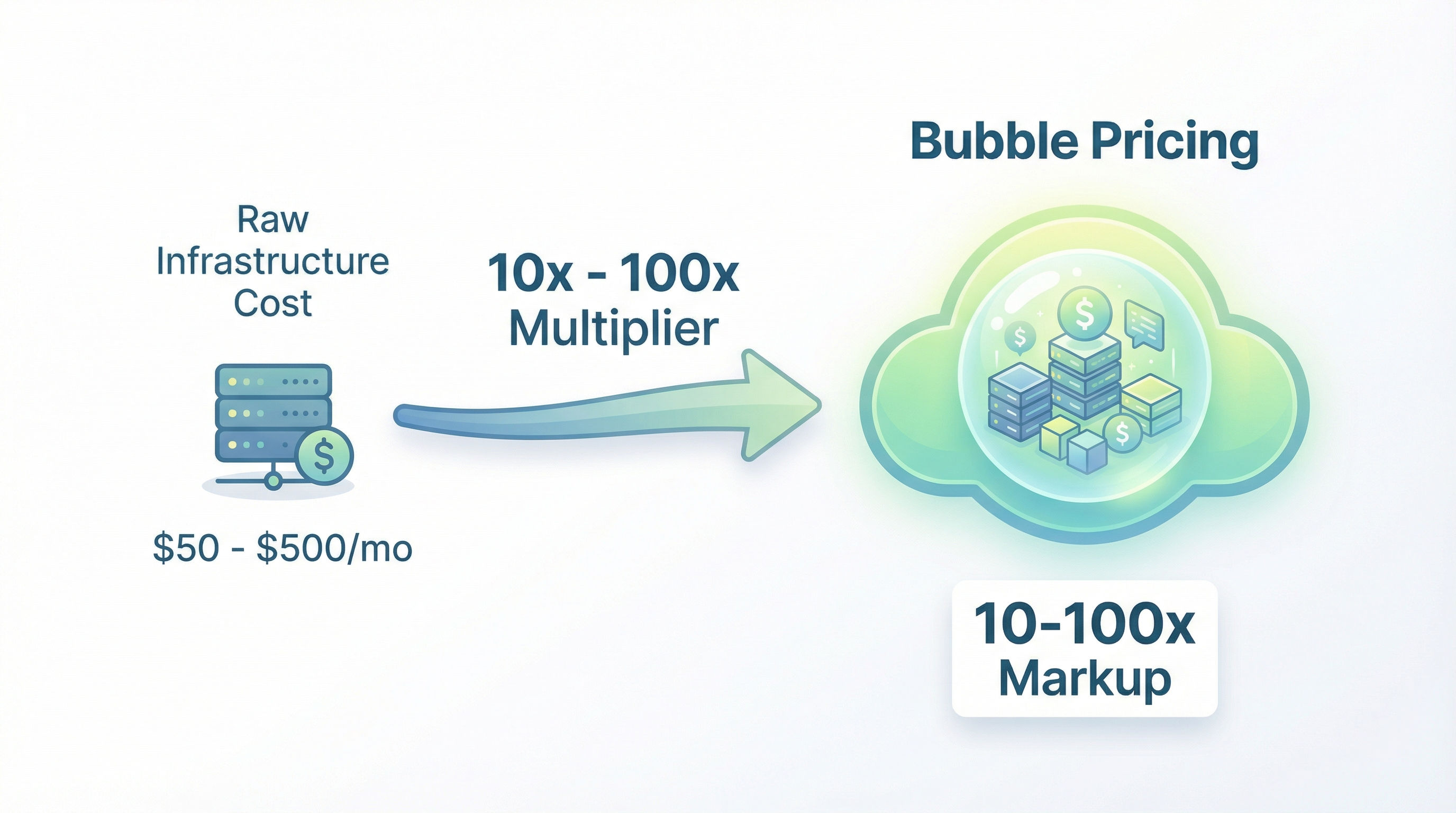
Remember that quote from sem about Bubble being "10-100 times more expensive"? Let's break down why that's mathematically accurate.
The Infrastructure Cost Baseline
When you run custom code on modern infrastructure, here's what you're actually paying for:
Compute (running your code):
- Serverless: $0.0000002 per millisecond of execution (Vercel/AWS Lambda)
- Traditional: $5-50/month for a VPS that handles thousands of concurrent users
Database:
- Managed PostgreSQL: $15-100/month handles millions of rows
- Queries: Fractions of cents per thousand operations
Storage:
- S3/Cloudflare R2: $0.015-$0.023 per GB per month
- Bandwidth: Often free or pennies per GB
Authentication:
- Most services free for thousands of users
- At scale: $0.01-0.05 per monthly active user
Total infrastructure cost: Typically $50-500/month for apps serving 10,000+ users.
What Bubble Charges for the Same Infrastructure
Bubble has to pay for the same underlying infrastructure—servers, databases, bandwidth. But they add significant margins:
- Platform development costs (maintaining the visual builder)
- Support infrastructure
- Hosting overhead (multi-tenant architecture has inefficiencies)
- Profit margins
- Customer acquisition costs (marketing, sales)
These are legitimate business costs, but you're paying for them in your bill. When sem says "10-100x more expensive," they're observing the spread between raw infrastructure costs and Bubble's end-user pricing.
The Workload Unit Arbitrage
Here's where it gets interesting. Workload units don't map directly to compute costs. Bubble created an abstraction layer that lets them charge based on "app activity" rather than actual server resources.
A simple example:
A database query in custom code:
- PostgreSQL executes query: ~0.001 seconds
- Cost: ~$0.00000001 (effectively free)
The same query in Bubble:
- Counts as workload units (varies by complexity)
- At scale, can cost $0.001-$0.01 per operation
- That's 1,000x-1,000,000x the raw infrastructure cost
This abstraction is what enables the "10-100x more expensive" reality. You're not paying for computing. You're paying for convenience—at a massive premium.
The One-Time Migration Cost vs. Ongoing Savings
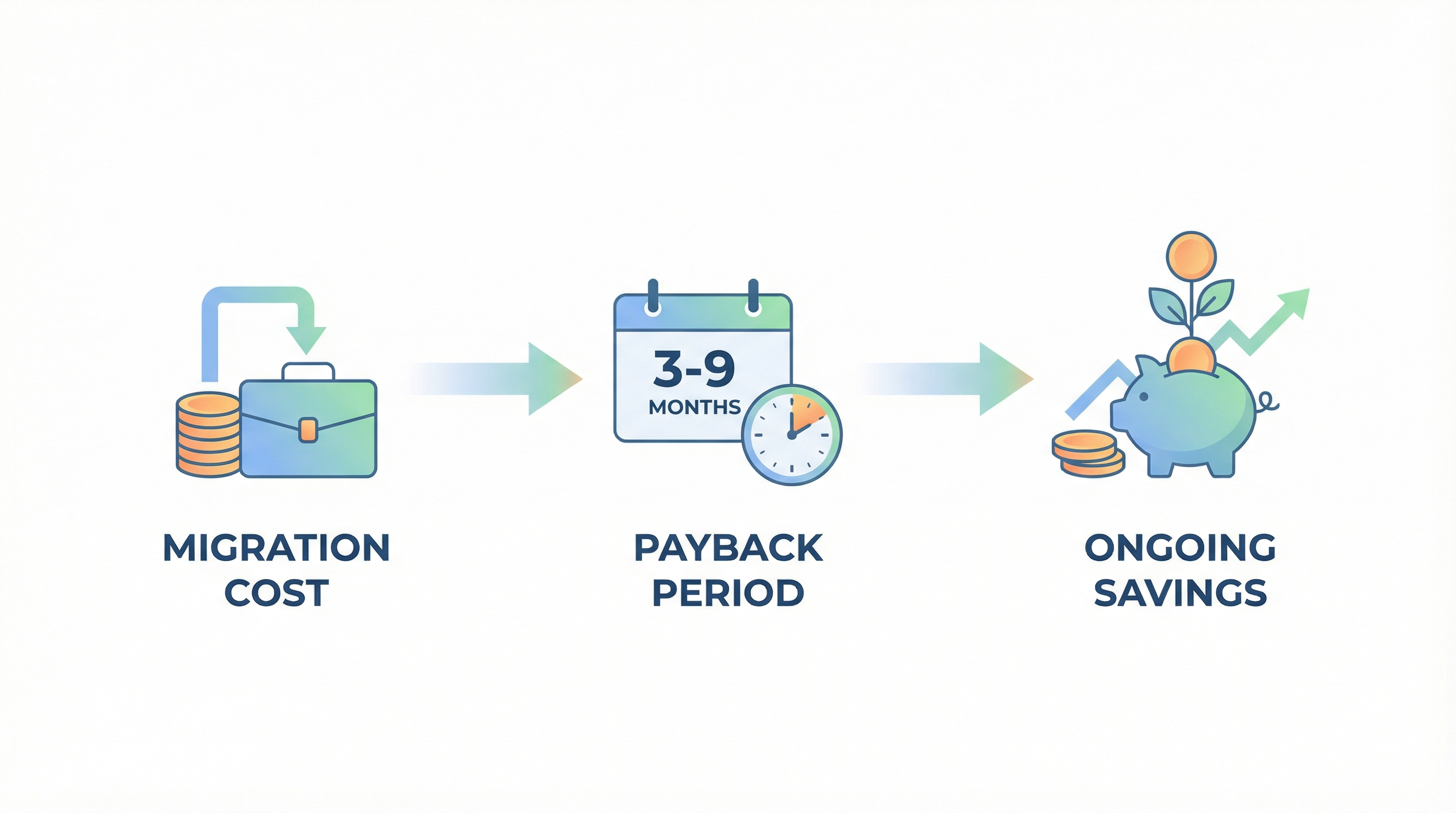
"But migration costs money too," you might be thinking. "How does that factor in?"
Let's calculate the payback period for different scenarios.
Migration Cost Estimates
Simple app (5-10 pages, basic features):
- Professional migration service: $1,500-$3,000
- DIY with AI tools: $0-$500 (your time)
Medium complexity (10-25 pages, moderate features):
- Professional migration service: $2,500-$5,000
- DIY with AI tools: $500-$2,000 (more time)
Complex app (25+ pages, advanced features):
- Professional migration service: $5,000-$15,000
- DIY with AI tools: $2,000-$10,000 (significant time)
Payback Period Calculations
Scenario: Growing app saving $6,000/year by migrating
| Migration Cost | Payback Period |
|---|---|
| $1,500 | 3 months |
| $3,000 | 6 months |
| $5,000 | 10 months |
Scenario: Scaling app saving $20,000/year by migrating
| Migration Cost | Payback Period |
|---|---|
| $3,000 | 2 months |
| $5,000 | 3 months |
| $15,000 | 9 months |
Scenario: Enterprise app saving $75,000/year by migrating
| Migration Cost | Payback Period |
|---|---|
| $5,000 | 3 weeks |
| $15,000 | 2.5 months |
| $50,000 | 8 months |
The math is stark: migration is almost always an investment that pays for itself within a year, often within a few months.
The 5-Year Cost Projection
Let's zoom out. Here's what staying on Bubble costs over 5 years versus migrating:
Growing app (5,000 MAU):
- Stay on Bubble: ~$40,000-$60,000 over 5 years
- Migrate Year 1 + hosting: ~$8,000-$12,000 over 5 years
- Savings: $28,000-$52,000
Scaling app (25,000 MAU):
- Stay on Bubble: ~$100,000-$200,000 over 5 years
- Migrate Year 1 + hosting: ~$20,000-$40,000 over 5 years
- Savings: $80,000-$160,000
Why People Stay on Bubble Despite the Math
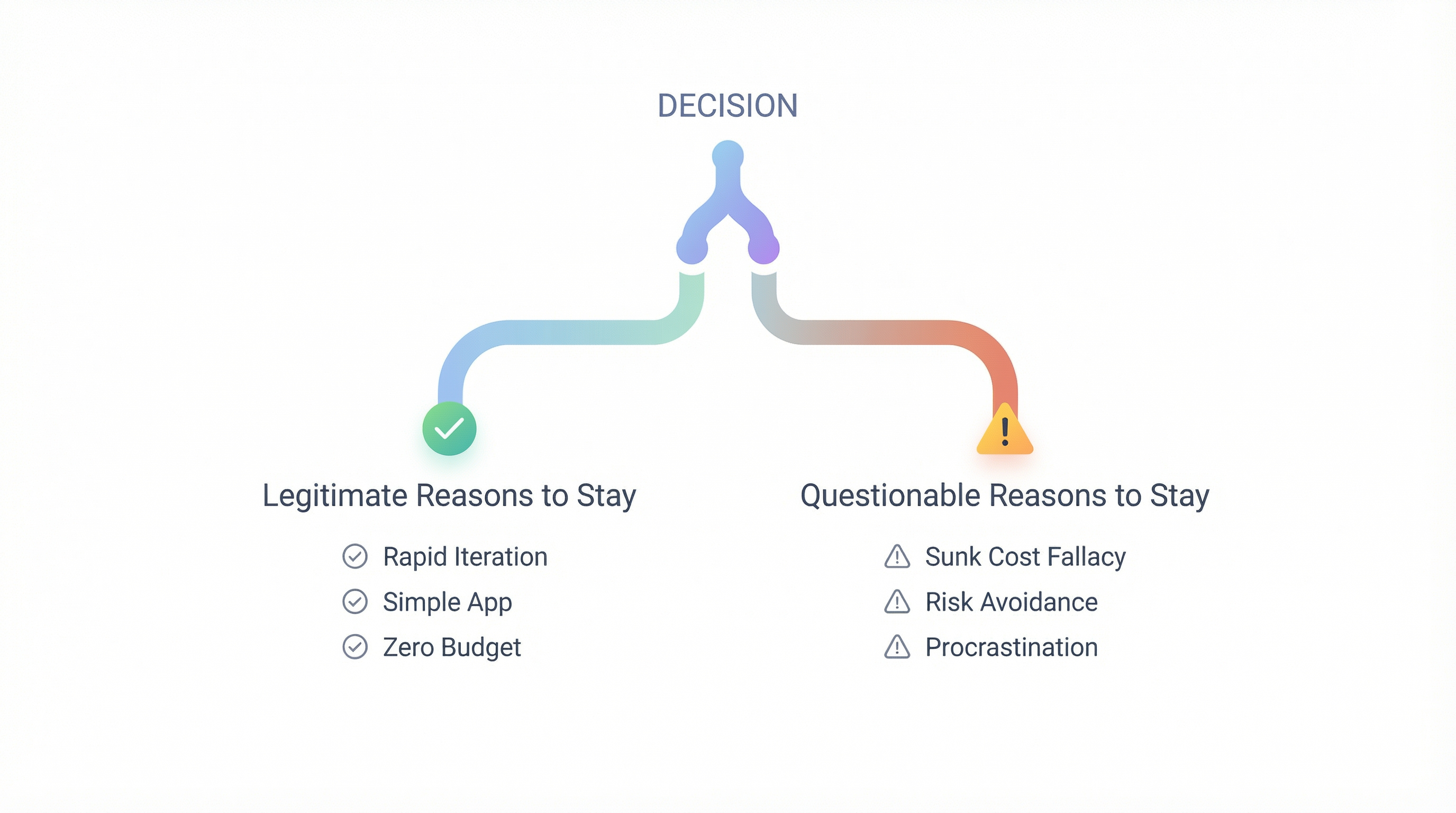
If the math is so clear, why doesn't everyone migrate immediately? Understanding the friction points helps explain the decision calculus.
Legitimate Reasons to Stay
1. You're still in rapid iteration mode.
If you're changing your product weekly based on user feedback, Bubble's visual builder does offer faster iteration than code. The time savings might outweigh the cost premium.
Signal you're past this stage: Your core features have been stable for 3+ months. You're optimizing and scaling, not pivoting.
2. Your app is genuinely simple.
A basic MVP with 100 users and stable features might cost $1,500/year on Bubble. The hassle of migrating isn't worth the modest savings.
Signal this applies to you: Your monthly Bubble bill is under $100, and you don't expect significant growth.
3. You have zero technical capability and no budget.
If you built on Bubble because you literally cannot write code and have no money to pay for migration, staying put is pragmatic.
Signal this is temporary: AI coding tools are rapidly closing this gap. What required a developer 2 years ago can now be done with prompts.
Questionable Reasons to Stay
1. "I've invested too much time to leave."
This is the sunk cost fallacy. Time already spent doesn't change future economics. The question is: What's the best decision from today forward?
2. "Migration is too risky."
Migration does have risks, but so does staying. Bubble has had significant outages, breaking changes, and pricing shocks. You're not avoiding risk by staying—you're choosing which risks to take.
3. "I'll optimize my Bubble app instead."
Optimization can help, but it has diminishing returns. If you're already on the Team plan with optimized workflows, there's a ceiling to how much you can reduce costs without reducing functionality.
4. "I'll migrate later when I have time."
Every month you delay costs you money. If you're saving $500/month by migrating, each month of delay is $500 lost. Procrastination has a price.
The Hidden Costs Nobody Talks About
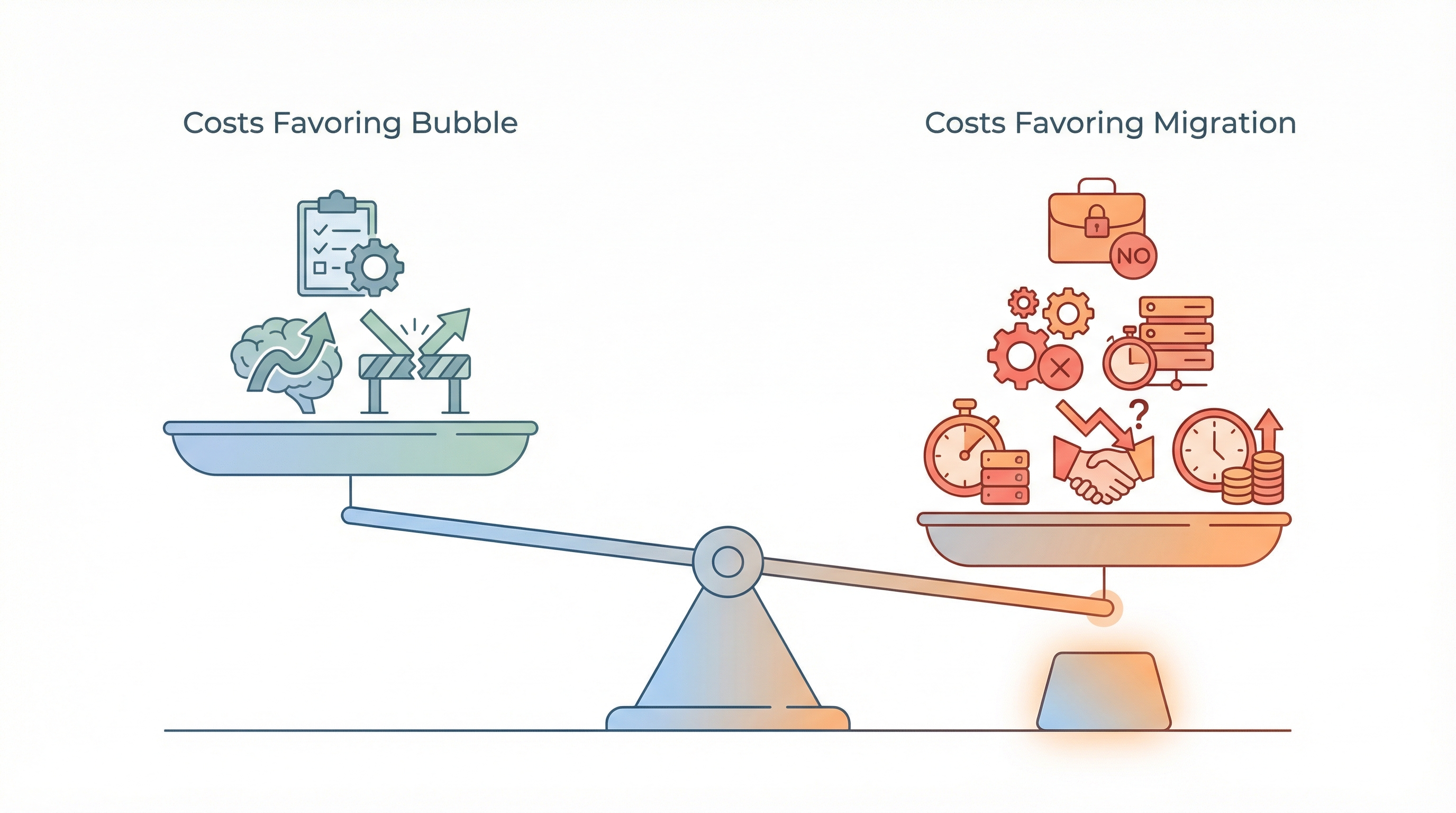
Cost comparisons usually focus on hosting bills. But there are other costs to consider—some favor Bubble, others favor custom code.
Costs That Favor Staying on Bubble
1. Migration project management: Coordinating a migration takes time and attention. That has value, even if it's not a line item.
2. Learning curve: If you manage your custom code yourself, there's time investment in learning new tools.
3. Potential bugs during transition: Any migration has risk of introducing issues. Plan for a stabilization period.
Costs That Favor Migrating
1. Hiring limitations: Bubble developers are a small, specialized talent pool. Custom code developers are everywhere. When you need to hire help, custom code gives you 100x more options.
2. Integration limitations: Some services don't have Bubble plugins. Custom code integrates with anything.
3. Performance-related business costs: Slow load times impact conversion rates, user retention, and SEO. The business cost of poor performance often exceeds hosting costs.
"Airbnb loads in 2.5 seconds, booking.com loads in 1.5 seconds" — thibautranger, Bubble Forum (comparing to his Bubble app taking 8+ seconds)
4. Investor and acquisition friction: If you're raising money or considering acquisition, lack of code ownership creates due diligence problems. We've seen deals fall through over this.
"my client lost a multi-million contract because they ran into compliance issue and they needed the code and DB to be run locally" — vascolucci, Bubble Forum
5. Opportunity cost of working around limitations: Time spent fighting Bubble's constraints is time not spent building features users want.
How to Calculate Your Personal ROI
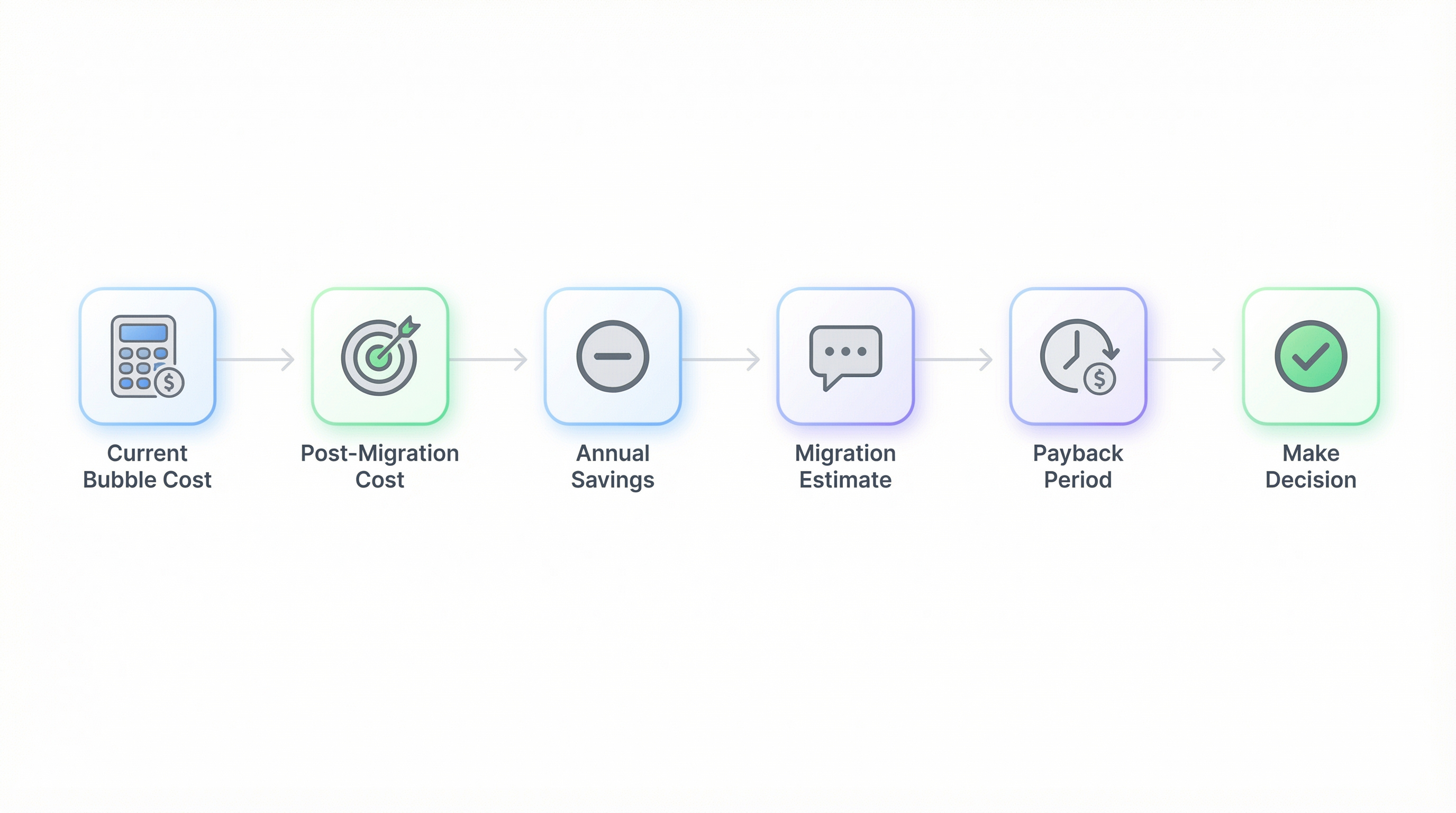
Here's a simple framework to calculate whether migration makes sense for your specific situation.
Step 1: Calculate Your Current Annual Bubble Cost
Add up:
- Monthly subscription × 12
- Average monthly WU overages × 12
- Capacity add-ons × 12
- Any other Bubble-related costs
Your number: $______/year
Step 2: Estimate Your Post-Migration Hosting Cost
For most apps:
- Small (< 1,000 MAU): $200-$600/year
- Medium (1,000-10,000 MAU): $600-$2,000/year
- Large (10,000-100,000 MAU): $2,000-$8,000/year
- Very large (100,000+ MAU): $8,000-$30,000/year
Your estimate: $______/year
Step 3: Calculate Annual Savings
Current cost minus post-migration cost.
Your annual savings: $______/year
Step 4: Get a Migration Cost Estimate
Get quotes from migration services or estimate DIY time cost.
Your migration cost: $______
Step 5: Calculate Payback Period
Migration cost ÷ (annual savings ÷ 12) = months to payback
Your payback period: ______ months
Step 6: Make the Decision
Clear yes to migrate:
- Payback period under 6 months
- Current costs are already painful
- Growth trajectory suggests costs will increase
Clear no (stay on Bubble):
- Payback period over 24 months
- App is stable with no growth expected
- Current costs are comfortable
Gray zone (consider carefully):
- Payback period 6-24 months
- Factor in non-financial benefits (performance, hiring, investors)
- Consider your risk tolerance and timeline
The "Is Bubble Worth It?" Decision Framework
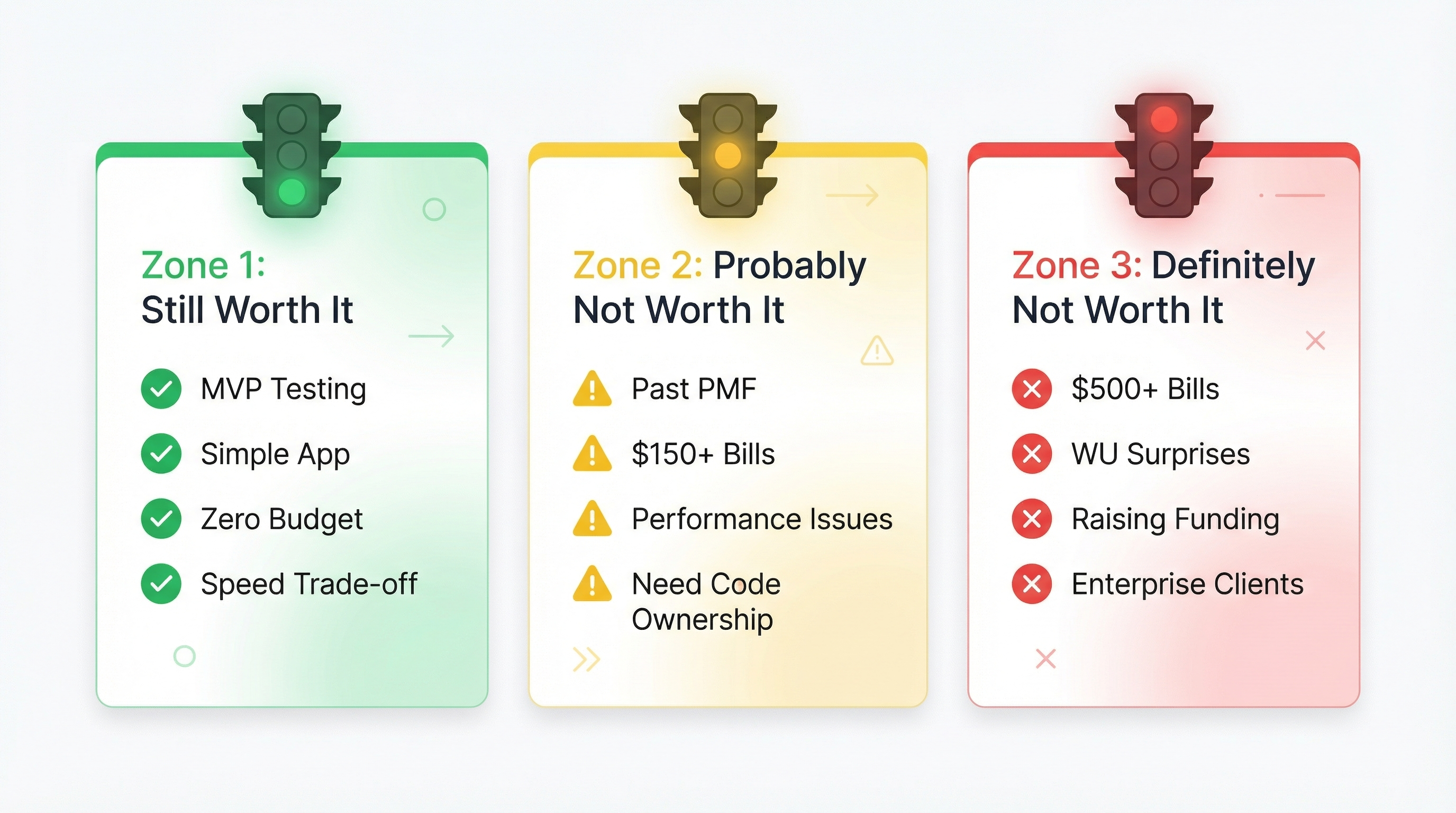
Instead of a simple yes/no, here's a nuanced framework for thinking about Bubble's value proposition:
Bubble Is Still Worth It If:
- ✅ You're building an MVP to test market fit (speed matters most)
- ✅ Your app is simple and will stay simple (cost stays low)
- ✅ You have zero technical capability AND zero budget (it's your only option)
- ✅ You're explicitly trading money for speed (conscious choice)
Bubble Is Probably Not Worth It If:
- ❌ You're past product-market fit and scaling (costs will explode)
- ❌ Your monthly bill exceeds $150-200 (migration ROI becomes obvious)
- ❌ You're experiencing performance issues (they'll get worse)
- ❌ You need code ownership for investors, compliance, or exit (fundamental blocker)
- ❌ You're spending significant time working around Bubble limitations (hidden cost)
Bubble Is Definitely Not Worth It If:
- 🚫 Your monthly bill exceeds $500 (paying >$6K/year for hosting)
- 🚫 You've had WU overage surprises (unpredictable costs are business risk)
- 🚫 You're planning to raise serious funding (investors will ask about this)
- 🚫 You're building for enterprise clients (compliance will bite you)
What Migration Actually Looks Like
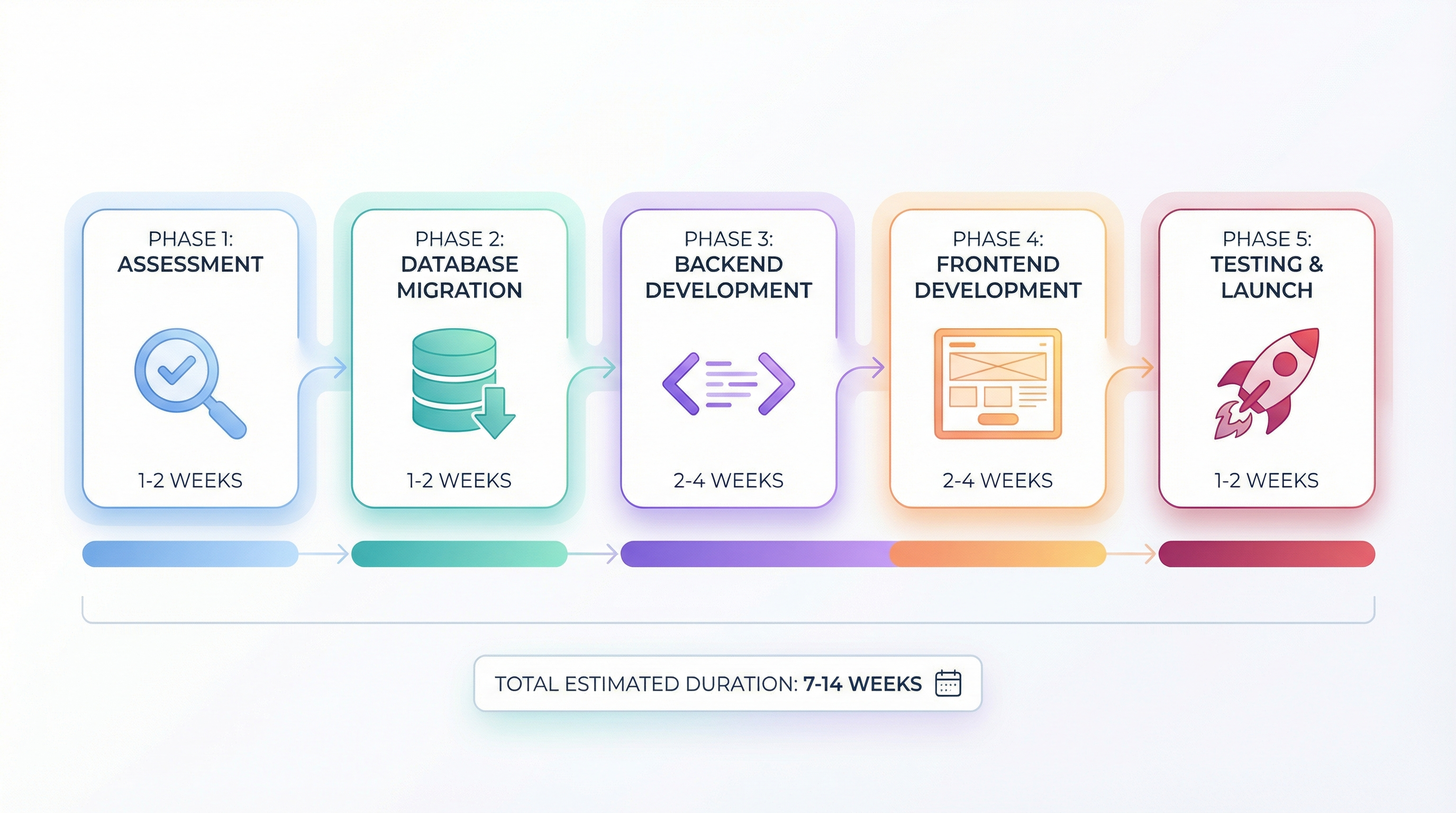
If the math says migrate, what does that process actually involve? Here's a realistic overview:
The Migration Process
Phase 1: Assessment (1-2 weeks)
- Inventory all pages, workflows, database tables
- Identify integrations and dependencies
- Map Bubble-specific features to code equivalents
- Define scope and timeline
Phase 2: Database Migration (1-2 weeks)
- Export data from Bubble
- Design PostgreSQL schema
- Transform and import data
- Validate data integrity
Phase 3: Backend Development (2-4 weeks)
- Recreate workflows in code
- Set up authentication
- Implement API integrations
- Build background jobs
Phase 4: Frontend Development (2-4 weeks)
- Recreate UI in React/Next.js
- Implement responsive design
- Connect to backend
- Optimize performance
Phase 5: Testing and Launch (1-2 weeks)
- Comprehensive testing
- Performance optimization
- Staged rollout
- Monitoring setup
Total timeline: 7-14 weeks for a medium-complexity app.
What You Get at the End
- Clean, documented codebase you own
- Modern tech stack (Next.js, PostgreSQL, etc.)
- 70-90% faster load times (typical)
- Predictable, lower hosting costs
- Ability to hire any developer
- No vendor lock-in
- Full compliance capability
Frequently Asked Questions
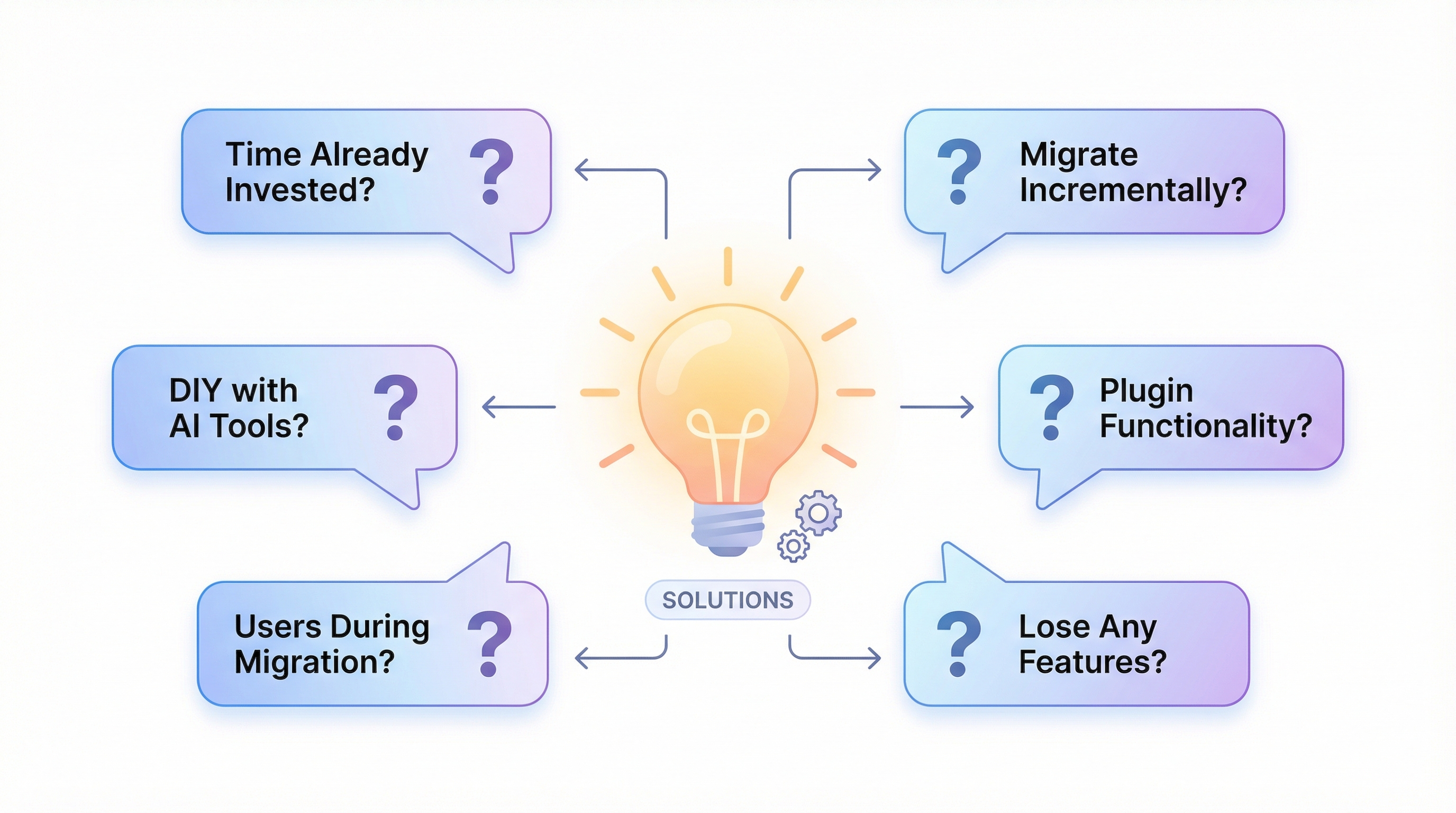
What about the time I've already invested learning Bubble?
That time gave you a working product and valuable experience. It wasn't wasted—it got you here. But past investment doesn't change future economics. The question is: What's the best path forward from today?
Can I migrate incrementally instead of all at once?
Yes. Some teams migrate their most resource-intensive features first (usually backend workflows and heavy database operations) while keeping the UI on Bubble temporarily. This can reduce costs immediately while spreading out the migration work.
What if my Bubble app uses a lot of plugins?
Most plugin functionality has equivalent solutions in code—often better ones. During assessment, each plugin gets mapped to its code equivalent. Some are direct replacements; others might need custom implementation.
Will I lose any functionality in the migration?
A well-executed migration should replicate all functionality. In practice, most teams end up with more capability, not less—because code can do things Bubble can't.
What about users during migration?
Migrations can be done with zero downtime using staged approaches. Users continue using the Bubble app until the coded version is ready and tested, then you switch over (often during low-traffic hours).
How much of the migration can I do myself with AI tools?
For simple apps, potentially 80-90%. AI coding tools have gotten remarkably capable at generating React components, database schemas, and API integrations. The complexity is in architecture decisions and edge cases—where experienced engineers still add significant value.
The Bottom Line
Here's the truth nobody in the Bubble ecosystem wants to say plainly:
Bubble is a great tool for building MVPs. It becomes a liability as you scale.
The same features that make Bubble accessible for beginners—abstraction, managed infrastructure, visual building—are what make it expensive for growing businesses. You're paying for convenience, and that convenience has a premium that grows with your success.
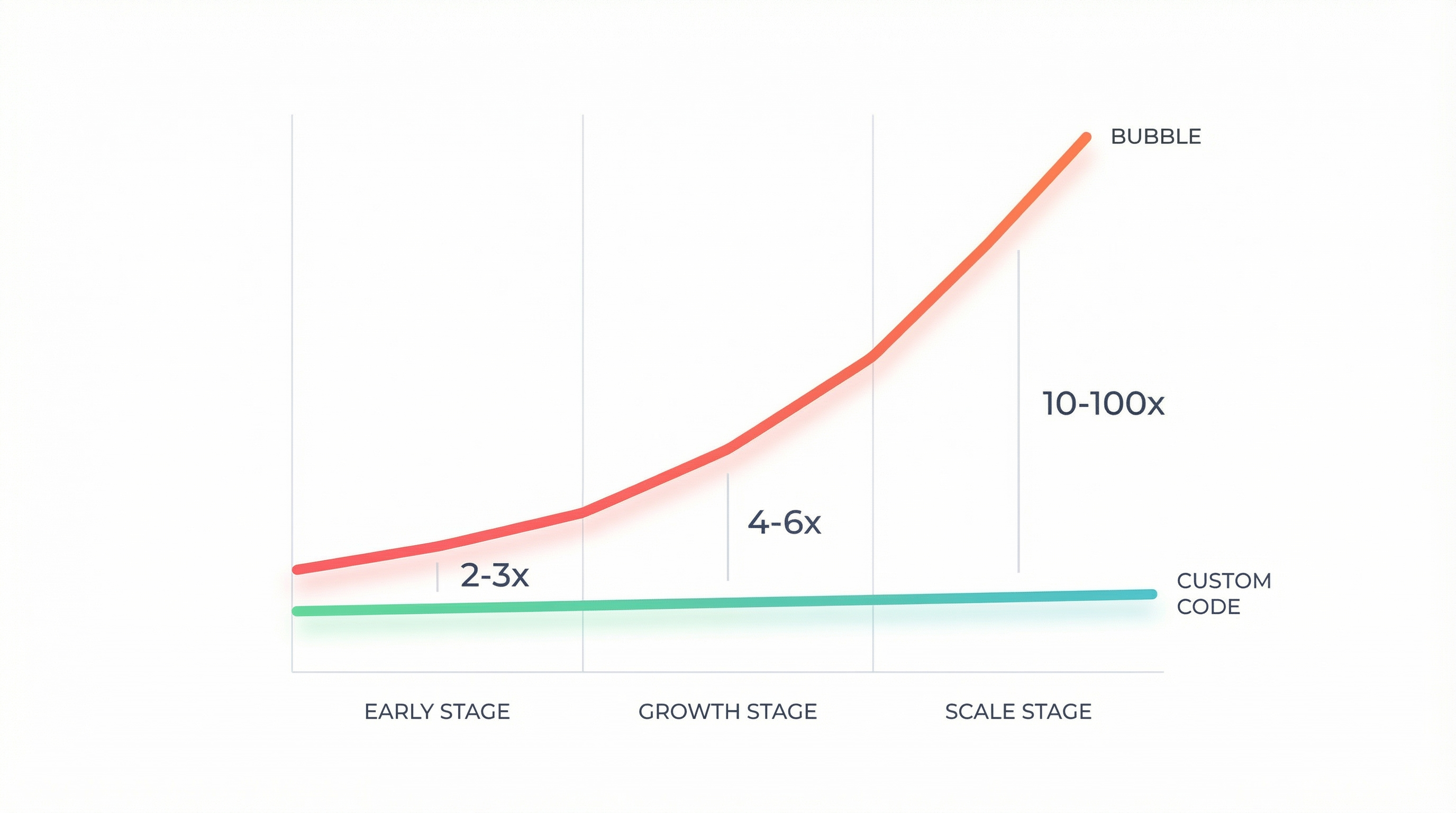
The math doesn't lie:
- Early stage: Bubble costs ~2-3x more than custom code (often worth it for speed)
- Growth stage: Bubble costs ~4-6x more than custom code (getting expensive)
- Scale stage: Bubble costs ~10-100x more than custom code (clearly not worth it)
If you're reading this with a Bubble app and a growing monthly bill, you already know something isn't right. The numbers in this article probably confirmed what your gut was telling you.
The question isn't whether you'll eventually migrate. The question is whether you'll do it proactively—while you can plan and optimize—or reactively, after a billing shock or scaling crisis forces your hand.
Every month you wait costs you the difference between Bubble and custom code hosting. For growing apps, that's hundreds or thousands of dollars. Money that could go into marketing, product development, or your own pocket.
The choice is yours.
Ready to See Your Numbers?
If you're curious what migration would look like for your specific Bubble app, we offer free assessments. No obligation, no sales pressure—just an honest look at your app's complexity, timeline estimate, and cost comparison.
Or if you're just starting to research, check out our other guides:
📊 Calculate Your Savings
Use this interactive calculator to see exactly how much you could save by migrating from Bubble to custom code.
Your Current Costs
3-Year Projection
Ready to see what migration looks like for your app?
Ready to talk migration?
Get a free assessment of your Bubble app. We'll tell you exactly what to expect — timeline, cost, and any potential challenges.