
What Happens If Bubble Shuts Down? (Your Vendor Lock-In Contingency Plan)

It's 3 AM and you can't sleep.
You're lying there, staring at the ceiling, and your brain won't stop running through scenarios. Not about competitors. Not about product features. Not about your next funding round.
About what happens if it all just... disappears.
What if you wake up tomorrow and Bubble is gone? What if there's a massive breach and your account gets deleted? What if they raise prices so dramatically that you can't afford to stay—but you also can't afford to leave?
You've built your entire business on this platform. Two years of work. Thousands of users. Hundreds of thousands in revenue. And somewhere beneath the confidence you project to investors and customers, there's this quiet terror:
You don't actually own any of it.
"what happens if someone hacks your account and deletes your app? Is there any way to recover from this?" — mc3digital, Bubble Forum
This question haunts the Bubble community because everyone knows the answer. And the answer isn't reassuring.
If you've ever felt this 3 AM anxiety, you're not paranoid. You're just thinking clearly about a risk that most no-code founders prefer to ignore. And in this guide, we're going to face it head-on: what actually happens if Bubble shuts down, what you can realistically do about it, and how to build a contingency plan that lets you sleep at night.
The Uncomfortable Reality of Platform Dependency
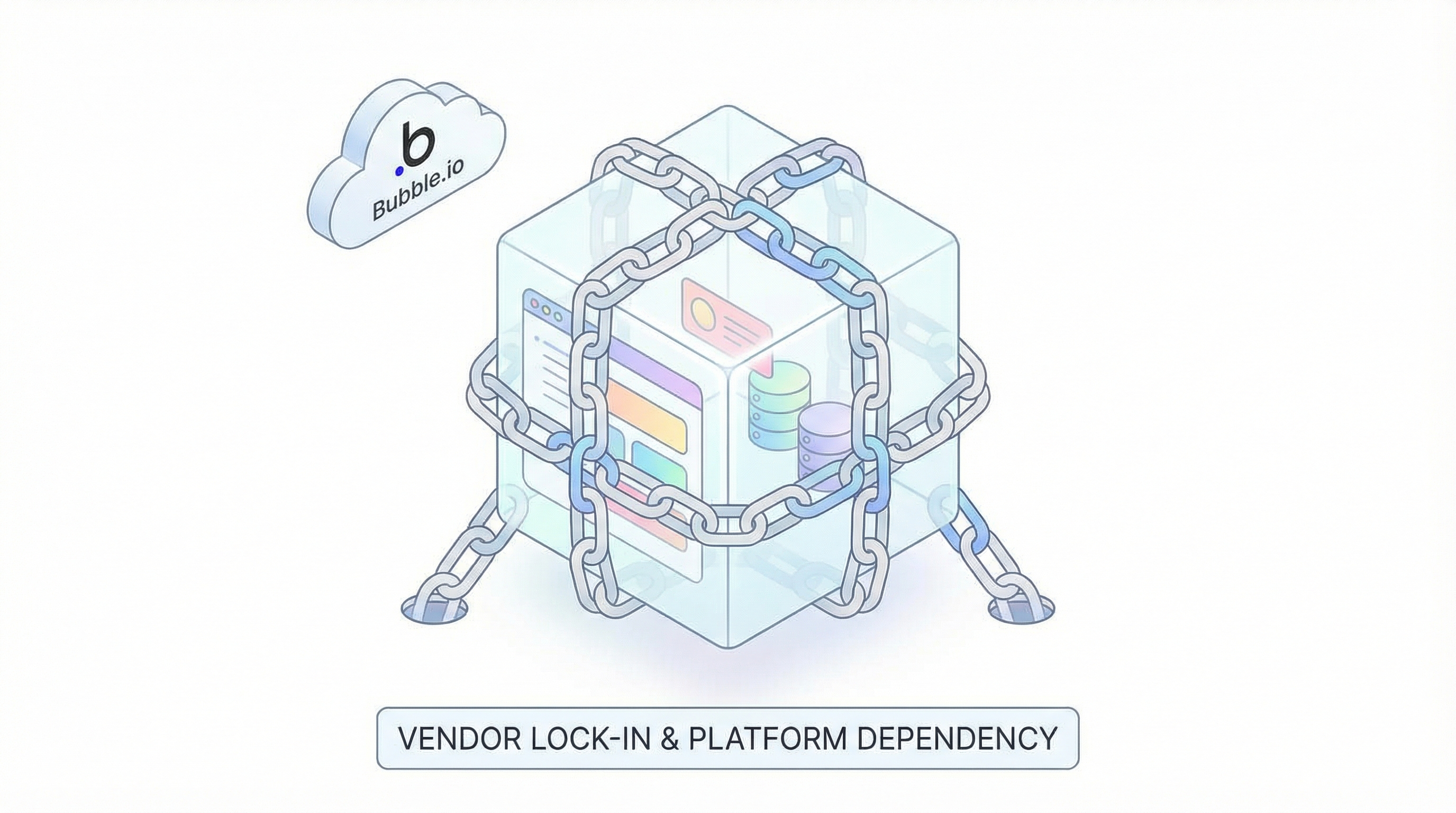
Let's start with what you already know but probably haven't fully processed:
You don't own your Bubble application.
This isn't a legal technicality or an edge case interpretation. It's the fundamental architecture of how Bubble works. Your "app" isn't a software asset—it's a configuration of Bubble's proprietary system. The code that makes it run belongs to Bubble. The infrastructure that hosts it belongs to Bubble. The only thing you truly own is your Bubble account and the data inside it.
"If you don't own your code, you don't own your app" — vascolucci, Bubble Forum
Emmanuel, Bubble's co-founder, has been explicit about this:
"Bubble apps can only be run on the Bubble platform; there's no way of exporting your application as code" — Emmanuel, Bubble co-founder
And when community members have pushed for an export feature, the response has been equally clear:
"Bubble has no plans to build an export tool in the next 1-2 years" — mikeloc, citing Bubble co-founder Josh
This isn't Bubble being malicious. It's their business model. They make money from ongoing subscriptions, not one-time exports. But understanding their incentives helps you understand your situation: they have no reason to make it easy for you to leave.
Which means if something happens to the platform—or to your relationship with it—you're in a precarious position.
The Scenarios That Keep Founders Awake
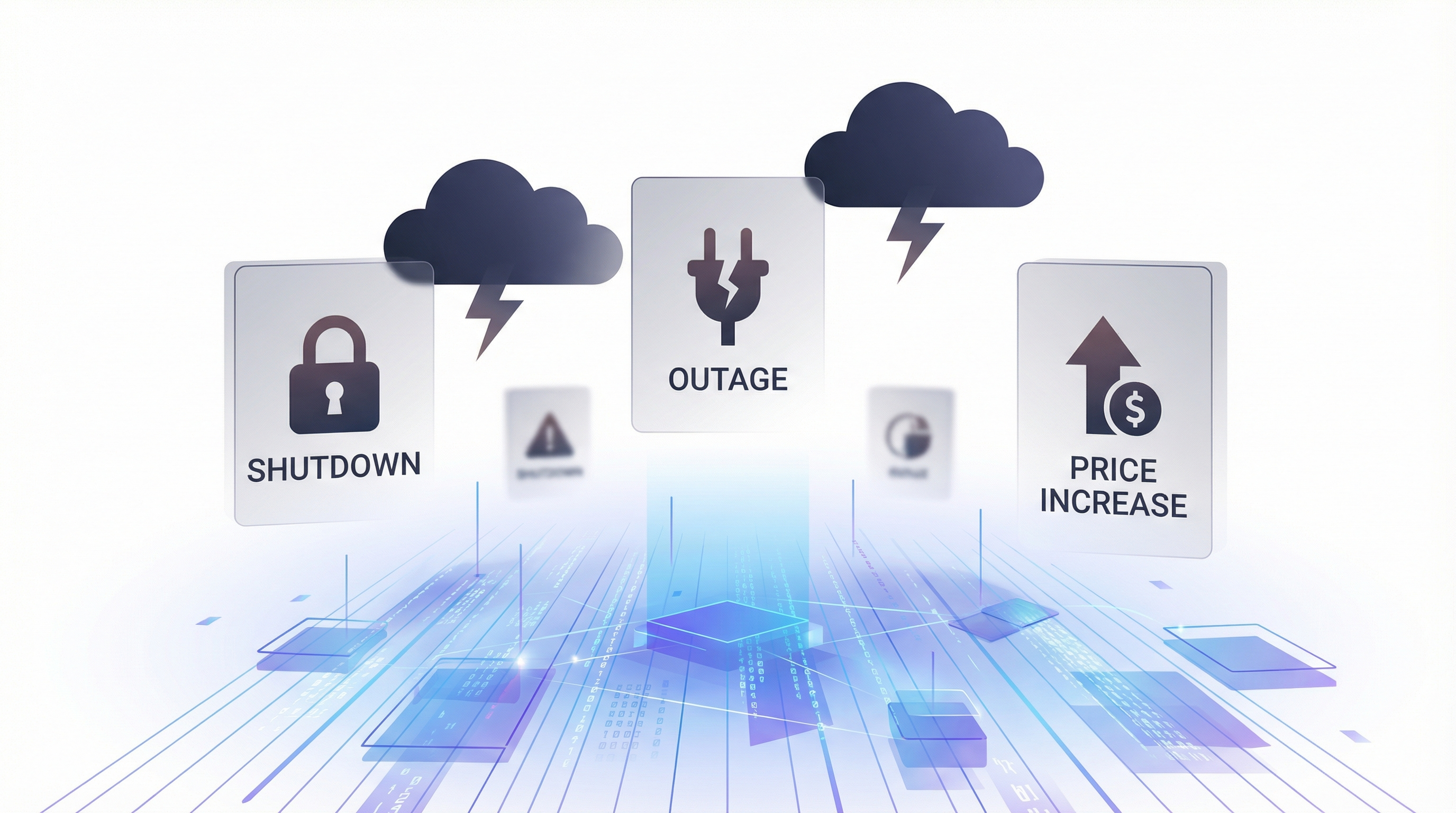
Let's map out the specific scenarios that should inform your contingency planning:
Scenario 1: Bubble Shuts Down Entirely
Could a well-funded startup with thousands of paying customers actually shut down? History says yes.
The startup graveyard is filled with platforms that seemed untouchable:
- Parse (2013-2017): Facebook's mobile backend-as-a-service. Millions of developers. Shut down with one year's notice. Apps had to migrate or die.
- Google Stadia (2019-2023): A first-party Google product. Dead. Games and progress gone.
- Heroku Free Tier (2010-2022): A cornerstone of startup infrastructure. Eliminated. Millions of apps forced to pay up or migrate.
"But Bubble is growing!" True. But growth doesn't guarantee survival. Bubble has raised $106 million in venture funding. That's not just money—it's obligation. Those investors expect returns. If the economics don't work out, if growth stalls, if the market shifts, the math changes quickly.
A VC-backed company that can't hit its targets has limited options: raise more at painful terms, get acquired (often resulting in product sunset), or wind down. None of these scenarios prioritize your business continuity.
What happens to your app: It ceases to exist. Your users see error pages. Your business stops functioning.
Your options in this scenario: If Bubble announces shutdown, you'll likely get 6-12 months notice (Parse gave 12 months). That's time to rebuild—but rebuilding under pressure, with a deadline, is expensive and stressful.
Scenario 2: Account Termination or Suspension
You don't need Bubble to shut down for your app to disappear. Your account just needs to be terminated.
This can happen for reasons within your control (violating terms of service) or entirely outside it (false positive in automated systems, disputed payment, compromised account).
"what happens if someone hacks your account and deletes your app? Is there any way to recover from this?" — mc3digital, Bubble Forum
The honest answer: maybe. Bubble's support team can sometimes restore deleted applications. But "sometimes" isn't a disaster recovery plan. You're relying on the responsiveness and capability of a support team at a company that doesn't have dedicated enterprise SLAs for most customers.
What happens to your app: Instant downtime. No access. No data. Complete dependency on Bubble support to restore service—with no guaranteed timeline.
Your options in this scenario: If you have external backups of your data, you can potentially rebuild. If you don't, you're completely at Bubble's mercy.
Scenario 3: Pricing Becomes Unsustainable
This isn't hypothetical. This has already happened. Multiple times.
When Bubble introduced workload-based pricing in 2023, the community erupted:
"I was paying $28/month when I started. Now I'm sitting at $225." — eric10, Bubble Forum (with only 10-15 daily users)
"7 million workload units used in less than 12 hours! A big fat auto charge bill on the credit card of $1000." — mitchbaylis, Bubble Forum
"within 2.5 hours it reached 100% of the 175,000 WU monthly limit, which caused Bubble to automatically take it offline" — 23acher
Some founders saw 8-10x price increases overnight. Others had their apps automatically disabled during launch because they hit workload limits. The trust damage was severe:
"I will never again recommend Bubble to anyone. I used to tell everyone about it, now I tell them to avoid it." — eric10, Bubble Forum
"The amount of lost trust isn't something that just comes back" — viable, Bubble Forum
What happens to your app: Your costs spiral. You either pay the escalating fees, scramble to optimize (which may not be possible), or face shutdown. You're locked in with nowhere to go.
Your options in this scenario: You're trapped. You can't quickly migrate because there's no export. You can't easily stop paying because your business depends on the platform. This is the definition of lock-in.
Scenario 4: Critical Outages and Data Loss
Platform outages aren't "if" scenarios—they're "when" scenarios. Bubble has had significant outages, and when they happen, every app on the platform goes down simultaneously.
"I lost clients over the outage yesterday and several developers effort having to rewrite everything we lost" — magentalogic, Bubble Forum
When your infrastructure is shared with thousands of other applications, you're vulnerable to:
- Platform-wide outages: A bug in Bubble's core system affects everyone
- Resource contention: Other apps on shared infrastructure can impact your performance
- Single points of failure: Bubble's architecture, whatever it is, becomes your architecture
What happens to your app: Your users can't access your product. You can't fix it. You wait for Bubble to fix it—along with thousands of other customers also demanding attention.
Your options in this scenario: None. You wait. You apologize to your users. You hope it gets fixed quickly.
Scenario 5: Acquisition and Product Sunset
This scenario is particularly insidious because it often starts with good news.
"Bubble has been acquired by [Major Tech Company]!"
The community celebrates. The founders get their exit. Investors are happy. And then, 18 months later:
"We're sunsetting Bubble to focus on integrating its technology into [Parent Company's] broader platform. Existing customers will have 12 months to migrate."
This is exactly what happened with Parse and Facebook. The acquisition seemed like validation. It was actually the beginning of the end.
What happens to your app: You get a deadline. Your comfortable, ongoing dependency becomes an urgent, expensive migration project. And you're competing for developer resources with every other Bubble customer facing the same deadline.
The True Cost of No Contingency Plan
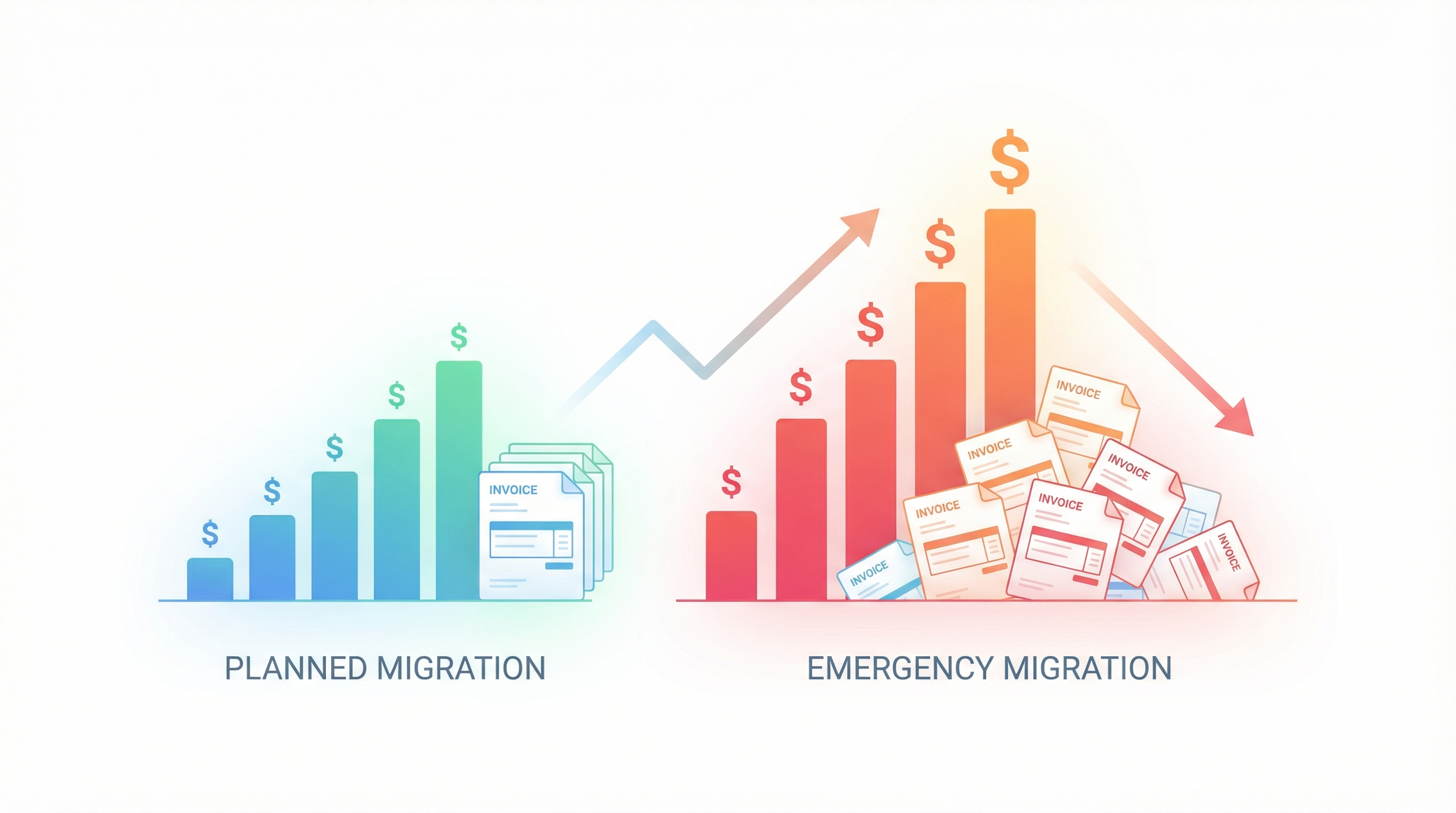
Let's quantify what you're risking by not having a plan:
The Direct Costs
| Expense | Emergency Migration | Planned Migration |
|---|---|---|
| Development cost | 2-3x normal (rushed work, premium rates) | Normal market rates |
| Timeline | 4-6 months (compressed, stressful) | 2-3 months (organized) |
| Quality | Lower (shortcuts taken under pressure) | Higher (time to do it right) |
| Business disruption | Significant (split focus, stressed team) | Minimal (planned transition) |
| User impact | Likely downtime, potential data issues | Seamless or near-seamless |
Emergency migrations cost 2-3x more than planned migrations—and produce worse results.
The Hidden Costs
Beyond direct expenses, consider:
- Opportunity cost: Every hour spent on emergency migration is an hour not spent on growth
- Reputation damage: Users who experience outages or data issues may never return
- Investor confidence: A company caught flat-footed on infrastructure risk looks poorly managed
- Employee stress: Emergency situations lead to burnout and turnover
- Competitive vulnerability: While you're scrambling, competitors are building
The Math That Should Scare You
Let's say your business generates $20,000/month in revenue and has been operating for 18 months. Your Bubble app represents:
- $360,000 in historical revenue that built the business
- $20,000/month ongoing revenue at risk
- Customer relationships built over 18 months
- Market positioning and competitive advantage
- Team expertise in your current product
All of it—100%—depends on a platform you don't control and can't export.
Would you run any other part of your business with a single point of failure this significant?
Building Your Contingency Plan
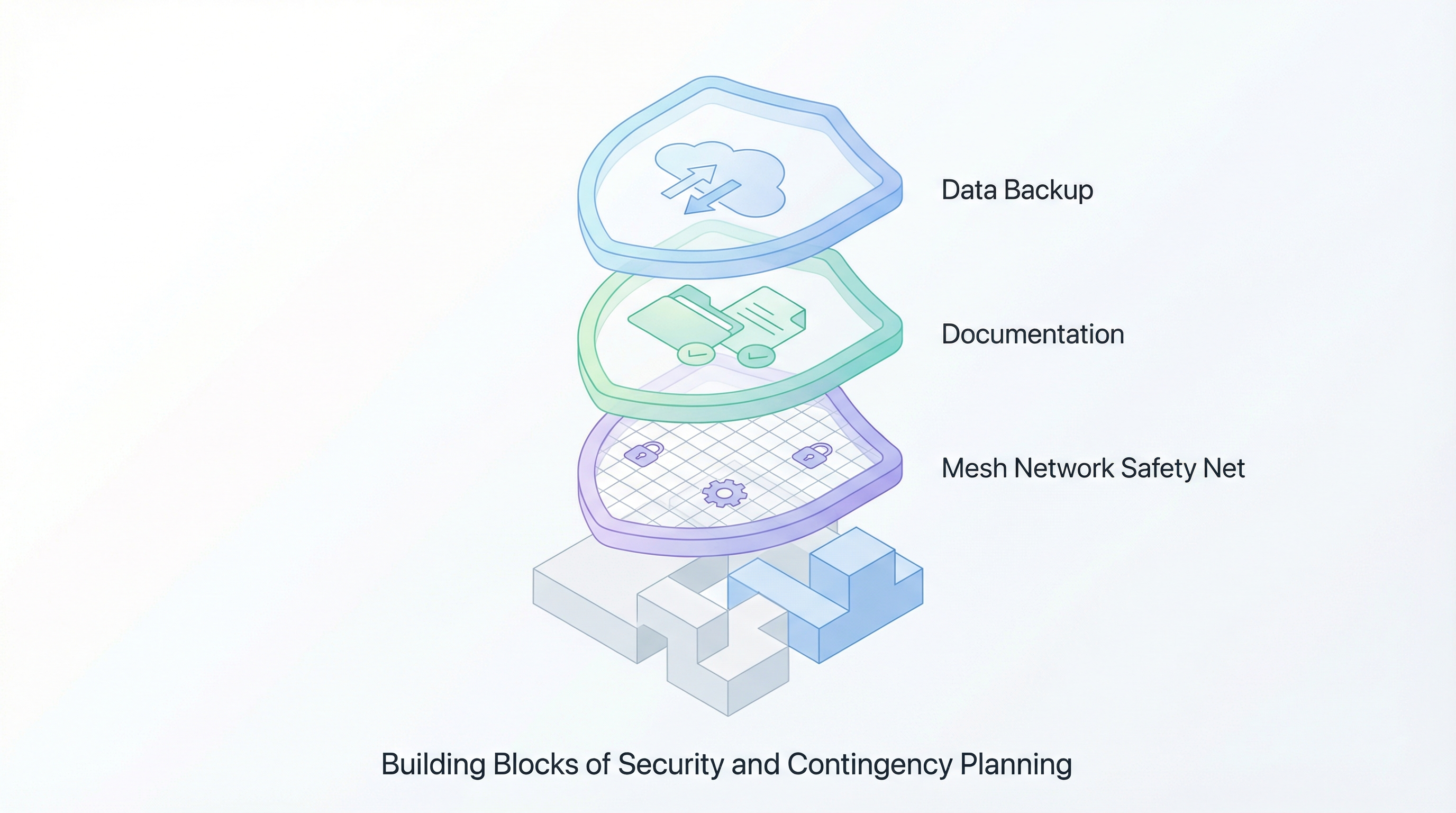
Enough fear. Let's build solutions.
A real contingency plan has three layers:
- Protect what you can today (minimal effort, ongoing process)
- Prepare for migration (moderate effort, one-time setup)
- Create an exit path (significant effort, peace of mind)
Layer 1: Protect What You Can Today
You can't export your application logic, but you can protect your data and documentation.
Regular Data Exports
Bubble allows CSV exports of your database. This should be automated and frequent:
- Export frequency: Weekly minimum, daily for high-transaction apps
- Storage location: External cloud storage (S3, Google Cloud) that you control
- Verification: Periodically test that exports are complete and importable
- Retention: Keep 90 days of exports to recover from gradual data issues
Document Everything
Your Bubble app's logic lives in visual workflows that can't be exported. But you can document them:
- User flows: Document every major user journey step-by-step
- Business logic: Write out the rules that govern your application
- Database schema: Map your data types and their relationships
- API integrations: Document every external service and how it's used
- Edge cases: Record the weird situations your workflows handle
This documentation serves two purposes: it helps you rebuild faster if needed, and it forces you to understand your own system deeply.
Maintain API Documentation
If your Bubble app has an API (and if you're at any scale, it should), document it thoroughly:
- Endpoint specifications
- Request/response formats
- Authentication methods
- Rate limits and constraints
External services and mobile apps that depend on your API can theoretically be pointed at a new backend—if your API contract is well-documented.
Layer 2: Prepare for Migration
Preparation means doing work now that makes future migration easier—even if you never migrate.
Choose Your Target Stack
Don't wait for an emergency to decide where you'd migrate. Research now:
| Stack | Best For | Complexity | Cost |
|---|---|---|---|
| Next.js + Supabase | Web apps, startups | Medium | Low |
| React + Node.js + PostgreSQL | Complex apps, custom needs | Medium-High | Medium |
| Laravel + MySQL | Traditional web apps | Medium | Low |
| Rails + PostgreSQL | Rapid development | Medium | Low |
Having a target stack means you can evaluate developers, estimate costs, and move faster when needed.
Build External Infrastructure
Move what you can outside Bubble today:
- Authentication: Consider adding a dedicated auth provider (Auth0, Clerk, Firebase Auth) that can persist across platforms
- File storage: Use S3 or Cloudflare R2 instead of Bubble's built-in file storage
- Email/SMS: Use dedicated providers (SendGrid, Twilio) rather than Bubble plugins
- Payments: Direct Stripe integration rather than Bubble-wrapped
Each piece of infrastructure you control externally is one less thing to migrate later.
Get Migration Quotes
You don't have to commit to migration to understand what it would cost. Get quotes from:
- Development agencies experienced in Bubble migration
- Specialized services like BubbleExport
- Freelance developers who've done similar work
Having real numbers makes your contingency plan concrete. When someone asks "what's your plan if Bubble shuts down?" you can answer with specifics, not hand-waving.
Layer 3: Create an Exit Path
For some apps—especially those generating significant revenue or raising institutional capital—preparation isn't enough. You need an actual exit path.
Consider Parallel Development
If your business can justify it, begin building the replacement system before you need it:
- Start with non-critical features
- Build your new backend while Bubble handles production traffic
- Migrate users in phases once the new system is proven
This is expensive, but for businesses where platform dependency represents existential risk, it's insurance worth buying.
Evaluate Migration Services
Specialized migration services can convert your Bubble application to custom code:
- What you get: Deployable codebase in modern frameworks (Next.js, React, Node.js)
- What it costs: $1,500-$10,000+ depending on complexity
- Timeline: 1-8 weeks depending on app size
This isn't rebuilding from scratch—it's translating your existing application into code you own. The cost is a fraction of a full rebuild, and you end up with a deployable safety net.
Test Your Escape
Whatever your contingency plan, test it:
- Take your documented business logic
- Import your data exports to a test database
- Have a developer estimate build time from your documentation
- Verify that your migration quote is realistic
A plan that's never tested is a fantasy, not a plan.
The Deeper Question: Why Live With This Risk?
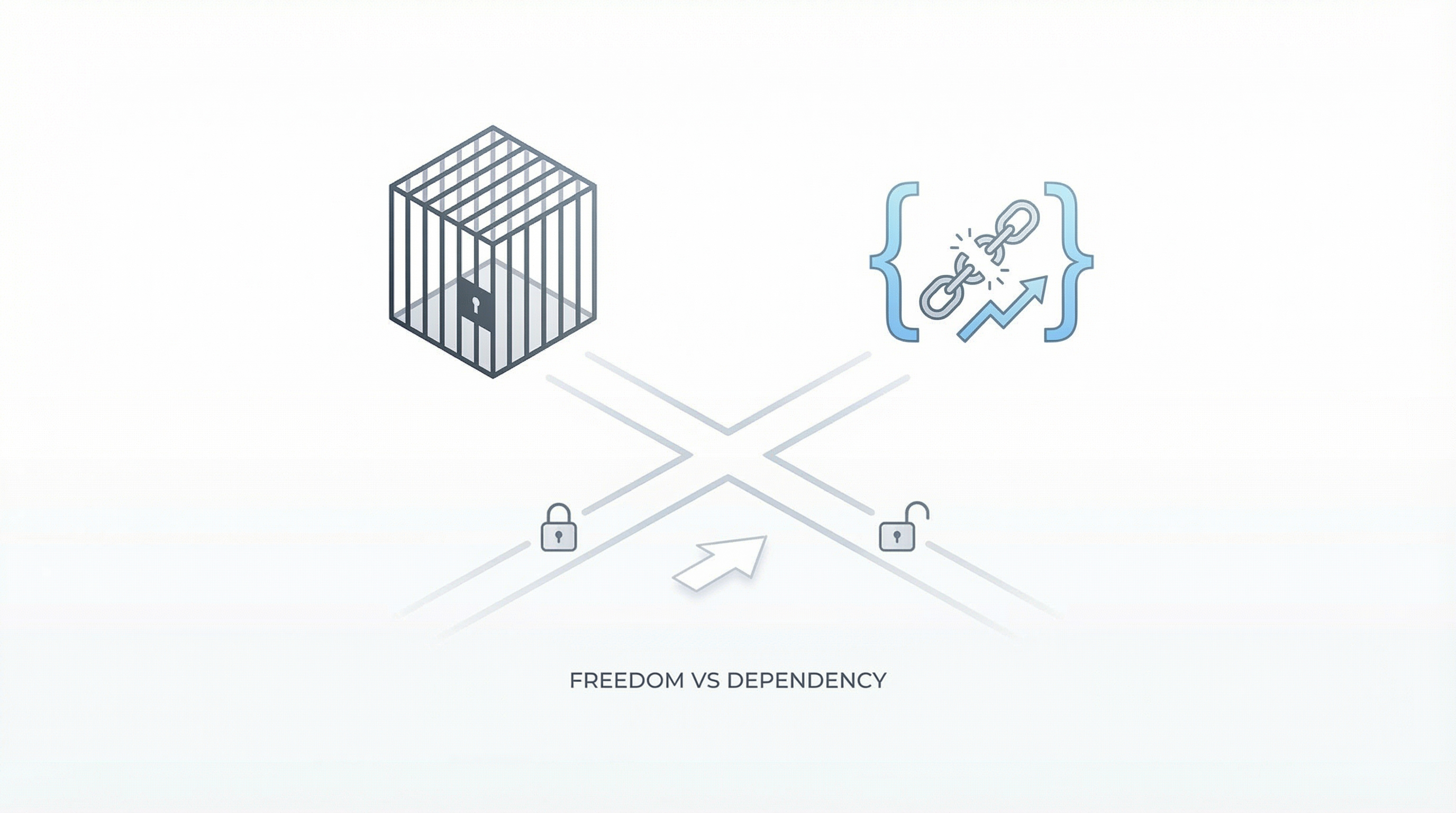
Let's zoom out from tactics to strategy.
If you're running a business with real revenue and real users, ask yourself: why accept this dependency at all?
The arguments for staying on Bubble are real:
- Faster iteration
- Lower development costs
- No engineering team required
- Focus on business, not code
But these arguments have an expiration date. They make sense when you're validating. They make less sense when you're scaling.
"We have moved out completely from bubble using supabase and next js. possibilities are endless" — munaeemmmm, Bubble Forum
"I never thought of going back to bubble" — munaeemmmm (months after migration)
"the best decision I've ever made" — thuto.co (on migrating from Bubble)
The founders who've made the transition describe a shift in their relationship with their product:
- From renting to owning: The code is yours. The infrastructure is yours. The future is yours.
- From constrained to possible: No more "can Bubble do this?" Questions become "should we do this?"
- From anxious to confident: The 3 AM terror goes away because the existential risk is gone.
"If AI can build anything you want in seconds, on a dollar per month hosting plan, why would you pay bubble 10 or 100x?" — sem, Bubble Forum
The calculus is changing. Modern AI coding tools have made the development cost argument less compelling. Hosting costs for custom code are negligible. The "premium" you pay for Bubble at scale funds their profit margin, not your advantage.
Your 90-Day Contingency Implementation Plan
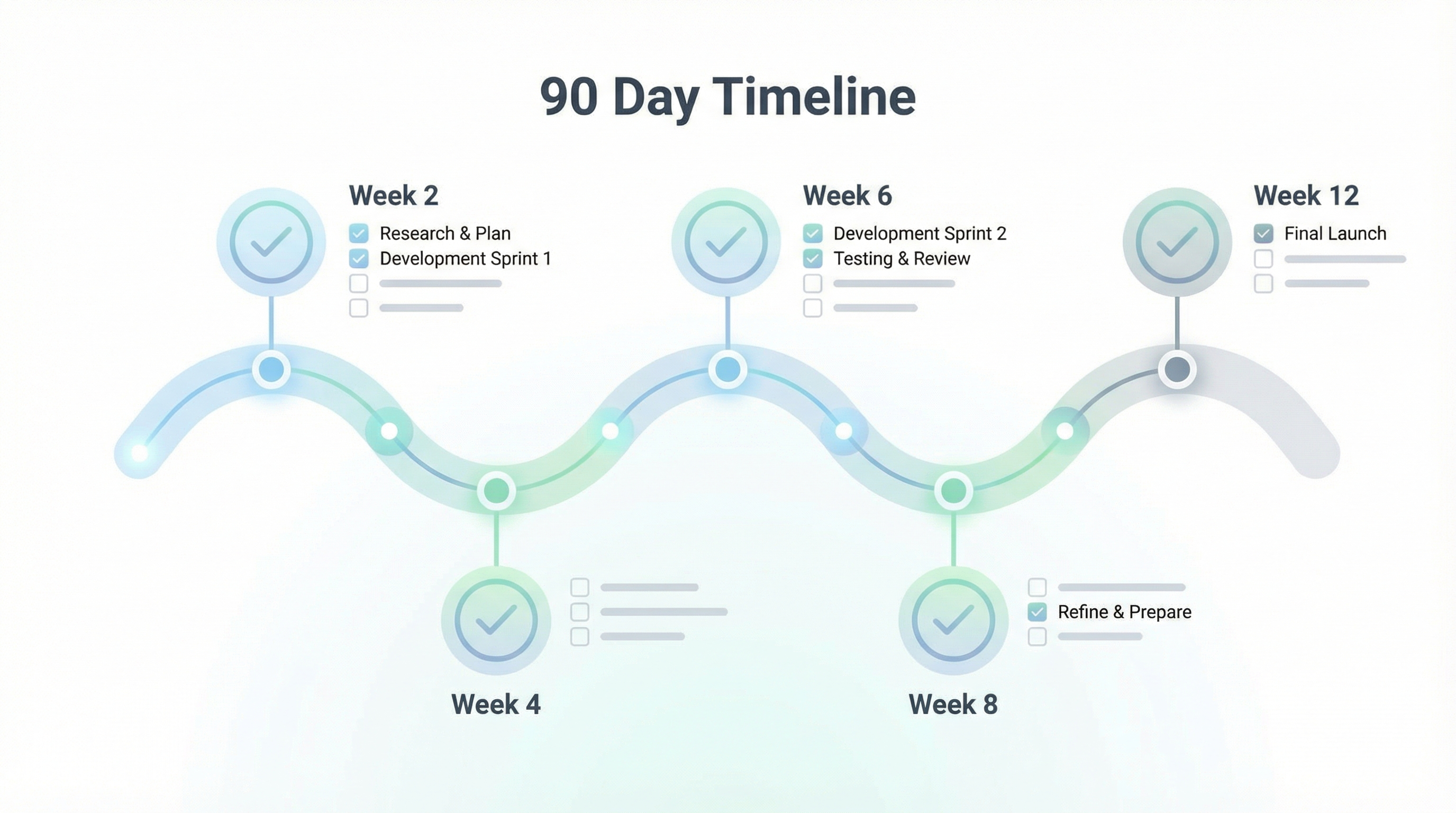
Let's make this actionable. Here's a 90-day roadmap:
Week 1-2: Assess and Document
- Inventory all data types in your Bubble database
- Document critical user flows and business logic
- List all external integrations (APIs, payments, email)
- Export current database and verify completeness
- Set up external storage for ongoing backups
Week 3-4: Automate Backups
- Implement automated weekly data exports
- Store exports in cloud storage you control
- Test restoration process with a sample
- Document backup and restoration procedures
- Set calendar reminders for quarterly backup verification
Week 5-6: Research Migration Options
- Define your target stack based on app requirements
- Contact 2-3 migration services for quotes
- Talk to 1-2 freelancers about rebuild estimates
- Compare costs: migration vs. rebuild vs. continued Bubble costs
- Document findings for future reference
Week 7-8: Begin Infrastructure Independence
- Evaluate moving file storage to S3/Cloudflare
- Consider dedicated email provider (SendGrid, Postmark)
- Review authentication options (Auth0, Clerk)
- Implement at least one external service
- Update documentation with new architecture
Week 9-12: Formalize Your Plan
- Write formal contingency plan document
- Include trigger conditions (when do we activate?)
- Include contact information (who do we call?)
- Include timeline expectations (how long will it take?)
- Include cost estimates (what will it cost?)
- Share with co-founders/leadership
- Schedule quarterly plan review
The Question Only You Can Answer

You now understand the risks. You have a framework for contingency planning. You know what it takes to build an exit path.
The question is: what will you actually do?
For some founders, the answer is: "I'll build a basic contingency plan, keep my backups current, and revisit when we're bigger." That's a reasonable answer for early-stage companies focused on finding product-market fit.
For others, the answer is: "This risk is too big to carry. We need to migrate before something forces our hand." That's a reasonable answer for companies with real traction facing investor conversations or enterprise sales.
And for a few, the answer is: "I understand the risk and accept it. Bubble's advantages outweigh the dependency." That's a reasonable answer if you've genuinely evaluated the trade-offs.
The unreasonable answer—the one that gets founders in trouble—is: "I'll think about it later."
Because later has a way of becoming too late.
"either I move / rebuild or I shutdown on October 1st, 2024" — Drahgoone, Bubble Forum
Don't be the founder who realizes the urgency when options have already narrowed.
What's Your Next Move?
If this guide has surfaced anxiety you've been avoiding, good. That anxiety is data. It's telling you something about risk that your optimistic planning brain would rather ignore.
The founders who navigate platform dependency successfully aren't the ones who pretend the risk doesn't exist. They're the ones who acknowledge it, plan for it, and make deliberate choices about how to manage it.
Your move now:
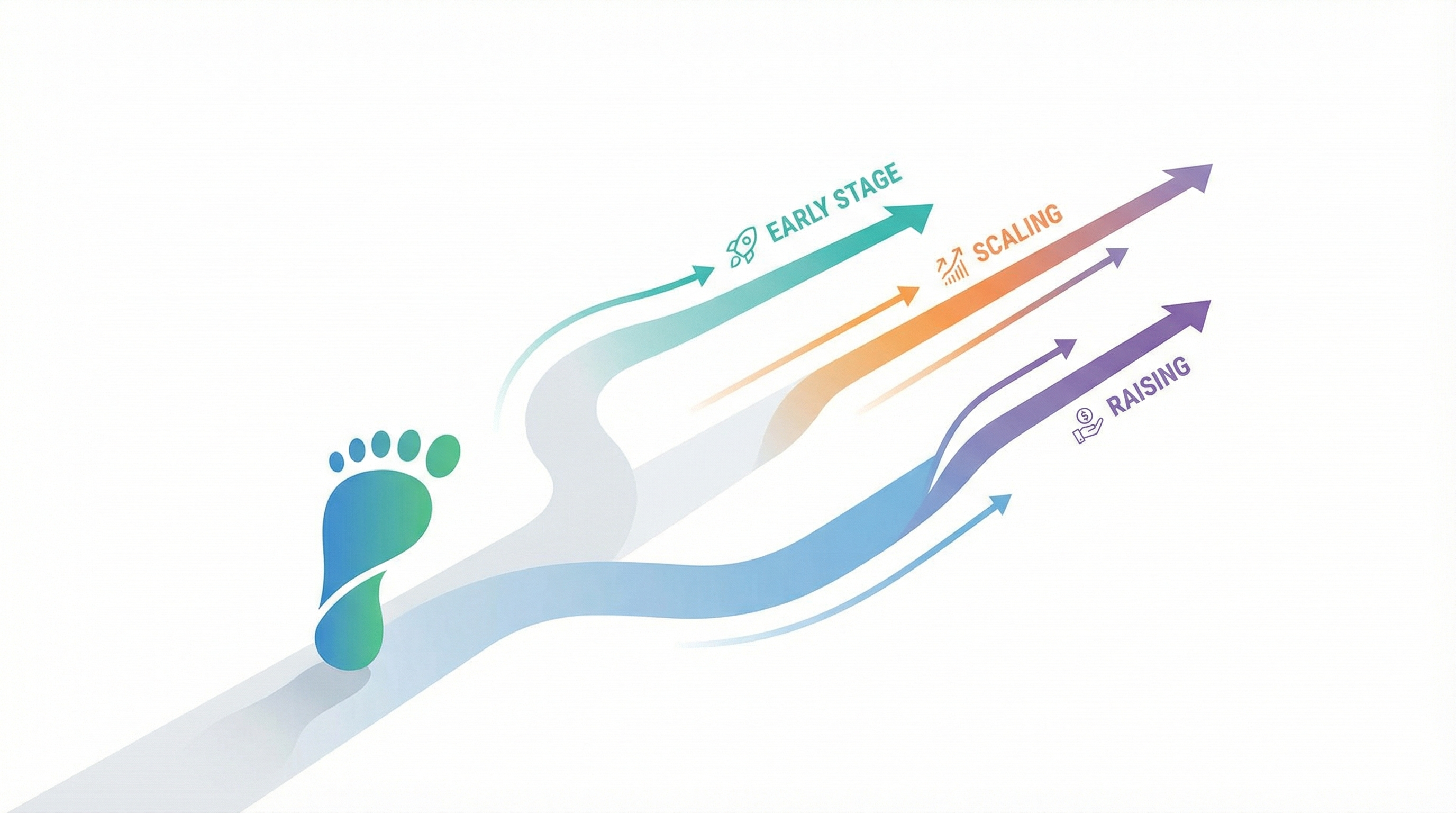
If you're early-stage: Implement Layer 1 (backups and documentation) this week. It costs nothing but time.
If you're scaling: Start Layer 2 (migration preparation) this month. Know your options before you need them.
If you're raising or selling: Consider Layer 3 (creating an exit path) seriously. Investors and acquirers will ask about platform dependency—have a real answer.
And if the 3 AM anxiety is bad enough, if the scenarios we've described feel too close for comfort, maybe it's time to stop planning for contingencies and start planning for migration.
Because the best time to leave a platform you don't control is before it forces you out.
Frequently Asked Questions
Can Bubble really shut down? They seem successful.
Any company can shut down. Bubble has raised $106 million in venture capital, which means they have investors expecting returns. If growth slows or economics don't work, their options become limited: raise more (diluting and changing terms), get acquired (often leading to product changes), or wind down. Parse was backed by Facebook and still got shut down. Success today doesn't guarantee existence tomorrow.
What's the minimum contingency plan every Bubble founder should have?
At minimum: weekly automated data exports stored in cloud storage you control (S3, Google Cloud), documented database schema and user flows, and external backups of any files/images. This takes 2-4 hours to set up and runs automatically. It won't save your app, but it will save your data and dramatically reduce rebuild time.
How much does it cost to migrate a Bubble app to custom code?
It depends on complexity. Simple apps (5-10 pages, basic workflows) can be migrated for $1,500-$3,000. Medium complexity apps (10-20 pages, custom logic, multiple integrations) typically run $3,000-$7,000. Complex apps (20+ pages, sophisticated workflows, large databases) can cost $7,000-$15,000+. This is still 70-90% cheaper than rebuilding from scratch with a development agency.
Should I migrate now or wait?
If you're pre-product-market-fit, wait. Bubble's speed advantage matters when you're iterating rapidly. If you're generating real revenue (>$5K MRR), start preparing. Know your options and costs. If you're raising institutional capital or pursuing enterprise clients, seriously consider migrating before those conversations—code ownership questions will come up, and "we're planning to migrate eventually" is a weak answer.
What happens to my users if I migrate?
Well-executed migrations are invisible to users. Their accounts, data, and experience continue unchanged—just running on infrastructure you control. The main considerations are: password handling (often requires password resets or a migration flow) and ensuring feature parity before switching. Most users never notice a backend migration.
Your Bubble app represents real value—but only if you can control what happens to it. Don't let platform dependency turn your business into a hostage situation.
Ready to talk migration?
Get a free assessment of your Bubble app. We'll tell you exactly what to expect — timeline, cost, and any potential challenges.