
When to Migrate Off Bubble (And When to Stay)

You've invested too much time and money to just throw it all away. But you can't afford to stay on Bubble either.
That's the internal monologue, right?
"I've invested 2+ years building in Bubble — am I throwing that all away?"
"either I move / rebuild or I shutdown on October 1st, 2024" — Drahgoone, Bubble Forum
The fantasy: Press a button and get your Bubble app as clean, deployable code—keeping your logic, your design, your data—without spending $50K or months rebuilding from scratch.
The fear: Migration means starting over completely, losing momentum, losing users, and spending months rebuilding something you already built.
Here's the thing: both are partially true. And which one dominates depends entirely on your specific situation.
I've read hundreds of forum posts, Reddit threads, and case studies from people who migrated and people who stayed. Here's the framework that separates "should migrate" from "should stay."
Clear Signs You Should Stay
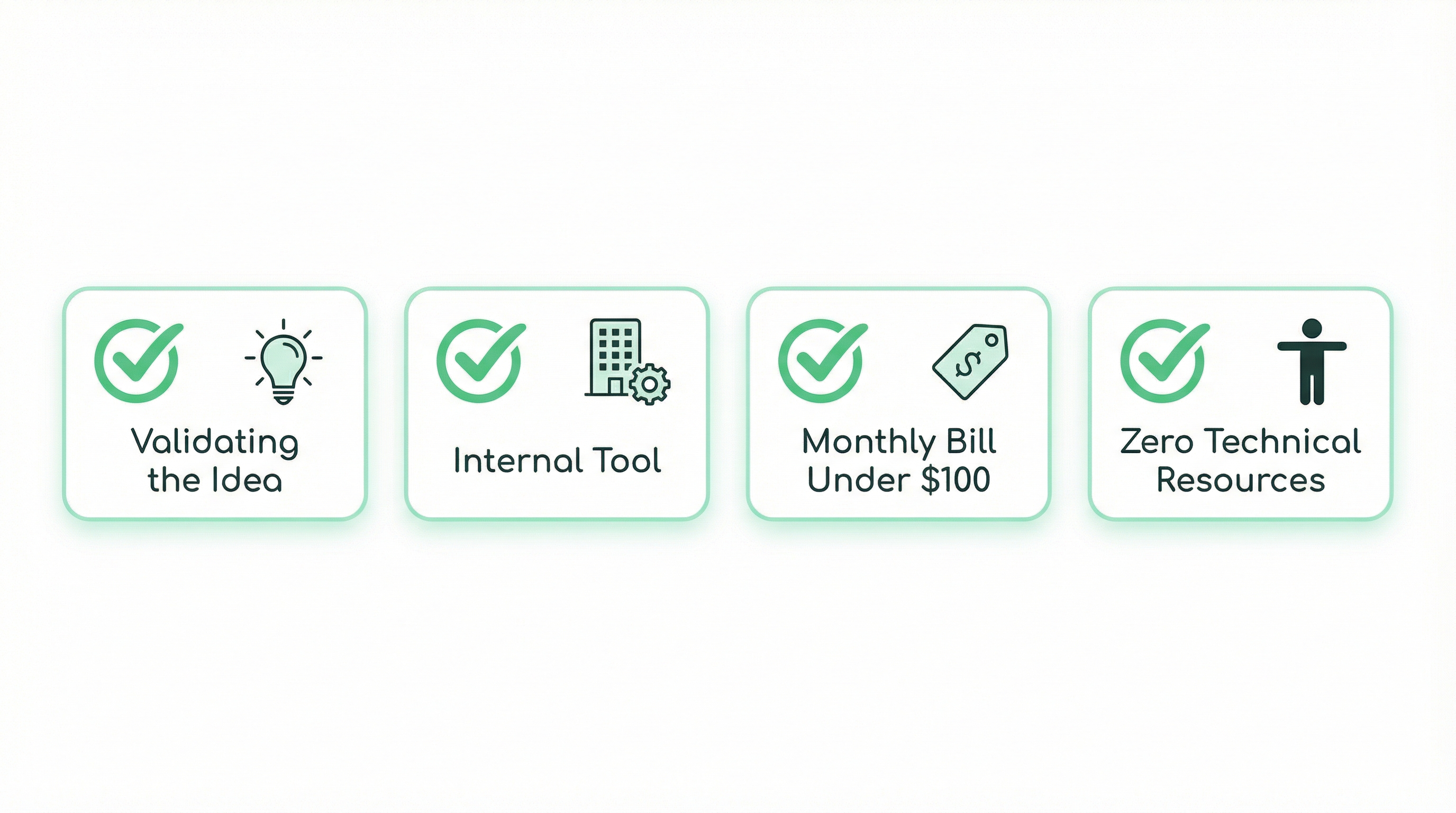
1. You're Still Validating the Idea
If you're not sure anyone will pay for this thing yet, don't migrate. That's ridiculous.
Bubble's value is speed to market. Build an MVP in weeks instead of months. Test hypotheses. Find product-market fit.
A founder spent 3 months perfecting custom-coded architecture before launching. By the time he shipped, the market had moved on. His competitor—who launched a janky Bubble prototype in 3 weeks—had already captured the early adopters.
Fast and ugly beats slow and perfect when you're searching for fit.
2. It's an Internal Tool
Nobody cares if your internal sales dashboard takes 8 seconds to load. Your employees will wait. They're being paid to wait.
The performance problems that kill consumer apps barely matter for internal tools. The vendor lock-in that terrifies investors doesn't concern HR software that 12 people use.
Building for your own company with no external revenue? Stay on Bubble.
3. Your Monthly Bill Is Under $100 and Stable
Some apps don't grow. That's fine. Not everything needs to be a unicorn.
If you've run on Bubble for a year with stable costs under $100, you might have found equilibrium. Check your workload unit trends. If you're consistently at 30-50% of allocation without spikes, you're probably okay.
4. You Have Zero Technical Resources
"As a non-technical founder I've been able to take bubble to about 85-90%. The UX/UI seems to stymie them all." — ericm, Bubble Forum
Migrating means you'll eventually need someone who can read JavaScript. Not write it from scratch, but understand what they're looking at.
If you're solo non-technical, no plans for a technical co-founder, no dev budget, no interest in learning—migration might create more problems than it solves.
That said: AI coding assistants are changing this fast. More on that below.
Clear Signs You Should Migrate
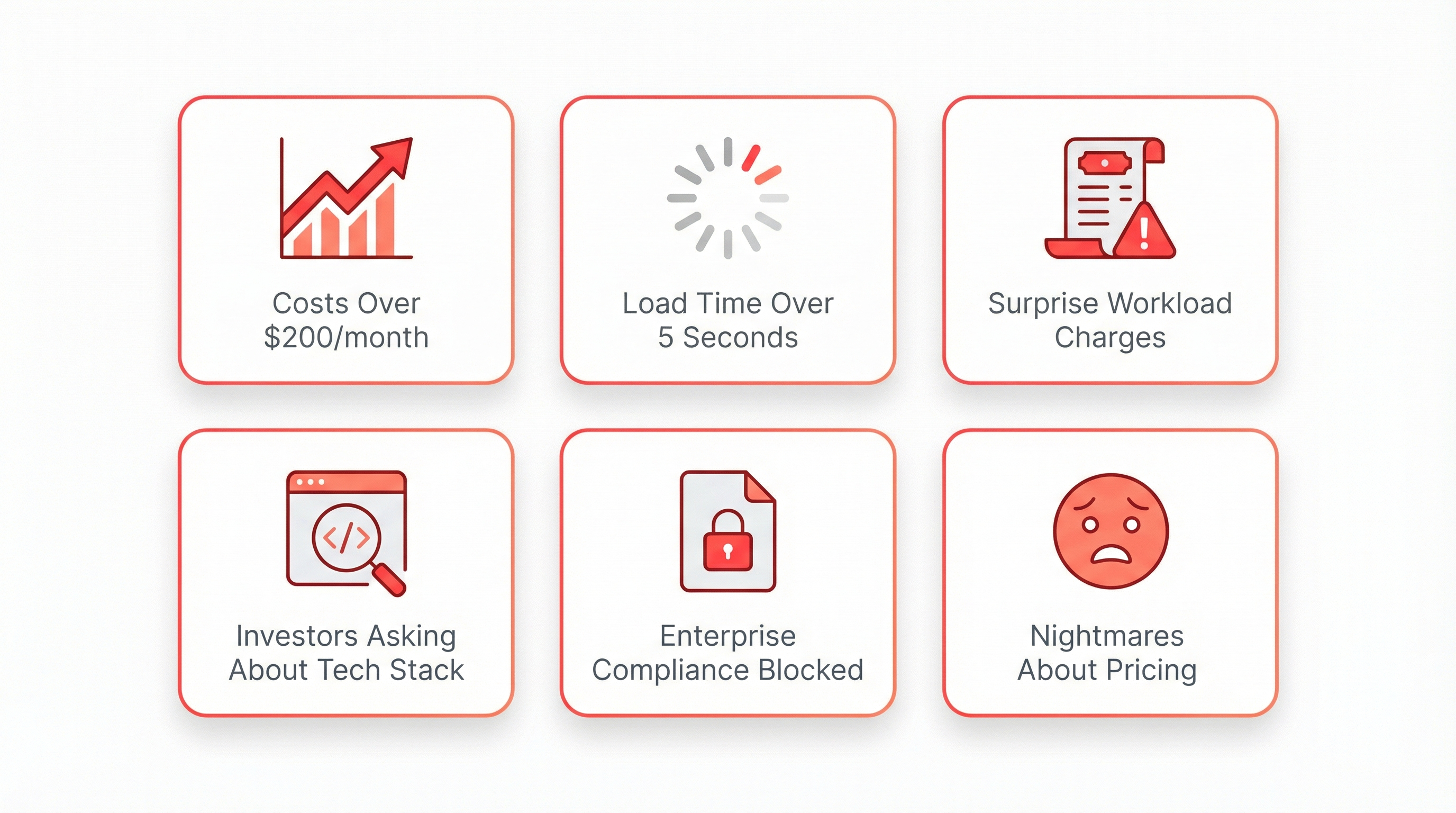
1. Your Monthly Costs Crossed $200
When your Bubble bill hits $200/month, something changed. Either your app is growing (good!) or pricing tightened around you (increasingly common).
$200/month = $2,400/year. Migration costs $1,500-$5,000 one-time with near-zero hosting after.
"I was paying $28/month when I started. Now I'm sitting at $225." — eric10, Bubble Forum
Eric went from $336/year to $2,700/year. That's the kind of increase that makes migration an obvious financial win.
2. Your App Takes More Than 5 Seconds to Load
From the Bubble forum:
"On my iPhone 14 pro, my app takes on average 8 seconds to load" — thibautranger
"on my Xiaomi Redmi A2, my app always take over a minute to load" — thibautranger
"takes a solid 30-40 sec on the splash screen before going to index view" — miracle
"It's dealbreakingly slow." — brenton.strine
For context:
"Airbnb loads in 2.5 seconds, booking.com loads in 1.5 seconds"
Users expect modern apps under 3 seconds. If yours takes 8-30, you're losing customers you'll never know about. They close the tab before seeing your product.
3. You've Had a Surprise Workload Charge
"7 million workload units used in less than 12 hours! A big fat auto charge bill on the credit card of $1000." — mitchbaylis
If you've woken up to an unexpected charge, you've learned something important: Bubble's pricing can bite you anytime.
Even if you recovered the money—you now know the risk is real. Can you live with that indefinitely?
"I've literally been having nightmares about this happening ever since the bubble pricing change." — mitchbaylis
4. Investors Are Asking About Your Tech Stack
"to attract investors you need code-export it is very important" — aj11, Bubble Forum
Technical due diligence is real. Sophisticated investors ask about architecture, scalability, vendor dependencies.
"We're built on Bubble and don't own our code" is a tough answer.
"I've lost over 90% of potential clients because I couldn't offer code ownership." — Orbit, Bubble Forum
This 5-year Bubble user eventually left entirely. Code ownership was the difference between winning and losing deals.
5. Enterprise Customers Need Compliance
"my client lost a multi-million contract because they ran into compliance issue and they needed the code and DB to be run locally" — vascolucci, Bubble Forum
If you're selling to enterprises, you'll hit compliance walls that Bubble's shared cloud can't satisfy. HIPAA with on-premises requirements. GDPR with strict data residency. FedRAMP.
Bubble can't give you self-hosted data. Can't give you infrastructure in specific regions. Offers limited audit trail capabilities for compliance use cases.
A single enterprise deal can dwarf your entire migration budget.
6. You're Having Nightmares About Pricing
Not in the spreadsheets, but real:
"I've literally been having nightmares about this"
"The amount of lost trust isn't something that just comes back" — viable
"it feels like i just got cheated on by my girl and she ran out with another man and my only car" — ryan8
If you're stressed about your Bubble bill, constantly checking workload usage, stomach dropping at "workload overage"—that's data.
That anxiety costs focus, sleep, mental health. Those things matter.
What's Actually Scary About Migration
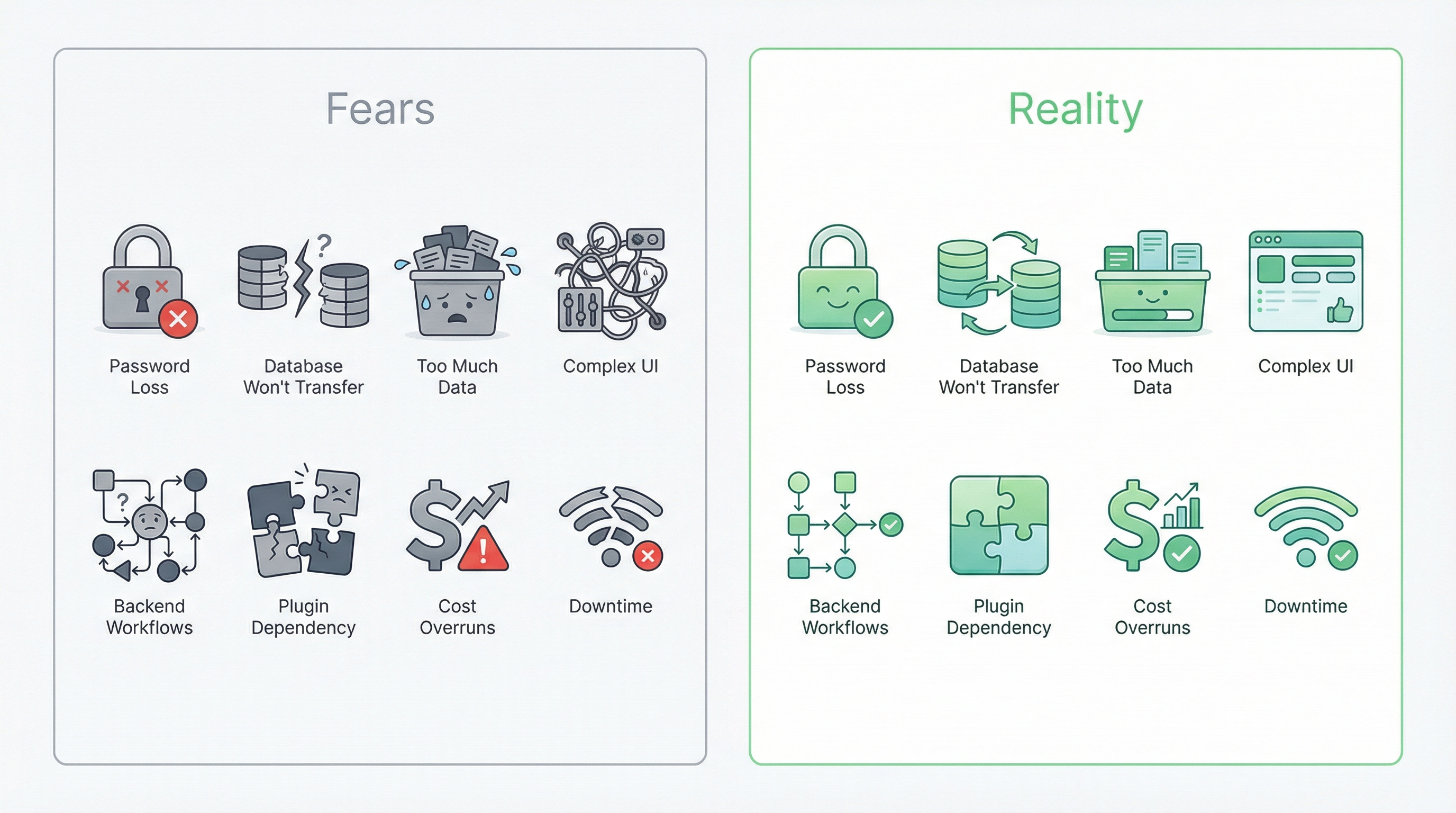
Let's address the fears directly. These are the things that keep people stuck:
Fear: "I'll lose all my user passwords"
"You can't export passwords" — will_ericksson
Reality: This is technically true. Bubble hashes passwords—you can't export them directly.
The solution: Password reset flow for all users on migration. Yes, everyone resets once. It's a minor inconvenience, not a dealbreaker. Every major platform does this occasionally (security breaches, acquisitions). Users understand.
Fear: "My database won't transfer cleanly"
"tables in Bubble works as Objects, because we relate each table with a reference to the other, not with single Ids like relational databases" — cdmunoz
Reality: Bubble's data model is different from PostgreSQL. But it's not incompatible—it needs translation.
The solution: Data migration tools handle the mapping. References become foreign keys. It's a solved problem.
Fear: "I have too much data to migrate"
"Migrating data out of Bubble is such a pain from someone who had to migrate over 3 million records" — stuart8
Reality: High volume makes migration more complex, not impossible. Stuart did migrate those 3 million records.
The solution: Bulk export, batch processing, and validation scripts. Takes planning, but works.
Fear: "My UI is too complex to replicate"
"my bubble app has some pretty sophisticated UI operations that non-bubble devs seem to scratch their heads when trying to replicate" — ericm
Reality: Complex UI can be rebuilt. What feels magical in Bubble is usually standard patterns in React/Next.js.
The solution: Screen recording and specification docs. Modern CSS and React can replicate virtually any Bubble interface.
Fear: "My backend workflows are complicated"
"Backend workflows is a bit more hairy" — rico.trevisan
Reality: Backend workflows need the most careful translation. Logic that runs automatically in Bubble needs equivalent cron jobs, webhooks, or serverless functions.
The solution: Workflow audit before migration. Map each trigger to its equivalent. This is where expertise matters.
Fear: "I rely heavily on plugins"
Reality: Some plugins have direct equivalents. Others need custom implementation.
Before migrating: Audit your plugins. Which handle critical features? What's the React/Next.js equivalent? Some take a day to replace; some take a week.
Fear: "What if it costs more than quoted?"
Reality: Legitimate fear with freelancers. Less so with fixed-price services.
The solution: Fixed-scope, fixed-price agreements. Clear deliverables. Milestone payments if you prefer.
Fear: "I have paying customers—I can't afford downtime"
Reality: You don't have to migrate all at once.
The solution: Run both systems in parallel. Migrate gradually. Cut over when ready. Zero-downtime migration is standard practice.
The AI Factor
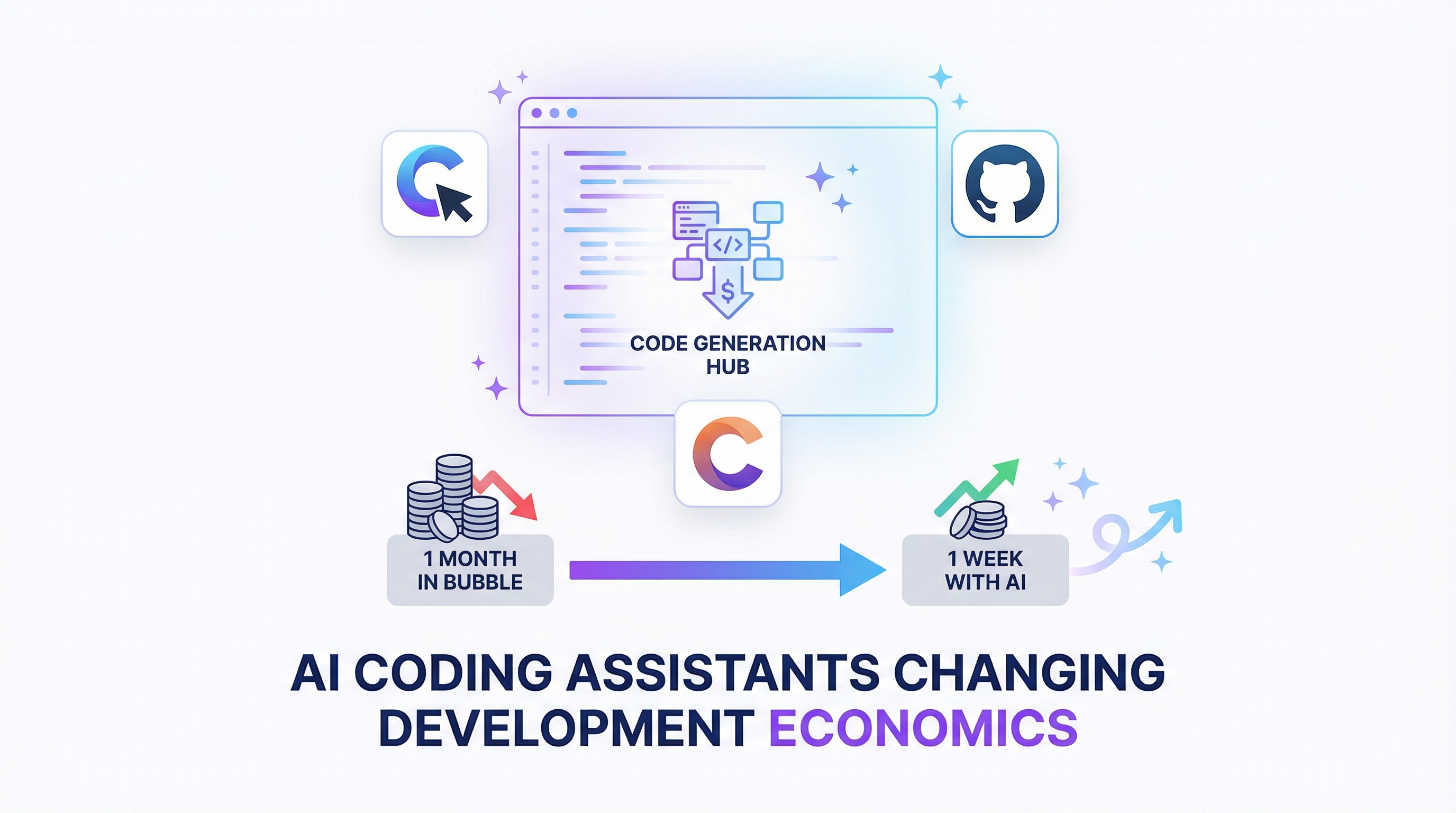
Something's changed:
"friends build the same app in one week that took me a month in Bubble" — Orbit, Bubble Forum
"The speed of development in modern AI-powered IDEs has become too significant for us to ignore." — Orbit (5-year user's goodbye post)
"If AI can build anything you want in seconds, on a dollar per month hosting plan, why would you pay bubble 10 or 100x?" — sem
AI coding assistants (Cursor, GitHub Copilot, Claude) have dramatically reduced custom development costs. Things that used to require dev teams can now be built by technical founders with AI assistance.
This means:
- "Custom code is too expensive" is less true than 2 years ago
- Maintaining migrated code is easier
- The Bubble vs. custom code speed gap is narrowing
For some people, this tips the scales.
The Decision Framework
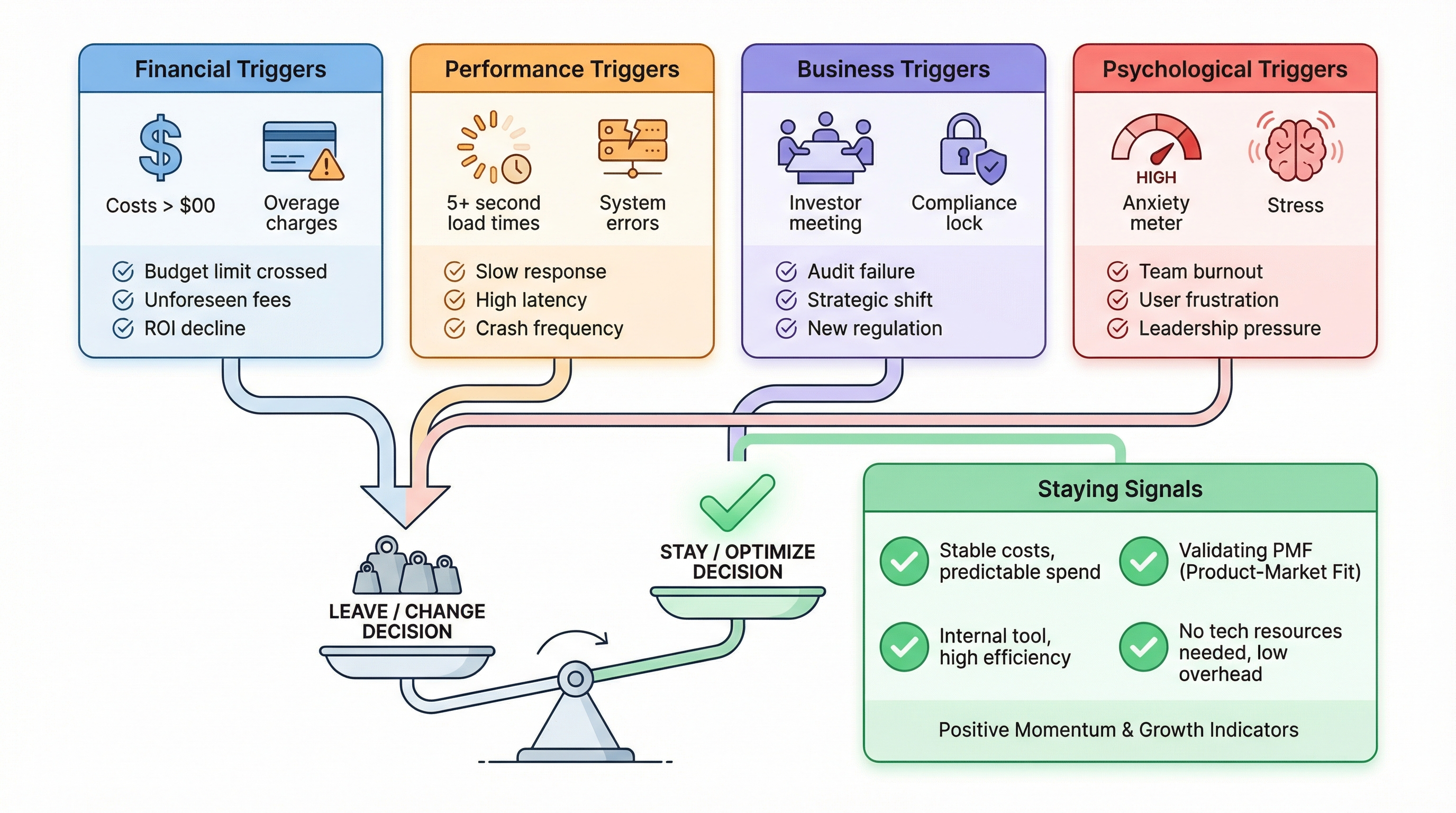
Answer these:
Financial triggers:
- Monthly Bubble cost > $200
- Had a surprise overage charge
- Costs increasing faster than revenue
Performance triggers:
- Load time > 5 seconds
- Users complaining about speed
- Lost customers due to performance
Business triggers:
- Investors asking about tech stack
- Enterprise deals blocked by compliance
- Can't hire devs who want to work on Bubble
Psychological triggers:
- Anxious about workload units
- Constantly checking usage dashboards
- Lost trust in the platform
Staying signals:
- Costs stable under $100/month
- Still validating product-market fit
- Internal tool with no external users
- Zero technical resources or willingness
3+ triggers and fewer than 2 staying signals? Migration is probably right.
Mostly staying signals? Keep building on Bubble. Revisit in 6 months.
What People Say After Migrating
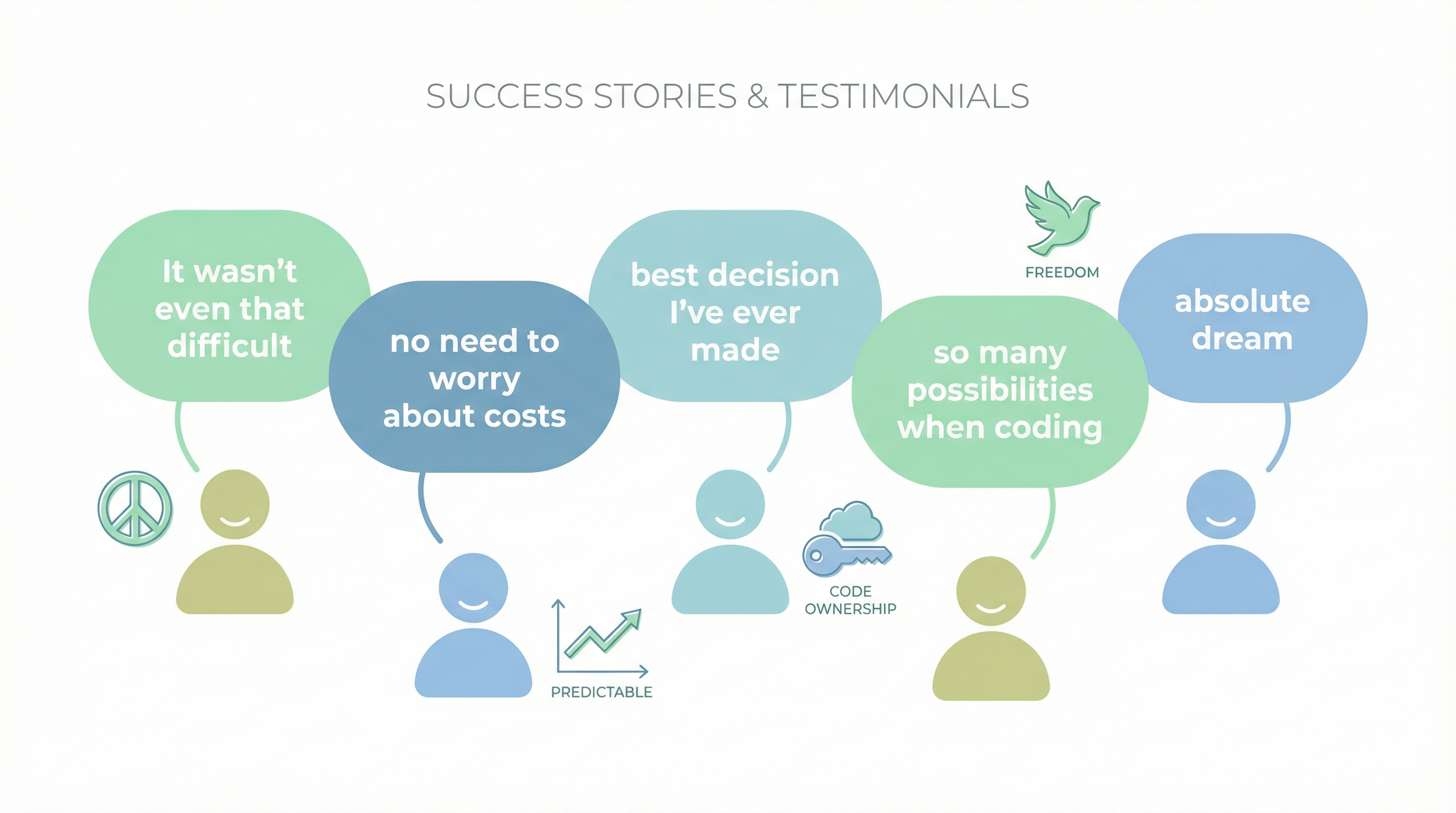
"I migrated to code. It wasn't even that difficult to be honest. One month and I had an app ready for production" — hoke
"you can't never go back" — hoke
"no need to worry about costs... I never thought of going back to bubble" — munaeemmmm
"the best decision I've ever made" — thuto.co
"There are so many possibilities when you're coding" — munaeemmmm
"much customisation, SSR, great loading state management" — thuto.co
"I switched to weweb and xano 6 months ago for all new projects and it has been an absolute dream" — mitchbaylis
The relief is palpable. Peace of mind. Predictable costs. Code ownership. Freedom.
Nobody who migrates seems to regret it. The ones who wait keep posting about 30-second load times and surprise charges.
What Happens After You Decide
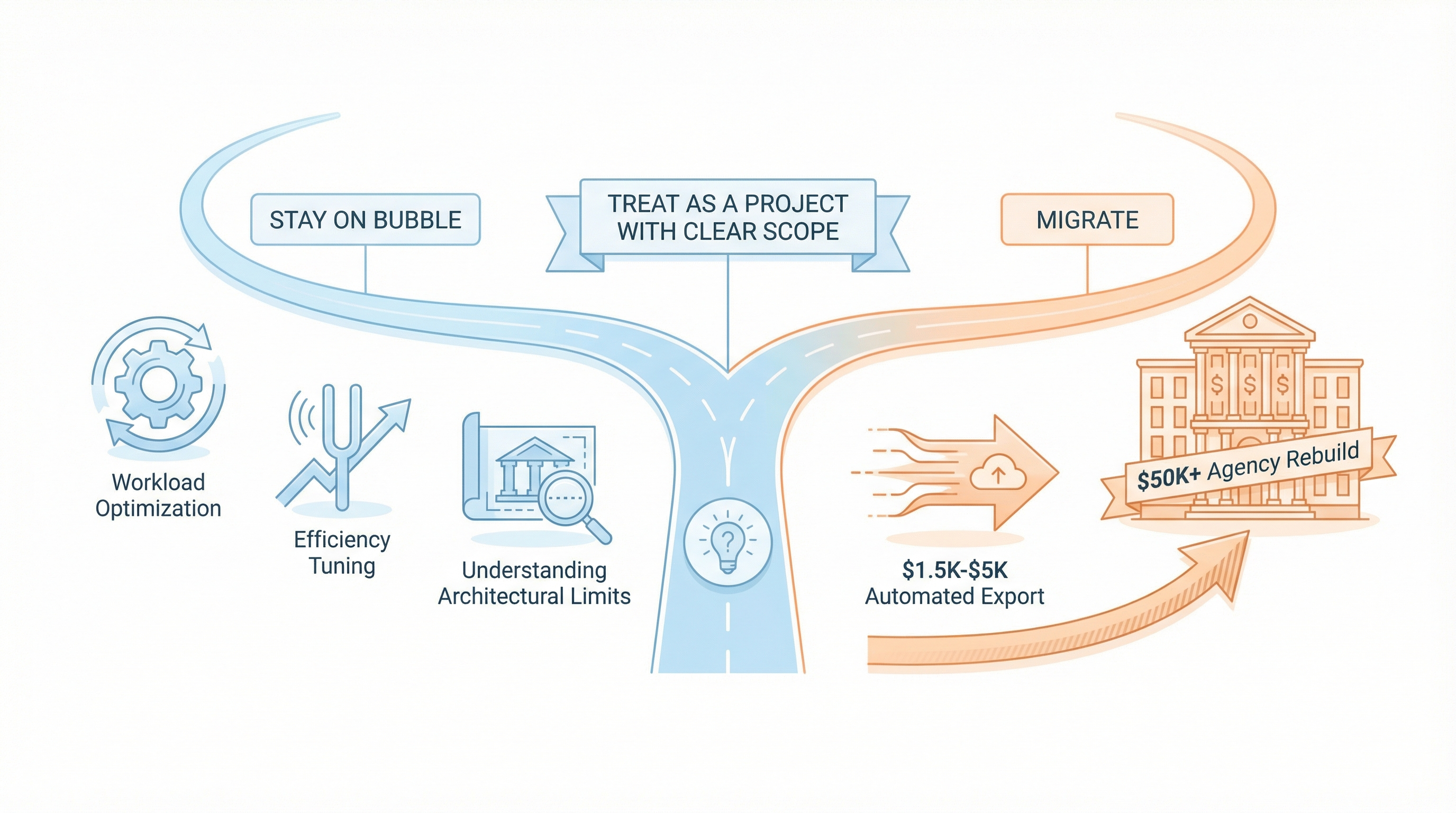
If you decide to stay: Focus on workload optimization. There are guides and forum threads. Understand that optimization has limits—you can improve efficiency, but you can't change Bubble's fundamental architecture.
If you decide to migrate: Options range from $50K+ agency rebuilds to $1.5K-$5K automated exports.
The founders who succeed treat migration as a project with clear scope and timeline—not an open-ended "someday" task.
"you can't never go back"
The ones who struggle keep waiting for the "right time" that never comes.
If you're reading this, you probably already know where you fall. Trust that sense.
Still not sure? Book a free 15-minute assessment. We'll look at your app, costs, and goals—and give honest advice. Sometimes that's "stay on Bubble for now." We'd rather tell you upfront than sell something you don't need.
Ready to talk migration?
Get a free assessment of your Bubble app. We'll tell you exactly what to expect — timeline, cost, and any potential challenges.