
Should I Stay on Bubble or Migrate? A Decision Framework for Founders

You're lying awake at 2 AM, running the same calculation for the hundredth time.
On one side: years of work. Your app. Your users. Your knowledge of every workflow, every data type, every quirky workaround you've built in Bubble. Walking away feels like admitting defeat.
On the other side: rising costs. Sluggish performance. That gnawing feeling every time you hit a wall that wouldn't exist in custom code. The investor who raised an eyebrow when you mentioned "no-code."
"I've invested too much time and money to just throw it away, but I can't afford to stay on Bubble either"
This isn't just one person's dilemma. It's the defining question facing thousands of Bubble founders right now. And unlike most hard decisions, this one comes with a deadline—even if you can't see it yet.
"either I move / rebuild or I shutdown on October 1st, 2024" — Drahgoone, Bubble Forum
Drahgoone reached their wall. A hard deadline. Move, rebuild, or close shop.
Most founders don't get such clear deadlines. Instead, they get the slow squeeze: monthly bills that creep upward, performance that degrades gradually, opportunities that slip away one by one because of platform limitations.
This post won't tell you what to decide. Your situation is unique. But it will give you a framework—a systematic way to evaluate your options, weigh the real factors, and make a decision you can defend. Not to investors. Not to your team. To yourself, at 2 AM, when the doubt creeps in.
Let's work through this together.
The Trap of False Binaries

First, let's clear up a misconception that paralyzes founders.
This isn't "stay on Bubble forever" versus "burn it down and start over." Those aren't your only options. The real landscape looks more like this:
Option 1: Stay and optimize — Squeeze maximum value from Bubble through aggressive optimization.
Option 2: Stay for now, plan for later — Continue on Bubble with a clear migration trigger point.
Option 3: Migrate incrementally — Move critical components to custom code while keeping the rest on Bubble.
Option 4: Migrate completely — Convert your entire application to custom code.
Option 5: Hybrid architecture — Use Bubble for some things, custom code for others, permanently.
Each option has different costs, risks, and timelines. The "right" answer depends entirely on your specific situation. Anyone telling you there's one universal answer is selling something.
The Seven Factors That Actually Matter
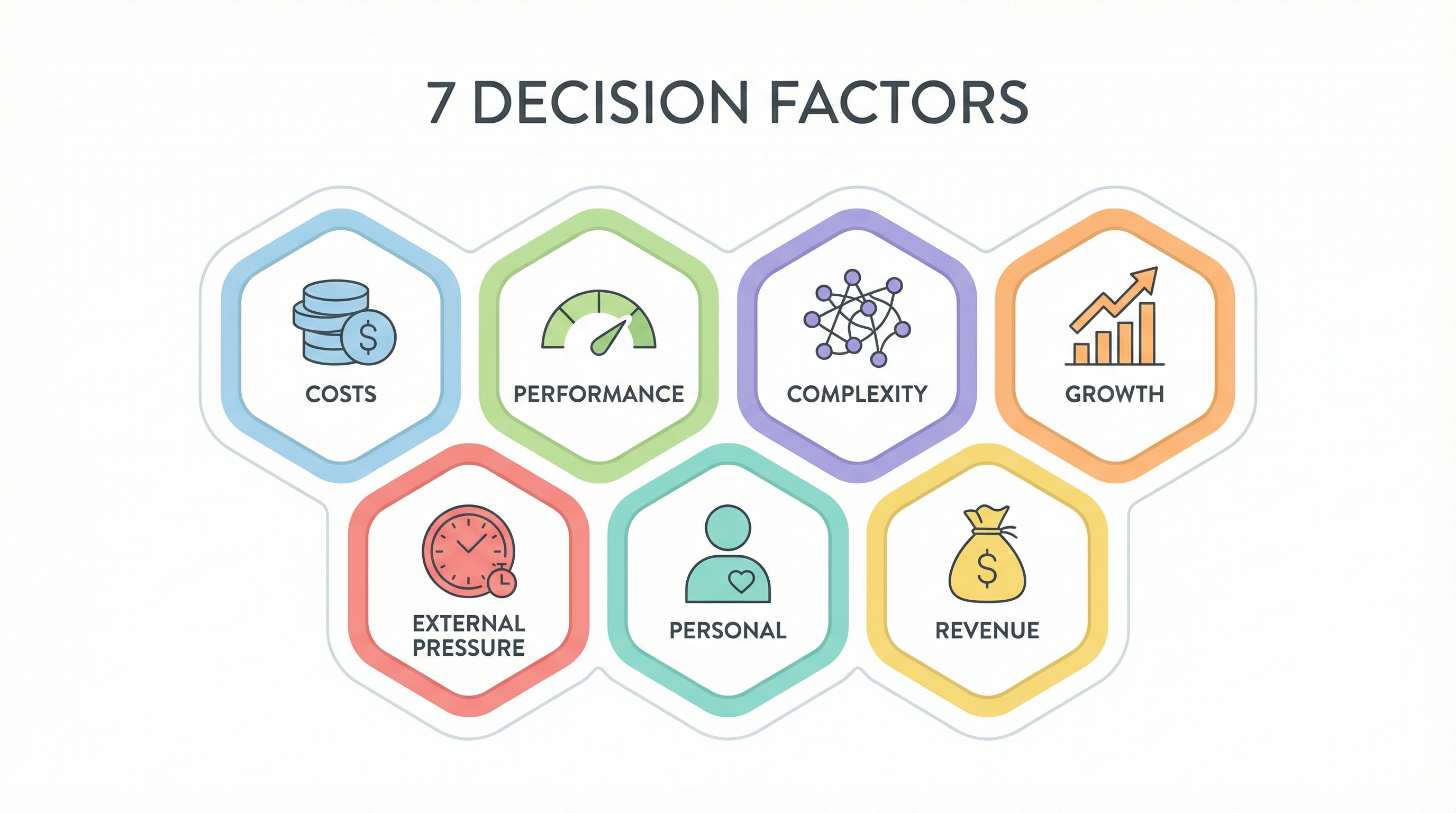
Through hundreds of conversations with Bubble founders, we've identified seven factors that reliably predict whether staying or migrating makes sense. Let's examine each one.
Factor 1: Your Current and Projected Costs
This is the most quantifiable factor, so let's start here.
Calculate your true Bubble cost:
- Monthly subscription: $___
- Average monthly WU overages: $___
- Additional capacity or editors: $___
- Bubble-specific contractors/developers: $___
- Time spent on Bubble-specific optimization: $___ (value your hours)
Total monthly cost: $___
Project forward 12 months:
If you're growing, costs grow too. WU consumption scales with user activity. Most growing apps see 20-50% annual cost increases on Bubble, sometimes more.
12-month projected cost: $___
Compare to custom code:
For most applications:
- Small (under 1,000 MAU): $20-$50/month hosting
- Medium (1,000-10,000 MAU): $50-$200/month hosting
- Large (10,000-100,000 MAU): $200-$1,000/month hosting
- Very large (100,000+ MAU): $1,000-$5,000/month hosting
The decision signal:
| Your Bubble Cost | Recommendation |
|---|---|
| Under $150/month | Staying probably makes sense |
| $150-$300/month | Gray zone—weigh other factors heavily |
| $300-$500/month | Migration ROI becomes compelling |
| Over $500/month | Strong case for migration |
| Over $1,000/month | Migration pays for itself quickly |
If your annual Bubble cost exceeds $3,000-4,000 and you expect growth, the migration math usually works out. A $2,500-$5,000 migration that drops ongoing costs to $600-$1,200/year pays for itself within 12-18 months.
But cost alone shouldn't drive the decision. Keep reading.
Factor 2: Performance Requirements
How fast does your app need to be? And how fast is it now?
Benchmark your current performance:
- Home page load time: ___ seconds
- Key workflow completion: ___ seconds
- Mobile performance: ___ seconds
- User complaints about speed: Yes / No / Frequent
Industry context:
Research consistently shows:
- 53% of mobile visitors abandon pages taking over 3 seconds to load
- Every 100ms of latency costs roughly 1% of conversions
- Google uses page speed as a ranking factor
"Airbnb loads in 2.5 seconds, booking.com loads in 1.5 seconds" — thibautranger, Bubble Forum
Thibautranger was comparing their Bubble app to competitors. Their Bubble app took 8+ seconds on a flagship iPhone. That's not a technical detail—it's a business problem.
"It's dealbreakingly slow." — brenton.strine, Bubble Forum
The decision signal:
| Performance Reality | Recommendation |
|---|---|
| Under 3 seconds, users happy | Stay—performance isn't your problem |
| 3-5 seconds, occasional complaints | Monitor closely, optimize first |
| 5-8 seconds, regular complaints | Migration likely needed for competitive viability |
| Over 8 seconds | Your performance is actively hurting your business |
Performance problems compound. Slow apps have higher bounce rates, lower conversion rates, worse SEO rankings, and lower user satisfaction. If you're competing against faster products, you're competing with a handicap.
Factor 3: Complexity and Technical Debt
Not all Bubble apps are equal. A 5-page MVP is different from a 50-page application with complex workflows.
Audit your app's complexity:
- Number of pages: ___
- Number of reusable elements: ___
- Number of database types: ___
- Number of backend workflows: ___
- Number of API connections: ___
- Number of plugins: ___
- Custom code blocks: ___
Technical debt indicators:
- Workflows you're afraid to touch
- Features that "mysteriously break"
- Inconsistent patterns across the app
- Performance hacks you've accumulated
- Features you can't build due to Bubble limitations
The decision signal:
Higher complexity creates both stronger arguments for staying AND for leaving:
For staying: Complex apps are expensive to migrate. If you've invested significantly in building sophisticated functionality, the migration cost and risk is higher.
For leaving: Complex apps often suffer most from Bubble's limitations. Technical debt in Bubble is harder to refactor than in code. And complexity on Bubble often correlates with high WU consumption.
The key question: Is your complexity working for you or against you?
If your Bubble app's complexity represents valuable functionality that serves users well, migration preserves that value in a better format.
If your complexity is mostly accumulated workarounds and hacks, you might use migration as an opportunity to simplify.
Factor 4: Growth Trajectory
Where is your app headed?
Assess your trajectory:
- Current monthly active users: ___
- Users 6 months ago: ___
- Users 12 months ago: ___
- Monthly growth rate: ___%
- Expected users in 12 months: ___
The growth math:
Bubble's costs scale with usage. If you're growing, costs grow with you—often faster.
Example:
- Today: 2,000 MAU, $200/month Bubble cost
- 12 months (40% growth): 5,600 MAU, $350-450/month Bubble cost
- 24 months (continued growth): 15,680 MAU, $600-1,000/month Bubble cost
Custom code hosting scales differently. You might pay $50/month at 2,000 MAU and $150/month at 15,000 MAU.
The decision signal:
| Growth Rate | Recommendation |
|---|---|
| Declining or flat | Stay—costs won't increase, complexity of migration isn't worth it |
| Modest (10-20%/year) | Consider migration if other factors align |
| Strong (20-50%/year) | Migration becomes more attractive—future costs diverge significantly |
| Explosive (50%+/year) | Migrate soon—you'll hit walls faster than expected |
Fast-growing apps have the most to gain from migration AND the most pressure to migrate. Every month of delay at high growth means more users to transition, more data to migrate, and higher Bubble costs accumulated.
Factor 5: Business Model and Revenue
Are you making money? How much? This changes the calculus significantly.
Assess your revenue situation:
- Current monthly revenue: $___
- Monthly profit (revenue minus all costs): $___
- Revenue growth rate: ___%
- Bubble costs as % of revenue: ___%
The revenue lens:
A $500/month Bubble bill means different things depending on context:
- Pre-revenue startup: That's $6,000/year of runway burned
- $10K/month revenue business: That's 5% of revenue—notable but sustainable
- $100K/month revenue business: That's 0.5% of revenue—probably not worth optimizing
The decision signal:
| Bubble Cost as % of Revenue | Recommendation |
|---|---|
| Over 20% | Unsustainable—migrate or raise prices |
| 10-20% | High—migration ROI is clear |
| 5-10% | Moderate—weigh other factors |
| Under 5% | Low—focus on other bottlenecks first |
For pre-revenue startups:
If you haven't found product-market fit yet, staying on Bubble often makes sense. You need to iterate quickly. You might pivot. Spending money and time on migration before you've validated your business model is premature optimization.
But set a trigger: "When we hit $X revenue (or Y users), we migrate."
Factor 6: External Pressures
Some migration triggers come from outside your app.
Evaluate external pressures:
Investors:
- Have investors expressed concerns about no-code? Yes / No
- Is code ownership required for your fundraising plans? Yes / No
- What due diligence requirements will you face? ___
"to attract investors you need code-export it is very important" — aj11, Bubble Forum
Enterprise customers:
- Do prospects ask about data residency? Yes / No
- Do compliance requirements (HIPAA, SOC 2, GDPR) matter? Yes / No
- Have you lost deals due to platform concerns? Yes / No
"my client lost a multi-million contract because they ran into compliance issue and they needed the code and DB to be run locally" — vascolucci, Bubble Forum
Vascolucci's client lost a multi-million dollar contract. Not because the app didn't work. Because they couldn't provide code ownership for compliance requirements.
Hiring:
- Can you find Bubble developers when you need them? Yes / No
- Would custom code expand your hiring options? Yes / No
- Are Bubble developer rates competitive with general developers? Yes / No
Acquisition:
- Is acquisition a potential exit path? Yes / No
- Would code ownership affect your valuation? Yes / No
- What do acquirers in your space expect? ___
The decision signal:
External pressures often create hard boundaries, not soft preferences:
- Investor requires code ownership → Must migrate before fundraise
- Enterprise compliance requirement → Must migrate to close deal
- Acquisition due diligence → Must migrate before exit
If external pressures are forcing your hand, the decision isn't "stay or migrate"—it's "migrate now or migrate later."
Factor 7: Your Personal Situation
This factor is often ignored in technical analyses, but it matters enormously.
Assess your personal reality:
- Technical comfort level: Low / Medium / High
- Available time for migration project: Hours / Week ___
- Risk tolerance: Low / Medium / High
- Runway remaining: ___ months
- Team capacity for transition: ___
Founder fit:
Some founders genuinely thrive on Bubble. They've mastered it. They enjoy visual development. They don't want to manage code. For them, staying might be right even when the "rational" math says migrate.
Other founders feel constrained. They want to learn to code. They're frustrated by limitations. They'd rather invest in skills that transfer broadly. For them, migration might be right even when the math is borderline.
"you can't never go back" — hoke (after migrating from Bubble)
Hoke didn't mean you're trapped in custom code. They meant they never wanted to go back. For some founders, leaving Bubble unlocks a level of control and satisfaction that spreadsheets can't capture.
The decision signal:
Be honest about who you are:
- If you love Bubble and dread coding → Stay requires compelling other factors to override
- If you're frustrated with Bubble → Migration has intangible benefits beyond the math
- If you have zero bandwidth → Delay any major decision until you can engage properly
The Decision Matrix
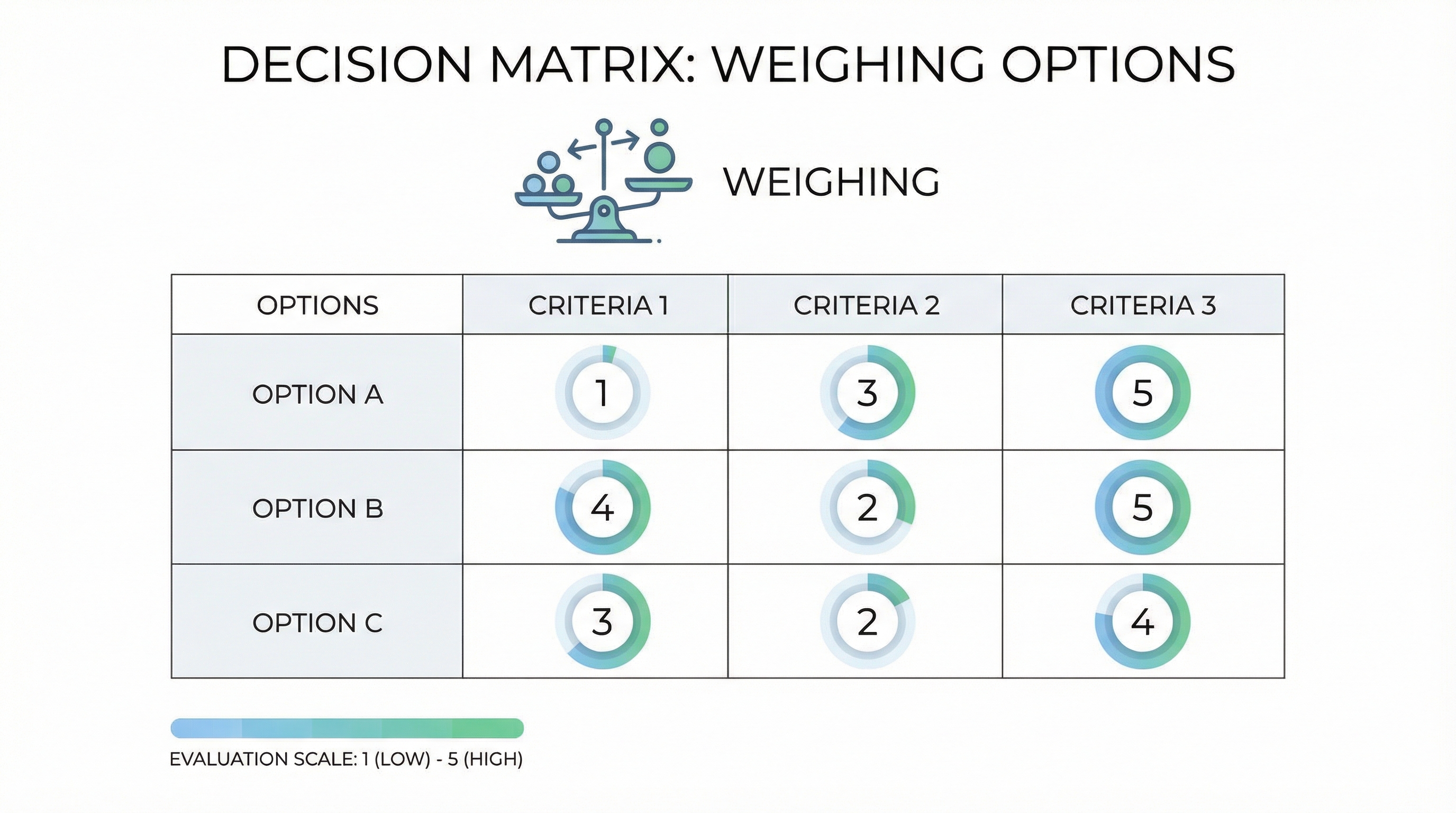
Now let's synthesize these factors into a decision matrix.
Score each factor from 1-5:
| Factor | Stay on Bubble (1) | Migrate (5) | Your Score |
|---|---|---|---|
| Cost | Under $150/mo | Over $500/mo | ___ |
| Performance | Under 3 seconds | Over 8 seconds | ___ |
| Complexity | Simple, well-built | Complex, debt-heavy | ___ |
| Growth | Flat or declining | Explosive (50%+) | ___ |
| Revenue | Bubble is <5% of revenue | Bubble is >15% of revenue | ___ |
| External Pressure | No requirements | Hard requirements | ___ |
| Personal | Love Bubble, no bandwidth | Want to learn code, have time | ___ |
Total Score: ___
Interpretation:
| Score Range | Recommendation |
|---|---|
| 7-14 | Stay on Bubble—optimize, don't migrate |
| 15-21 | Gray zone—consider incremental approach or delayed migration |
| 22-28 | Lean toward migration—build a plan |
| 29-35 | Strong case for migration—act soon |
Important: This is a framework, not a formula. A score of 20 with external investor pressure forcing your hand is different from a score of 25 with no external timeline.
The Warning Signs You've Waited Too Long
Some founders delay until delay is no longer an option. Here are the warning signs that you're approaching—or past—the tipping point:
🚨 Red Flag 1: Monthly Bills Are Surprising You
"7 million workload units used in less than 12 hours! A big fat auto charge bill on the credit card of $1000." — mitchbaylis, Bubble Forum
If your Bubble bills are unpredictable, you've lost control of costs. This only gets worse with scale.
🚨 Red Flag 2: You're Avoiding Features
When you stop building features because you know they'll break things or consume too many WUs, your platform is constraining your product. The cost isn't just the features you don't build—it's the users who leave because competitors build those features.
🚨 Red Flag 3: You've Hit a Wall You Can't Work Around
Every Bubble app eventually hits a wall. Maybe it's performance. Maybe it's a feature that can't be built visually. Maybe it's a compliance requirement.
"my bubble app has some pretty sophisticated UI operations that non-bubble devs seem to scratch their heads when trying to replicate" — ericm, Bubble Forum
Ericm built something sophisticated on Bubble—so sophisticated that it's now hard to replicate anywhere else. That's technical debt disguised as capability.
🚨 Red Flag 4: Your Team Is Frustrated
If your developers (or you) increasingly dread working in Bubble, productivity suffers. Frustrated teams build worse products, more slowly.
🚨 Red Flag 5: You're Losing Deals Over Platform
"I've lost over 90% of potential clients because I couldn't offer code ownership." — Orbit, Bubble Forum
When the platform becomes the objection, you're losing business directly attributable to your technology choice.
The Six-Step Decision Process
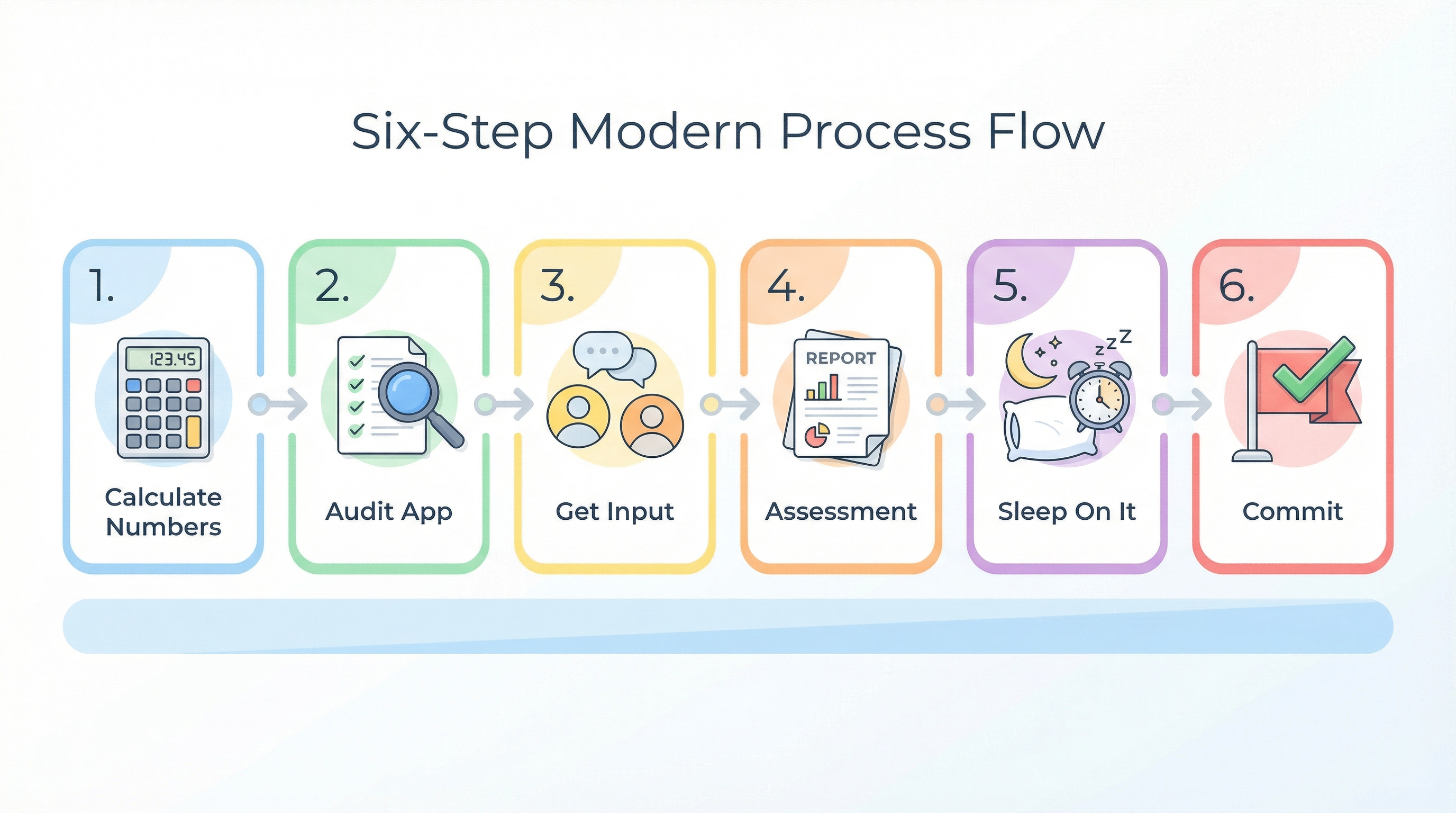
Here's a structured process to move from analysis to decision:
Step 1: Calculate Your Numbers (1 hour)
Pull your actual Bubble billing statements. Calculate your true cost including overages and time spent optimizing. Project forward 12-24 months at your growth rate.
Step 2: Audit Your App (2-4 hours)
Document your app's scope: pages, workflows, database, integrations. Identify complexity and technical debt. Note the features that are hardest to maintain.
Step 3: Get External Input (1-2 hours)
Talk to 2-3 people who've made this decision. Ask what they wish they'd known. Join Bubble community discussions. Learn from others' experiences.
Step 4: Get a Migration Assessment (1 hour)
Whether you ultimately migrate or not, get a professional assessment. Understand your app's migration complexity, realistic timeline, and cost. This gives you a concrete data point to factor into your decision.
Step 5: Sleep On It (24-48 hours)
Don't decide immediately. Let the information settle. Your subconscious often synthesizes factors your conscious analysis misses.
Step 6: Commit and Execute
Once you decide, commit fully. If staying, optimize aggressively. If migrating, move with purpose. The worst outcome is indefinite limbo—paying Bubble costs while not progressing toward either optimization or migration.
If You Decide to Stay

Staying isn't admitting defeat—it's making a strategic choice. Here's how to make it work:
Optimize Aggressively
- Audit all workflows for WU efficiency
- Reduce database queries through better data architecture
- Cache aggressively
- Eliminate redundant operations
- Consider WU-optimization consultants
Set Clear Trigger Points
Don't stay forever without review. Set specific triggers:
- "If monthly costs exceed $X, we reconsider"
- "If load times exceed X seconds, we migrate"
- "If we hit Series A, we include migration in funding plans"
Build Migration Optionality
Even while staying, prepare for eventual migration:
- Document your app thoroughly
- Avoid excessive plugin dependencies
- Keep data clean and well-structured
- Understand your database export options
Accept the Trade-offs
You're trading money and flexibility for speed and simplicity. Own that choice. Don't complain about Bubble's limitations if you've chosen to work within them.
If You Decide to Migrate
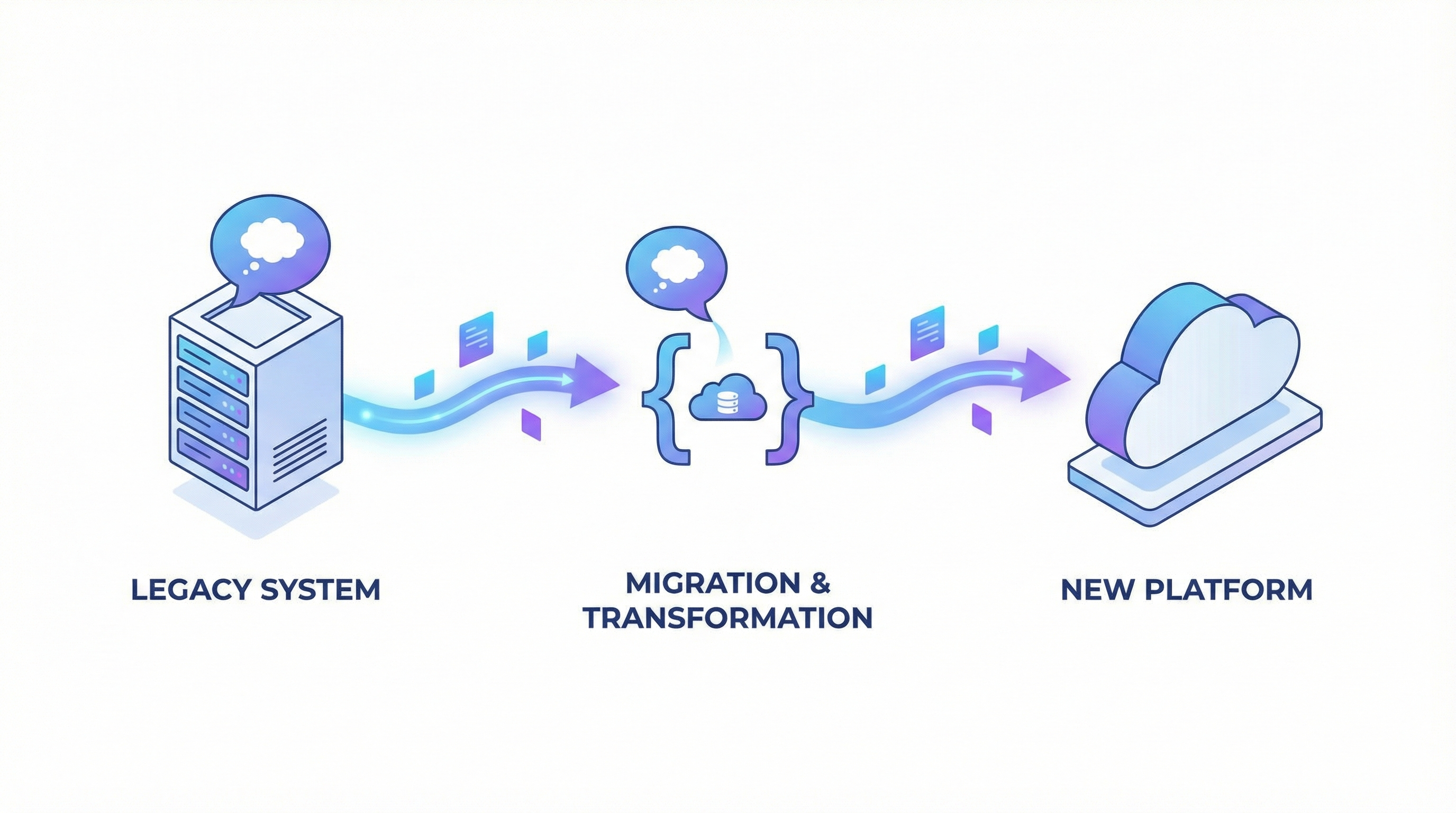
Migration isn't starting over—it's transforming what you've built into something more robust. Here's how to execute:
Choose Your Migration Path
Self-migration: If you're technical and have time, AI-assisted coding can help you rebuild. Expect 2-8 weeks for a medium-complexity app.
Hire developers: Agencies or freelancers can rebuild from specifications. Expect $25,000-$100,000+ and 2-6 months.
Export conversion: Services like ours convert your existing Bubble app to code. Expect $1,500-$5,000 and 1-8 weeks depending on complexity.
Plan the Transition
- Inform users if there will be any disruption
- Plan database migration carefully
- Handle authentication transition (users may need to reset passwords)
- Run parallel systems during cutover
- Have a rollback plan
Execute Methodically
Don't rush. A botched migration is worse than delayed migration. Test thoroughly. Migrate in phases if possible. Validate everything works before cutting over.
Invest in Learning
If you're becoming a code-based company, invest in understanding your new stack. You don't need to become a developer, but you should understand what you're running.
Frequently Asked Questions

What if I'm not sure which way to go after using the framework?
If you're genuinely in the gray zone, default to staying for now—but set a specific review date and clear trigger conditions. Migration is a significant project; it's not something to do "just because." But procrastination has costs too. Give yourself 3-6 months to gather more data, then decide definitively.
Can I migrate just part of my app?
Yes. Some founders migrate their most resource-intensive components (usually backend workflows and heavy database operations) to custom code while keeping the UI on Bubble. This can reduce costs immediately while spreading out migration work. It adds architectural complexity but reduces risk.
What if I can't afford the migration cost right now?
If you're pre-revenue and burning runway on Bubble costs, you have limited options: continue burning, find ways to reduce Bubble costs, or find migration funding (investors, revenue, savings). Some founders pause growth temporarily to fund migration. Others raise specifically to enable migration. The worst option is continuing to burn money you don't have.
How do I explain migration to my users?
Most users don't care what technology runs their software. They care that it works. A well-executed migration with minimal disruption doesn't need elaborate explanation. If you're worried about perception, frame it positively: "We're upgrading our infrastructure to serve you better."
What about my Bubble developers?
If you have Bubble-specific team members, migration is a transition for them too. Some Bubble developers successfully transition to custom code (especially with AI tools lowering the barrier). Others prefer to specialize in Bubble and may not be the right fit post-migration. Have honest conversations early.
What if Bubble improves significantly?
Bubble continues to evolve. They may address some limitations. They may even eventually offer code export. But you can't run your business on features that might exist someday. Make decisions based on what's available now. If Bubble dramatically improves, you can always reconsider—but waiting indefinitely for improvements that may never come is its own decision.
The Real Question Behind the Question

Here's what founders are really asking when they say "Should I stay or migrate?":
"Am I making the right bet?"
There's no guaranteed right answer. Both paths have worked for founders. Both paths have failed for founders. What matters is making a conscious choice with clear reasoning—not drifting into a decision by default.
"Will I regret this?"
You might regret either choice. Staying might mean watching costs spiral. Migrating might mean a harder transition than expected. What you'll definitely regret is not deciding—spending months in limbo, paying the costs of staying while not getting the benefits, not investing in migration while not committing to Bubble.
"When will I know for sure?"
You won't. Not before you decide. Certainty is a luxury that founders rarely get. At some point, you evaluate the information available, make the best call you can, and live with the consequences.
The Final Framework
Here's the simplest version of the decision:
Stay on Bubble if:
- Your costs are manageable (<$150/month)
- Performance meets your needs
- You're still finding product-market fit
- No external forces are pushing you out
- You genuinely prefer visual development
Migrate from Bubble if:
- Costs are escalating (>$300/month and climbing)
- Performance is hurting your business
- You've found product-market fit and are scaling
- Investors, customers, or compliance require code ownership
- You want the control and flexibility of custom code
Don't defer the decision indefinitely if:
- You're burning money on a platform you're not committed to
- You're losing opportunities due to platform limitations
- The math clearly says one thing but you're doing another
Every month of limbo has a cost. Choose your path and walk it.
Ready to Make Your Decision?
If you're working through this framework and want a concrete data point on migration, we offer free assessments. We'll review your Bubble app, estimate complexity and timeline, and give you honest perspective on whether migration makes sense for your situation.
No sales pressure. Just information to help you decide.
Or continue researching:
Ready to talk migration?
Get a free assessment of your Bubble app. We'll tell you exactly what to expect — timeline, cost, and any potential challenges.