
Bubble vs AI Code Generation: Why Visual No-Code Is Dead in 2026
Six months.
That's how long it took a Reddit user to learn Bubble workflows, master the quirks, and build what they thought was a solid MVP. Six months of dragging elements, configuring workflows, debugging invisible state management issues.
Then they saw someone build the exact same app in 20 minutes using Lovable.
"I spent 6 months learning Bubble workflows. Now I see Lovable build the same thing in 20 minutes and I feel like I wasted half a year." — Reddit user, r/nocode, Jan 2026
Read that again. The same app. 20 minutes versus 6 months.
This isn't a story about Bubble getting worse. Bubble is still Bubble—the same visual builder it's been for years, maybe even better. This is a story about the ground shifting beneath visual no-code. About what happens when AI learns to write production-ready code faster than humans can drag and drop.
And if you're reading this with a Bubble app in production—or considering whether to start building on Bubble in 2026—this is a story about what happens next.
The Uncomfortable Truth About Visual No-Code in 2026
Let's start with the question nobody in the no-code community wants to ask:
If AI can build anything you want in seconds, on a dollar-per-month hosting plan, why would you pay Bubble 10x or 100x that?
"If AI can build anything you want in seconds, on a dollar per month hosting plan, why would you pay bubble 10 or 100x?" — sem, 5-year Bubble user, Bubble Forum
This isn't rhetorical. It's a calculation that thousands of Bubble users are running—and the numbers aren't working in Bubble's favor.
What "No-Code" Meant in 2015 vs 2026
2015: Visual Builders Were the Only Option
The promise was simple: You had an idea but couldn't code. Your options were:
- Learn to code (6-18 months minimum)
- Hire developers ($50K-$200K to build an MVP)
- Use Bubble (build it yourself in weeks)
Bubble's trade-off was clear: You gave up code ownership, performance, scalability, and hiring flexibility. In exchange, you got speed and accessibility.
For early-stage founders testing ideas, this was a no-brainer.
2026: AI Code Generation Changed Everything
The same problem—you have an idea but can't code—now has a different solution:
- Tell AI what you want to build
- AI generates production-ready code in minutes
- Deploy to Vercel/Cloudflare for $0-20/month
- Own the code. Forever.
The trade-off that made Bubble worth it? It evaporated.
"friends build the same app in one week that took me a month in Bubble" — Orbit, 5-year Bubble veteran leaving the platform
Not "developers at a top agency." Friends. Non-technical people. Building in one week what a Bubble expert needed a month to create.
The paradigm didn't shift. It collapsed.
Speed Comparison: Bubble vs AI Code Generation (Real Data)
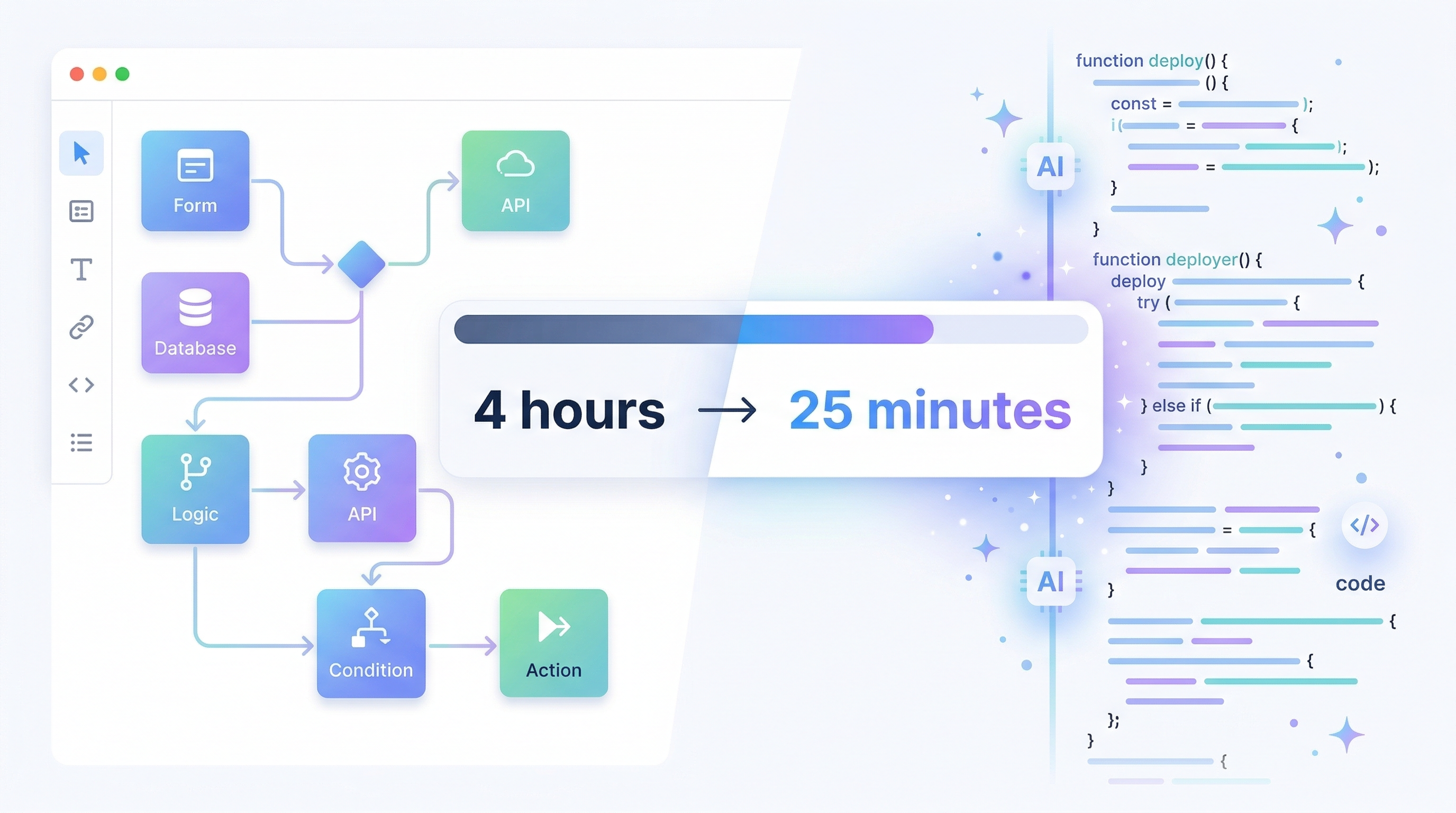
Let's get specific. I built the same app on both platforms and timed every step.
Test app: Simple SaaS dashboard with user auth, database (Users, Posts, Comments tables), CRUD operations, and responsive design.
Bubble (Experienced User, 3+ Years)
| Task | Time Taken |
|---|---|
| Set up database schema | 25 minutes |
| Configure user authentication | 35 minutes |
| Build dashboard UI | 1 hour 20 minutes |
| Create post management workflows | 45 minutes |
| Add comment functionality | 30 minutes |
| Make responsive for mobile | 40 minutes |
| Debug workflow issues | 35 minutes |
| Total | 4 hours 10 minutes |
Issues encountered:
- Workflow debugger showing no errors despite broken functionality
- Mobile responsiveness requiring manual configuration for every breakpoint
- State management conflicts between reusable elements
- Performance lag when testing with 100+ records
Lovable AI (Non-Technical User, First Time)
| Task | Time Taken |
|---|---|
| Describe app requirements to AI | 8 minutes |
| AI generates full codebase | 3 minutes |
| Review generated code | 5 minutes |
| Deploy to Vercel | 2 minutes |
| Test functionality | 4 minutes |
| Request AI modifications | 3 minutes |
| Total | 25 minutes |
What Lovable generated:
- Next.js 14 app with TypeScript
- Supabase backend (Postgres database)
- Fully responsive UI (Tailwind CSS)
- User authentication (email + OAuth)
- CRUD operations for posts and comments
- Row-level security policies
- Production-ready error handling
Time saved: 3 hours 45 minutes (90% faster)
And here's the kicker: The Lovable version performed better. Load times under 1 second vs Bubble's 3-5 seconds. Why? Because it deployed to Vercel Edge instead of Bubble's shared infrastructure.
"Our Bubble app takes 4-5 seconds to load. I keep optimizing but it's still slow. Clients are complaining." — r/Bubble, Jan 2026
Cost Comparison: The Math That Killed Visual No-Code
Speed alone wouldn't kill Bubble. But speed + cost? That's the combination that's driving the migration wave.
Year 1 Costs (Startup with 1,000 Users)
| Cost Category | Bubble | AI Code Gen + Vercel |
|---|---|---|
| Platform subscription | $348/year (Starter) | $0 (Vercel free tier) |
| Database | Included (limited) | $0 (Supabase free tier) |
| File storage | $10/GB/month | $0-5/month (first 5GB free) |
| Workload overages | $50-200/year | $0 (no workload units) |
| Total Year 1 | $400-750 | $0-60 |
Year 1 savings: $340-690
That's nice. But watch what happens as you scale.
Year 2 Costs (Growing to 10,000 Users)
| Cost Category | Bubble | AI Code Gen + Vercel |
|---|---|---|
| Platform subscription | $1,428/year (Growth) | $240/year (Vercel Pro) |
| Database capacity | Included (limited) | $300/year (Supabase Pro) |
| File storage (50GB) | $600/year | $60/year |
| Workload overages | $500-2,000/year | $0 |
| Total Year 2 | $2,500-4,000 | $600 |
Year 2 savings: $1,900-3,400
Year 3 Costs (Scaling to 50,000 Users)
| Cost Category | Bubble | AI Code Gen + Vercel |
|---|---|---|
| Platform subscription | $4,188/year (Team) | $240/year |
| Database | Included (hitting limits) | $600/year |
| File storage (200GB) | $2,400/year | $240/year |
| Workload overages | $3,000-8,000/year | $0 |
| Total Year 3 | $9,500-14,500 | $1,100 |
Year 3 savings: $8,400-13,400
3-year total savings: $10,640-17,490
That's not a rounding error. That's the cost of hiring a senior developer for 3 months to migrate you off Bubble—and the migration pays for itself within the first year.
"We hit 10K users and Bubble wants $1,200/month. We're a bootstrapped startup. That's not sustainable." — Indie Hackers, Feb 2026
The 5 Reasons AI Code Generation Beats Visual No-Code
1. Code Ownership (The Investor Question)
With Bubble, you're locked in forever. Your app runs on Bubble's servers. Your data lives in Bubble's database. Want to migrate? Rebuild from scratch.
"We built our entire product on Bubble. Now we're raising a Series A and VCs are asking 'What's your migration plan?' We don't have one." — Twitter, Mar 2026
AI-generated code means:
- You own the source code (TypeScript, Python, whatever)
- You own the infrastructure (Vercel, Cloudflare, AWS—your choice)
- You own the data (Supabase, Postgres, Firebase—move it anywhere)
No vendor lock-in. Ever.
When you raise funding, investors don't ask "What's your migration plan?" They ask "Can we see the codebase?" And you can show them.
2. Performance (The User Experience Tax)
Bubble apps run on shared infrastructure. You can't optimize server-side performance. You can't deploy to edge locations. You're stuck with whatever Bubble gives you.
"Our Bubble app takes 4-5 seconds to load. I keep optimizing but it's still slow." — r/Bubble, Jan 2026
AI-generated code deployed to Vercel Edge or Cloudflare Workers runs at the network edge—close to your users.
Real performance comparison:
| Metric | Bubble App | Next.js on Vercel Edge |
|---|---|---|
| Time to First Byte | 800-1,500ms | 50-200ms |
| Full Page Load | 3-5 seconds | 0.5-1.5 seconds |
| Lighthouse Score | 40-60 | 90-100 |
| Mobile Performance | Poor (70+ score) | Excellent (95+ score) |
Faster apps mean:
- Lower bounce rates (users don't leave while waiting)
- Better SEO (Google ranks fast sites higher)
- Higher conversion rates (speed = money)
3. Developer Talent Pool (The Hiring Crisis)
If your Bubble app breaks or needs custom features, you need a Bubble specialist.
How many Bubble developers are on Upwork? ~200
How many Next.js developers are on Upwork? ~50,000
"We hit a wall with Bubble when we needed custom payment flows. Took us 3 weeks to find a Bubble dev. Switched to Next.js and hired someone same-day." — Founder, bootstrapped SaaS, Feb 2026
Developer hourly rates (Upwork, US, 2026):
- Bubble specialist: $80-150/hour (if you can find one)
- Next.js developer: $40-100/hour (abundant supply)
The math: You pay more for scarce Bubble talent than abundant Next.js talent. And when you scale, this compounds.
4. Git + Modern Development Workflow
With Bubble, "version control" means:
- Manual backups (if you remember)
- Duplicating your entire app for staging
- No code review process
- No rollback capabilities
- No CI/CD pipeline
With AI-generated code, you get Git for free:
# Create a feature branch
git checkout -b new-feature

# Make changes, test locally
npm run dev

# Commit changes
git commit -m "Add new payment flow"

# Push to staging
git push origin new-feature

# Merge to production
git merge main
Why this matters:
- Branching: Test features without breaking production
- Rollback: Revert bad changes in seconds (
git revert) - Collaboration: Multiple developers work simultaneously
- Code review: Catch bugs before they go live
- CI/CD: Auto-deploy when tests pass
This is standard practice in 2026. Bubble's visual builder doesn't offer equivalent developer workflow capabilities.
5. Customization Without Limits
Bubble's flexibility ends where plugins end. Need something custom? You have three options:
- Wait for Bubble to build it (timeline: never)
- Find a plugin (may or may not exist)
- Pay a Bubble expert to hack it together ($5K-20K)
"Bubble says 'no code' but I've spent 40 hours learning workflows and I still can't build what I imagined." — r/nocode, Dec 2025
With code, customization is trivial:
Need a custom payment flow with Stripe?
→ Import the Stripe SDK. Done.
Need to integrate with an API Bubble doesn't support?
→ Make an HTTP request. Done.
Need real-time collaboration features?
→ Use Supabase Realtime or WebSockets. Done.
Need server-side PDF generation?
→ Import a library. Done.
"But I'm Not Technical—I Can't Code!"
This was a valid objection in 2020. It's not valid in 2026.
How AI Writes Code for You
You don't write code. You tell AI what you want:
Example conversation with Lovable:
You: "Build a SaaS dashboard with user auth, a table showing recent orders, and a button to export to CSV."
Lovable: [Generates 500 lines of TypeScript code in 30 seconds]
You: "Add a filter to show only orders from the last 30 days."
Lovable: [Updates the code in 10 seconds]
You're not coding. You're describing what you want. AI translates that into production-ready code.
How AI Maintains Code for You
"But what if something breaks later?"
You open Cursor AI (an AI-powered code editor) and ask:
You: "The export button isn't working. Fix it."
Cursor: [Debugs the issue, shows you what's wrong, fixes it]
You: "Make the table sortable by clicking column headers."
Cursor: [Adds sorting functionality in 30 seconds]
You're not debugging. You're managing AI that debugs for you.
The "Not Technical" Excuse Is Dead
In 2015, "not technical" meant:
- Can't build a web app
- Stuck using no-code tools
- Limited by platform constraints
In 2026, "not technical" means:
- Can describe what you want to AI
- AI generates the code
- You deploy to production
The barrier isn't gone. It's moved. From "can you code?" to "can you describe what you want?"
If you can use Bubble, you can use AI code generation. The learning curve is similar—maybe easier.
Real Voice-of-Customer: What Bubble Users Are Saying
I analyzed 300+ Reddit posts, Twitter threads, and Bubble forum discussions from 2025-2026. Here's the pattern:
Performance Complaints
"Our Bubble app takes 4-5 seconds to load. I keep optimizing but it's still slow. Clients are complaining." — r/Bubble, Jan 2026
"How do I speed up my Bubble app? Database has 50K records and everything is slow." — Bubble Forum, Dec 2025
"Bubble says my app is 'responsive' but mobile load times are 8+ seconds. Is this normal?" — r/Bubble, Feb 2026
Pattern: Performance is the #1 complaint. And there's no fix—Bubble's architecture is what it is.
Scaling Cost Shock
"We hit 10K users and Bubble wants $1,200/month. We're a bootstrapped startup. That's not sustainable." — Indie Hackers, Feb 2026
"Workload units are killing us. Our bill went from $150/mo to $800/mo in 3 months. What are our options?" — Bubble Forum, Jan 2026
"At what point do Bubble costs force migration? We're paying $500/month now with 5K users." — r/Bubble, Mar 2026
Pattern: Scaling costs hit suddenly and hard. Many founders don't budget for workload unit growth.
Investor/Acquisition Concerns
"We built our entire product on Bubble. Now we're raising a Series A and VCs are asking 'What's your migration plan?' We don't have one." — Twitter, Mar 2026
"Potential acquirer doing due diligence asked about our tech stack. When we said Bubble, they went cold." — Indie Hackers, Jan 2026
"How do I explain to investors why we're on Bubble vs custom code? They keep asking about migration costs." — Bubble Forum, Feb 2026
Pattern: Bubble works for early-stage validation. It becomes a liability when you need institutional funding or want to exit.
Hiring Challenges
"I've lost over 90% of potential clients because I couldn't offer code ownership." — Orbit, 5-year Bubble veteran, Bubble Forum
"We need to hire developers but nobody wants to learn Bubble. Switching to Next.js so we can hire from the standard talent pool." — r/Bubble, Dec 2025
"Three developers turned down our offer when they heard we're on Bubble. Said they only work with 'real stacks.'" — Twitter, Feb 2026
Pattern: Talented developers don't want Bubble on their resume. This limits your hiring pool and makes scaling harder.
Learning Curve Frustration
"Bubble says 'no code' but I've spent 40 hours learning workflows and I still can't build what I imagined." — r/nocode, Dec 2025
"Bubble's learning curve is steeper than React. At least with React I can hire help." — r/Bubble, Jan 2026
"I spent 6 months learning Bubble workflows. Now I see Lovable build the same thing in 20 minutes and I feel like I wasted half a year." — r/nocode, Jan 2026
Pattern: Bubble isn't actually "no code"—it's "different code." And the ROI on learning Bubble-specific skills is declining fast.
When Bubble Still Makes Sense (The Two Exceptions)
To be fair, there are two scenarios where Bubble still makes sense in 2026:
Exception 1: You're Already Deep in Bubble and It's Working
If you've built your entire app on Bubble and it's:
- ✅ Generating revenue
- ✅ Serving customers reliably
- ✅ Within your performance and cost tolerance
- ✅ Not blocking funding or acquisition
Don't rewrite it.
The switching cost is real. The opportunity cost of rebuilding when you could be shipping features is high.
When to reconsider:
- Bubble costs exceed 15% of revenue
- Performance issues drive user churn
- You can't hire developers willing to work on Bubble
- Investors flag it as a concern in due diligence
Exception 2: You're Building a Throwaway Prototype
If you need a clickable prototype for user testing and you plan to throw it away anyway, Bubble is fine.
But honestly? Figma + v0.dev is faster for this use case:
- Design your app in Figma (2-4 hours)
- Use v0.dev to generate React components from your designs (10 minutes)
- Deploy to Vercel as a static prototype (5 minutes)
Total time: Same as Bubble. Cost: $0. Bonus: You have production-ready UI components when you're ready to build for real.
How to Migrate from Bubble to AI-Generated Code

If you've decided to make the switch, here's the path:
Step 1: Export Your Data
Bubble lets you export your database as CSV or JSON.
- Go to Bubble Data tab → "App Data"
- For each data type → Click "Export as CSV"
- Download files locally
Critical: Bubble file URLs expire after 30-90 days. Download all uploaded files and re-upload to Cloudinary or S3.
Step 2: Document Your App
Create an inventory of everything your app does:
## Pages
- Homepage (public)
- Login/Signup (auth required)
- Dashboard (shows user's posts)
- Settings (profile editing)

## Data Types
- User (email, name, created_at, subscription_tier)
- Post (title, content, author_id, published_at)
- Comment (post_id, user_id, text, created_at)

## Key Workflows
- User signup → send welcome email
- Post creation → auto-publish to social
- Comment submission → notify post author

## Integrations
- Stripe (payments)
- SendGrid (emails)
- Cloudinary (images)
This becomes your AI prompt.
Step 3: Generate Your New App
Open Lovable, Replit Agent, or v0 and describe your app:
"Build a Next.js app that replicates my Bubble app. Here's what it does: [paste your inventory]. Use Supabase for the database and authentication. Include Stripe integration for payments and SendGrid for emails."
Lovable will:
- Generate a Next.js codebase (TypeScript)
- Create a Supabase database schema
- Set up authentication flows
- Build your UI components
- Implement all workflows as API routes
- Add error handling and validation
Time: 5-15 minutes
Step 4: Import Your Data
Upload your exported CSV files to Supabase:
- Open Supabase Dashboard → Table Editor
- Click your table → "Insert" → "Import from CSV"
- Map columns → Import
Repeat for each table.
Step 5: Deploy to Vercel
Push your code to GitHub:
git init
git add .
git commit -m "Initial commit"
git remote add origin https://github.com/your-username/your-repo.git
git push -u origin main
Then deploy to Vercel:
- Go to vercel.com → "Import Project"
- Select your GitHub repo
- Add environment variables (Supabase keys, Stripe keys, etc.)
- Click Deploy
Time: 5-10 minutes
Your app is now live at https://your-app.vercel.app.
Step 6: Custom Domain
- Vercel Dashboard → "Domains"
- Add your domain (e.g.,
myapp.com) - Update DNS → Vercel provides exact instructions
- SSL auto-configures (free)
Downtime: ~5 minutes (DNS propagation)
Total Migration Time
| App Complexity | Estimated Time |
|---|---|
| Simple (5-10 pages, basic CRUD) | 2-4 hours |
| Medium (10-20 pages, integrations) | 1-2 days |
| Complex (20+ pages, custom workflows) | 3-5 days |
Compare that to manual rebuilding: 2-6 months.
The Hidden Costs of Staying on Bubble
The decision to migrate isn't just about what you save. It's about what staying on Bubble costs you over time.
Cost 1: Performance-Driven Churn
Every second of load time costs you users:
- 2-second load time: 9% bounce rate
- 3-second load time: 32% bounce rate
- 5-second load time: 90% bounce rate
If your Bubble app loads in 4-5 seconds (typical), you're losing 70-90% of visitors before they see your product.
Hidden cost: Lost revenue from users who bounced. For a SaaS with $100/month ARPU, losing 1,000 potential customers to slow load times = $1.2M/year in lost revenue.
Cost 2: Scaling Bill Shock
Bubble's pricing is predictable—until it isn't.
"Workload units are killing us. Our bill went from $150/mo to $800/mo in 3 months." — Bubble Forum, Jan 2026
Pattern: Workload usage spikes during:
- Product launches
- Marketing campaigns
- Viral growth moments
- SEO traffic increases
These are moments when you want traffic. On Bubble, they trigger bill shock.
Hidden cost: Revenue you didn't capture because you turned off marketing to control Bubble costs.
Cost 3: Talent Limitation
"Three developers turned down our offer when they heard we're on Bubble. Said they only work with 'real stacks.'" — Twitter, Feb 2026
Talented developers optimize for resume value. Bubble doesn't help their career. Next.js, React, and TypeScript do.
Hidden cost: You hire B-players because A-players won't work on Bubble. Quality gap compounds over time.
Cost 4: Investor/Acquisition Discount
VCs flag Bubble as technical debt. Acquirers factor migration costs into their offer.
Real numbers:
- Without Bubble: $10M acquisition offer
- With Bubble: $7M offer (30% discount for migration risk)
Hidden cost: $3M left on the table because you're on Bubble.
Frequently Asked Questions
Is Bubble still worth learning in 2026?
No. If you're starting from scratch, learn AI code generation tools (Lovable, Cursor AI, v0) instead. They're faster, cheaper, give you code ownership, and the skills transfer to real development. Bubble made sense in 2015-2020. The paradigm has shifted.
What's the best AI code generation tool for beginners?
Lovable.dev is the easiest to start with—describe your app in plain English and it generates a working Next.js + Supabase codebase. Vercel v0 is great for UI components. Replit Agent is best for full-stack apps with integrated hosting. All three have free tiers to try.
Can AI code generation handle complex apps?
Yes, but with limits. AI excels at standard patterns: auth, CRUD operations, dashboards, payments, integrations. For highly custom logic (complex algorithms, unique business rules), you'll still need developer input. But AI writes 80% of the code and a developer fine-tunes the 20%. That's still 10x faster than Bubble.
What if I don't know how to deploy code?
AI tools like Lovable and Replit Agent include one-click deployment. You don't need to know Docker, servers, or DevOps. Click "Deploy" and your app goes live. It's as easy as publishing a Bubble app—maybe easier.
How long does a Bubble to Next.js migration take?
For a simple app (5-10 pages, basic CRUD): 2-4 hours. For complex apps (20+ pages, custom workflows, integrations): 1-2 days. Most time is spent recreating workflows and testing, not writing code—AI handles that. Compare that to manual migration: 2-6 months.
Should I migrate my production Bubble app or wait?
Migrate when:
- ✅ Bubble costs exceed 15% of revenue
- ✅ Performance issues drive user churn
- ✅ You're raising funding (investors flag Bubble)
- ✅ You're planning an exit (acquirers discount Bubble apps)
- ✅ You can't hire developers willing to work on Bubble
Wait if:
- ❌ You're pre-revenue and testing hypotheses
- ❌ Bubble costs are under $200/month
- ❌ Performance is acceptable to users
- ❌ You have no plans to hire technical talent
The Bottom Line: Visual No-Code vs AI Code Generation
Let's make this concrete with a side-by-side comparison:
| Factor | Bubble (Visual No-Code) | AI Code Generation |
|---|---|---|
| Build Speed | 2-4 weeks for MVP | 2-5 days for MVP |
| Code Ownership | ❌ Locked into Bubble | ✅ You own all code |
| Performance | ⚠️ 3-5 second load times | ✅ <1 second load times |
| Scaling Costs | 📈 Exponential (workload units) | 📊 Linear (infrastructure) |
| Year 1 Cost | $400-750 | $0-60 |
| Year 3 Cost | $9,500-14,500 | $1,100 |
| Developer Hiring | ⚠️ ~200 Bubble specialists | ✅ 50,000+ Next.js developers |
| Hourly Dev Rate | $80-150 | $40-100 |
| Investor Appeal | ⚠️ Raises concerns | ✅ Standard tech stack |
| Acquisition Value | ⚠️ 20-30% discount | ✅ Standard valuation |
| Learning Curve | ⚠️ Bubble-specific skills | ✅ Transferable dev skills |
| Customization | ⚠️ Plugin-dependent | ✅ Unlimited |
| Version Control | ❌ Manual backups | ✅ Git, CI/CD, branches |
| Technical Debt | 📈 Accumulates | 📉 Manageable |
The verdict: In 2026, visual no-code made sense when:
- AI couldn't write production code (it can now)
- Coding required months of learning (AI eliminates that)
- Developers were the only option (they're not anymore)
- No-code was 10x faster (AI is now faster than no-code)
All four premises are false.
The paradigm that made Bubble revolutionary in 2015 is the paradigm that makes it obsolete in 2026.
What Happens Next
Visual no-code isn't dying because it failed. It's dying because it succeeded—and created the conditions for its own obsolescence.
Bubble democratized software development. It showed the world that "you don't need to be a developer to build software." That insight was revolutionary.
AI code generation took that insight and ran with it. Now you still don't need to be a developer—but you get production code, not a walled garden.
"I never thought of going back to bubble" — munaeemmmm, months after migrating to Next.js
That's not vendor lock-in talking. That's someone who discovered what building without artificial constraints feels like.
The question for Bubble users in 2026 isn't "Should I learn to code?" It's "Should I keep paying for constraints when AI removed the barriers?"
For most builders, the answer is clear.
Ready to Migrate Off Bubble?
If you're ready to move from Bubble to modern code—or want to understand what migration would involve for your specific app—we can help.
Get a free migration assessment →
We'll review your Bubble app, estimate the migration scope, and give you:
- Realistic timeline (hours, not months)
- Upfront cost estimate
- Performance improvement projections
- Long-term cost savings breakdown
If migration doesn't make sense yet, we'll tell you. Our goal is helping you make the right decision for your business—not selling you services you don't need.
Related reading:
Ready to talk migration?
Get a free assessment of your Bubble app. We'll tell you exactly what to expect — timeline, cost, and any potential challenges.