
5 Warning Signs Your Bubble App Has Outgrown the Platform
Everything was working fine last month.
Now every morning starts the same way: open Bubble dashboard, watch the workload units tick up, feel that familiar knot in your stomach. You're doing mental math before coffee. "If I got 100 more signups this week, that's... fuck, another $150?"
The pitch was simple. $29/month to build real software without hiring developers. No code, no complexity, just drag and drop your way to launch. And honestly? It worked. You shipped. You got users. Maybe you're even making money.
But somewhere around user #500, the economics broke. Your costs started climbing faster than your revenue. And now you're in this weird middle ground where you're too successful to stay on Bubble, but too deep in to just... start over.
There are five warning signs that you've outgrown the platform. Most founders hit at least three of them simultaneously before they realize what's happening. Here's what to watch for.
Warning Sign #1: Your Monthly Bill Crossed $200 (And Keeps Climbing)
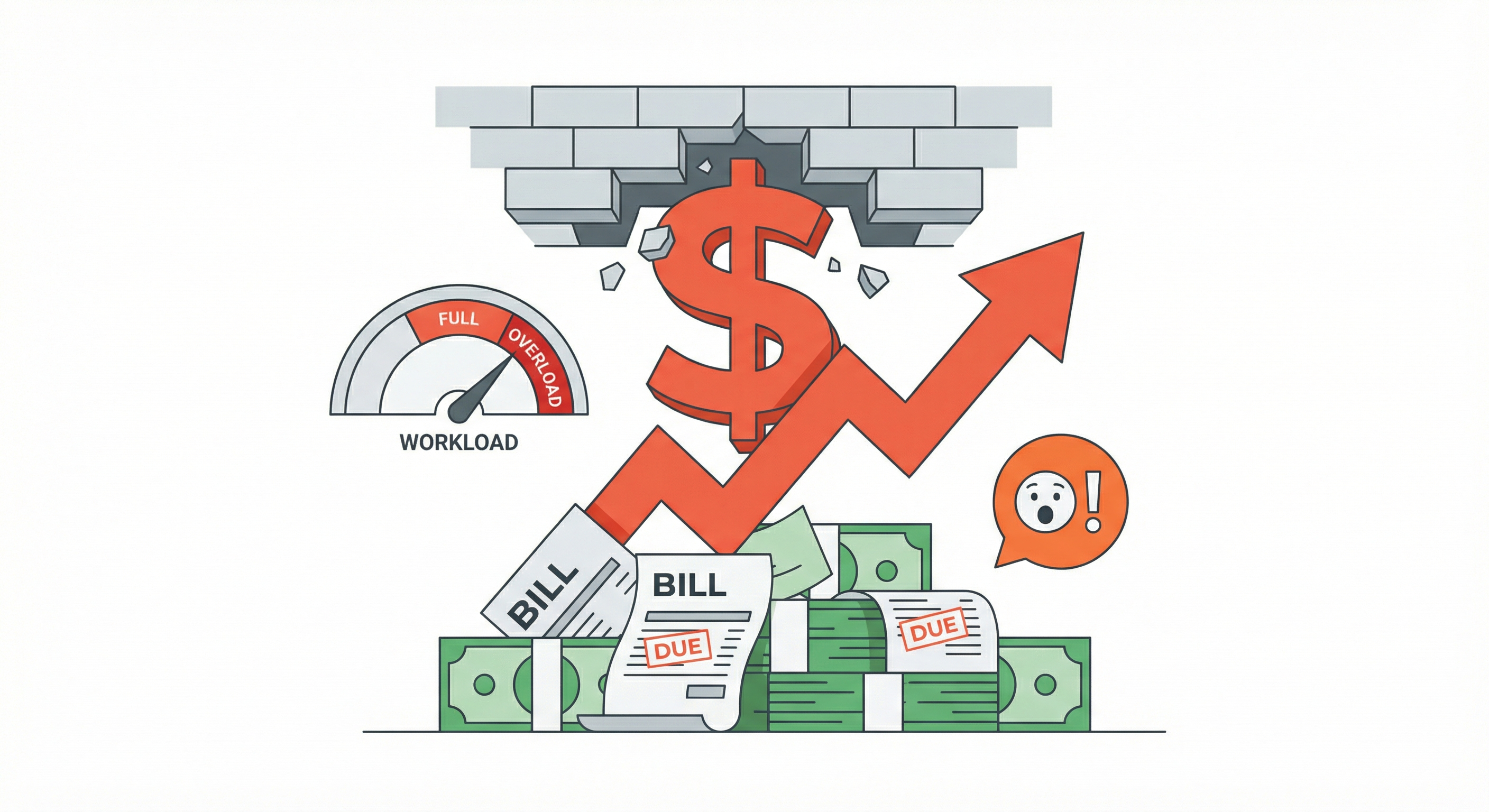
The bill. That's usually the first thing that breaks.
How Bad Can It Get?
"I was paying $28/month when I started. Now I'm sitting at $225." — eric10, Bubble Forum
This guy has 10-15 daily active users. Not thousands. The bill grew 8x while his user count barely moved.
Then there's mitchbaylis:
"7 million workload units used in less than 12 hours! A big fat auto charge bill on the credit card of $1000."
He did the math — if he'd accidentally left his app running over a weekend, he'd be looking at $5,000 auto-charged to his credit card. 37x his normal monthly bill. No warning, no cap, just... gone.
Or this nightmare from 23acher:
"Within 2.5 hours it reached 100% of the 175,000 WU monthly limit, which caused Bubble to automatically take it offline."
Launch day. Traffic spike. App... offline. Bubble's auto-shutoff kicked in because he was "using too much."
That's not a bug. That's working as designed.
Why This Happens
The economics are backwards. Your revenue grows in a straight line. Bubble's costs grow exponentially.
Let's say you charge $10/month per user:
At 100 users:
You make $1,000/mo. Bubble costs $119. That's 12% of revenue. Annoying but manageable.
At 500 users:
You make $5,000/mo. Bubble costs $349+ (with overages). Now it's 7%+ and climbing.
At 1,000 users:
You make $10,000/mo. Bubble costs anywhere from $500 to $1,500 depending on how your workflows run. That's 5-15% of revenue going to platform fees.
At 5,000 users:
You make $50,000/mo. Bubble wants $3,500/month minimum for Dedicated. That's 7% forever, before any workload overages.
Meanwhile, if you were running the same app on Vercel? $50/month. Maybe $200/month if you're doing serious volume.
"When successful, running on Bubble is 10-100 times more expensive than running on self-written code." — sem, Bubble Forum
He's not exaggerating.
What You Can Do
You can optimize. Audit your heaviest workflows. Cache database calls. Implement pagination. Schedule backend workflows for off-peak hours.
These help. But they buy you months, not years.
The hard truth? You can't optimize your way around Bubble's core architecture. The platform overhead is what it is.
The alternative is simpler than you think.
A Next.js app on Vercel costs $20-50/month. Flat rate. No workload units, no surprise charges, no 3am panic about overage bills.
10,000 users? Still $50/month (maybe $200 if you're doing something compute-heavy).
Cost Comparison:
| User Count | Bubble Cost/Month | Next.js Hosting/Month | Annual Savings |
|---|---|---|---|
| 100 | $119 | $20 | $1,188 |
| 500 | $349+ | $50 | $3,588+ |
| 1,000 | $500-1,500+ | $100 | $4,800-16,800+ |
| 5,000 | $3,500+ | $200 | $39,600+ |
Migration costs $1,500-$5,000 once. Bubble costs that every year.
Do the math.
Warning Sign #2: Load Times Hit 3+ Seconds (Users Are Bouncing)
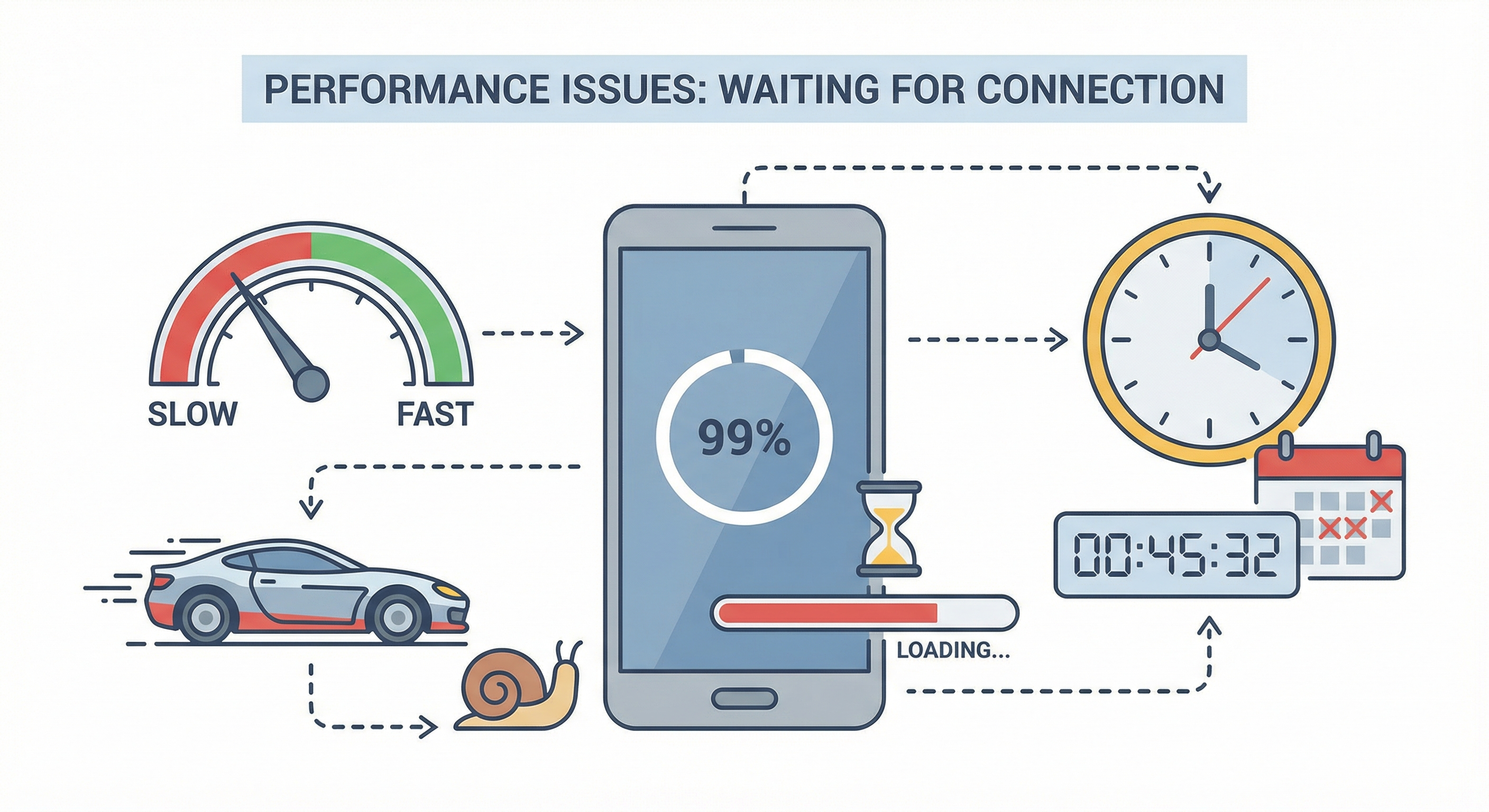
You could live with the bill if the app was fast. But it's not.
Your app is slow. Like, really slow. And there's only so much you can do about it.
thibautranger tested his app on an iPhone 14 Pro. Average load time? 8 seconds.
On Android (Xiaomi Redmi A2), it's worse:
"My app always takes over a minute to load." — thibautranger, Bubble Forum
miracle's experience:
"Takes a solid 30-40 sec on the splash screen before going to index view." — miracle, Bubble Forum
brenton.strine summed it up:
"It's dealbreakingly slow." — brenton.strine, Bubble Forum
The Comparison That Hurts
Want to feel worse? Here's what users expect:
- Airbnb: 2.5 seconds
- Booking.com: 1.5 seconds
- Your Bubble app: 8-30 seconds
thibautranger summed it up:
"I don't see myself releasing my app to my users with these load times."
Why It Happens
Bubble sits between your app and the user. Every click, every database call, every workflow — it all runs through Bubble's runtime layer first.
You can't optimize database indexes. You don't control caching. The workflow engine processes everything sequentially.
On desktop it's tolerable. On mobile, with weaker processors and slower connections, everything takes 2-3x longer.
What You CAN'T Optimize
Some things are just baked into the platform.
Bubble's runtime adds 2-5 seconds to every page load. The entire app bundle loads upfront. There's no server-side rendering, no edge caching, no control over what gets optimized.
You can shave off a second or two with workflow optimization. But 30-second load times? You're not fixing that without leaving Bubble.
What Migration Fixes
Real numbers from real migrations:
- 70%+ load time reduction (typical across migrations)
- Operations that took minutes now take seconds (from Meerako case study)
- 100x capacity increase with zero performance degradation (Meerako)
Next.js gives you:
- Server-side rendering (instant first paint)
- Automatic code splitting (load only what you need)
- Image optimization (serve WebP, lazy load)
- CDN edge caching (milliseconds to first byte)
- Full control over database indexes and query optimization
Warning Sign #3: You Can't Hire the Developers You Need
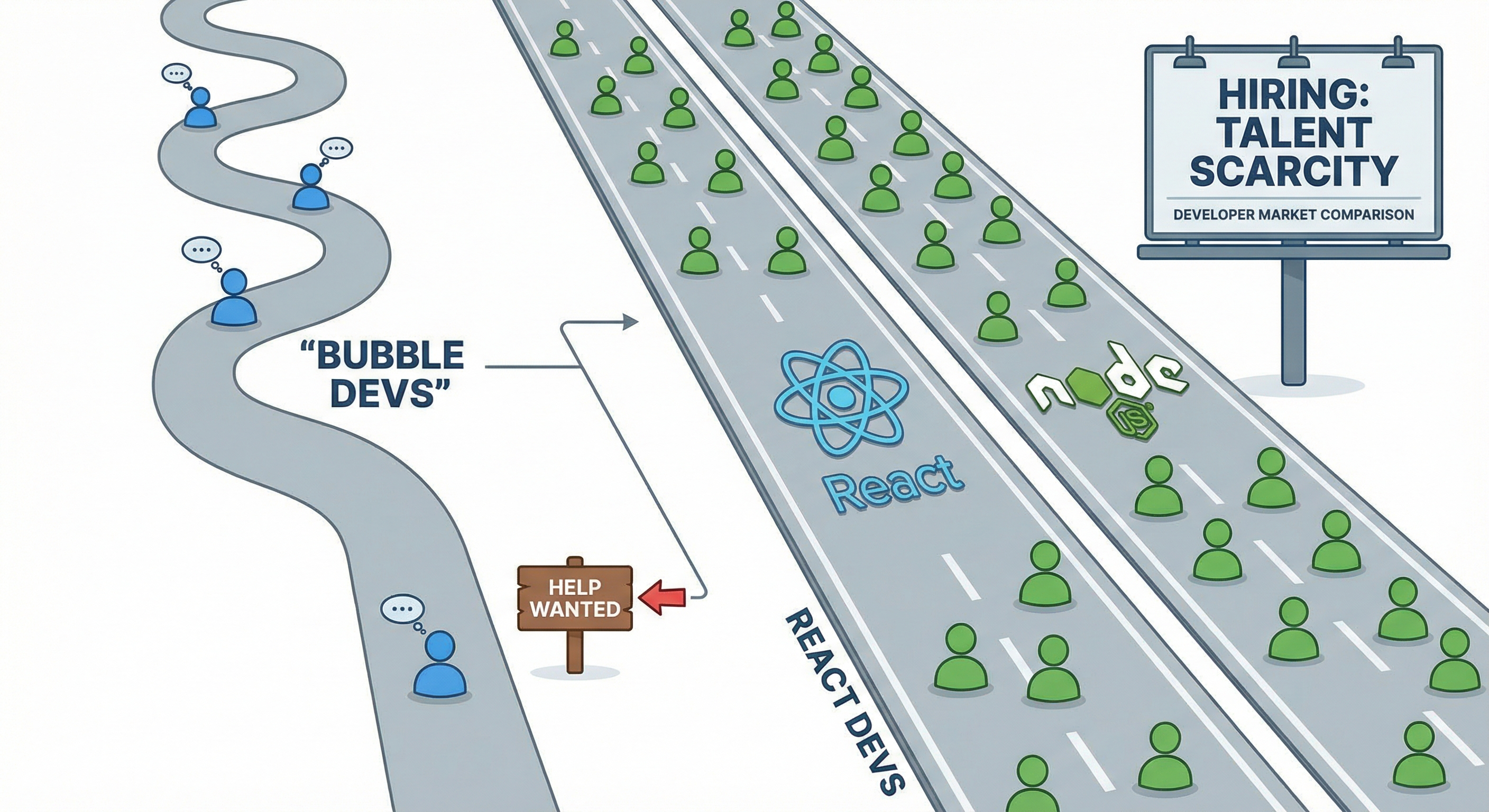
This one creeps up on you.
You need to move faster. You try to hire help. And then you realize: there's nobody to hire.
"I can't hire React devs to work on Bubble." — Bubble Forum
Think about the math here. There are ~500,000 professional React developers. Bootcamps teach React. Every CS program covers it. It's the industry standard.
Bubble? Maybe 5,000 people who do it professionally. It's a side skill for most of them.
What happens when you need to hire?
- You can't post on standard job boards
- You can't hire from your network (nobody knows Bubble)
- You can't bring on contractors from Upwork or Toptal
- You can't onboard your technical co-founder (they want to code, not click)
The Agency Trap
Bubble-specific agencies exist. But they charge a premium.
Why? Scarcity pricing.
When there are 500,000 React devs competing for work, rates stay competitive. When there are 5,000 Bubble devs, they can charge whatever they want.
Plus:
- Limited developer pool drives up rates
- Hard to find qualified help quickly
- Your existing in-house dev team can't help
- Can't outsource to standard development agencies
The Scaling Problem
One founder's reality check:
"Friends built the same app in one week that took me a month in Bubble." — Orbit, Bubble Forum
That's a 4x speed difference. Because React developers work in React all day. Bubble is a side skill for most.
What happens as you grow:
- Technical co-founders resist using Bubble (want modern tools)
- Existing dev team wants to build in code
- Can't split work across multiple developers effectively
- Velocity slows as complexity grows
What Code Ownership Fixes
Suddenly, you have access to:
- Global talent pool of 500,000+ React/Node developers
- Competitive market rates ($50-150/hr vs. premium Bubble rates)
- Easy team scaling — hire juniors, seniors, contractors, agencies
- In-house developers can contribute immediately
- Any web dev agency can maintain your codebase
Want to hire someone in 48 hours? With code, you can. With Bubble? Good luck.
Warning Sign #4: Compliance Requirements Block Your Growth
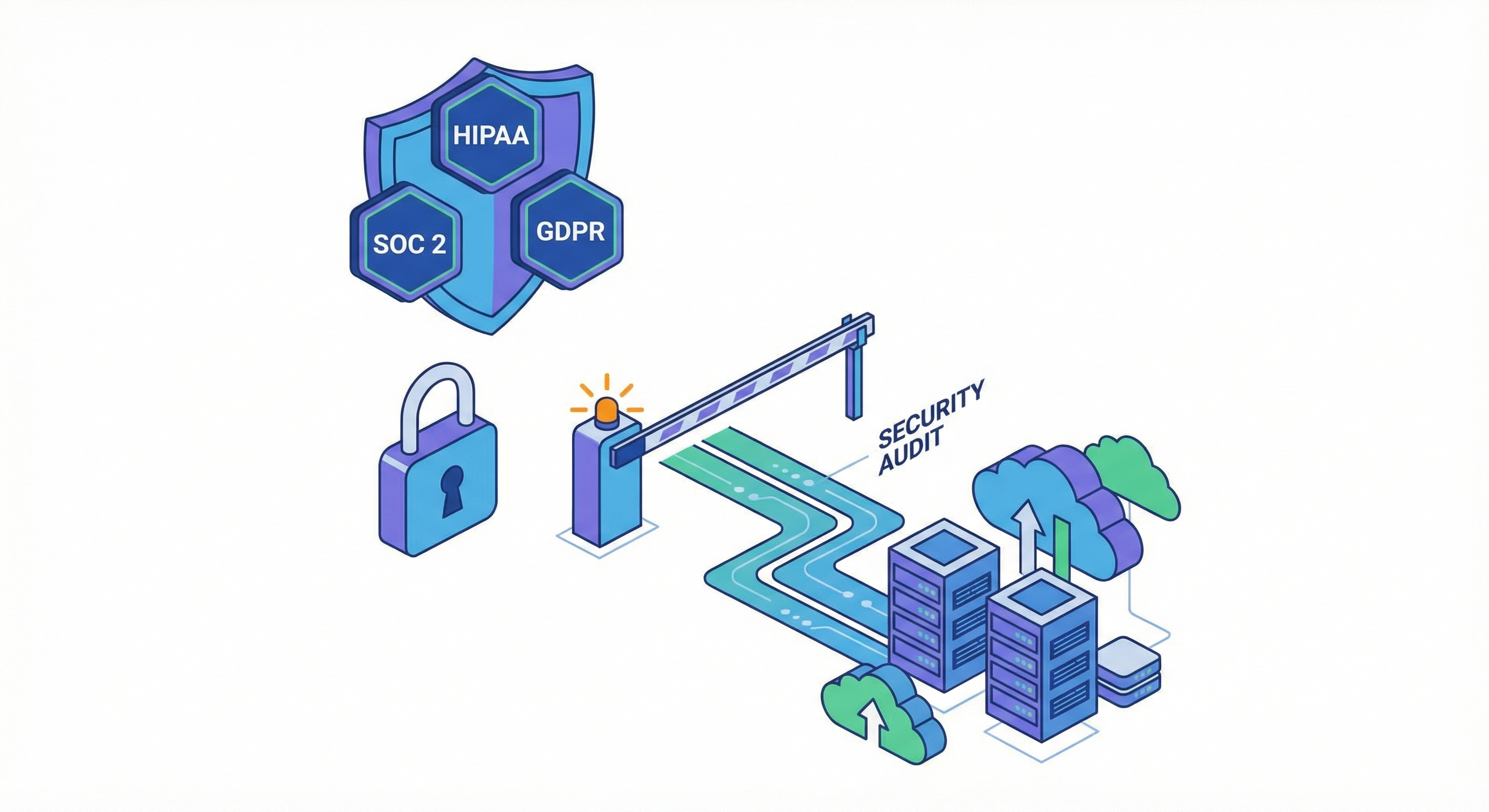
This is the one that kills enterprise deals.
The Enterprise Wall
Real story from the Bubble Forum:
"My client lost a multi-million dollar contract because they ran into compliance issues and they needed the code and DB to be run locally." — vascolucci
A multi-million dollar contract. Lost. Because Bubble can't self-host.
Common compliance blockers:
- HIPAA: Healthcare data must be self-hosted or on BAA-covered infrastructure
- SOC 2: Auditors need infrastructure control and access logs
- GDPR data residency: EU customer data must stay in EU servers (Bubble has limited data residency options for specific EU regions)
- Security audits: Enterprise won't approve third-party-hosted proprietary systems
The Questions You Can't Answer on Bubble
Enterprise security questionnaires ask:
"Can we self-host this?"
→ No
"Can we run this in our AWS account?"
→ No
"Can we audit the codebase for security vulnerabilities?"
→ No
"Who at Bubble has access to our data?"
→ Bubble staff + anyone they grant access to
These aren't nitpicky questions. They're deal-breakers.
When Compliance Becomes Non-Negotiable
You hit compliance walls in:
- Healthcare (HIPAA-covered entities)
- Finance (SOC 2, PCI DSS requirements)
- Enterprise B2B (security questionnaires, vendor audits)
- Government contracts (FedRAMP, IL4, IL5 requirements)
- Series A+ funding (investors require due diligence, infrastructure control)
One founder's wake-up call:
"To attract investors you need code-export; it is very important." — aj11, Bubble Forum
What Code Ownership Enables
With your own codebase:
- Self-host on your infrastructure (AWS, GCP, Azure)
- Pass security audits (source code review, penetration testing)
- Control data residency (EU data in EU, US data in US)
- Get compliance certifications (SOC 2, HIPAA, ISO 27001)
- Unlock enterprise sales (no more "we can't host on third-party platforms")
Warning Sign #5: Investors or Advisors Are Asking Hard Questions
Raising money? This one's for you.
The Due Diligence Problem
"To attract investors you need code-export." — aj11, Bubble Forum
"I've lost over 90% of potential clients because I couldn't offer code ownership." — Orbit, agency owner, Bubble Forum
Here's what happens during technical due diligence:
- Investor brings in a CTO to evaluate your tech stack
- CTO discovers you're on Bubble (vendor lock-in, no code access)
- CTO flags this as "technical risk" in investment memo
- Deal gets delayed, downsized, or killed
The Questions That Kill Deals
"What happens if Bubble changes pricing again?"
(They already did. Twice. With community backlash both times.)
"What's your exit strategy from the platform?"
If you can't answer this, you don't control your destiny.
"Can we hire developers to work on this codebase?"
Not if it's Bubble.
"What if Bubble gets acquired or shuts down?"
Unlikely, but not impossible. And you'd lose everything.
"Do you own your intellectual property?"
The design and data, yes. The code that makes it work? No.
The Credibility Gap
Fair or not, this is what investors think:
"Serious companies don't run on no-code." — Common VC sentiment
Why?
- Bubble on the pitch deck = technical debt flag
- YC partners ask about your roadmap off Bubble
- Later-stage investors require code ownership as a term
- Acquirers won't buy a company they can't control the code for
One founder's brutal honesty:
"Bubble just wasted 2 years of my life and put me out of business before I can even start." — ryan8, Bubble Forum
That's the emotional reality of realizing too late that platform lock-in blocks funding.
What "Investor-Ready" Means
To pass technical due diligence:
- Own your intellectual property (the code, not just the idea)
- Platform-independent architecture (not locked into Bubble)
- Ability to hire standard developers (React/Node, not niche Bubble devs)
- No vendor lock-in risk (control your infrastructure)
- Credible technical foundation for scale (modern, maintainable stack)
The Pattern: It's Not One Sign, It's All Five
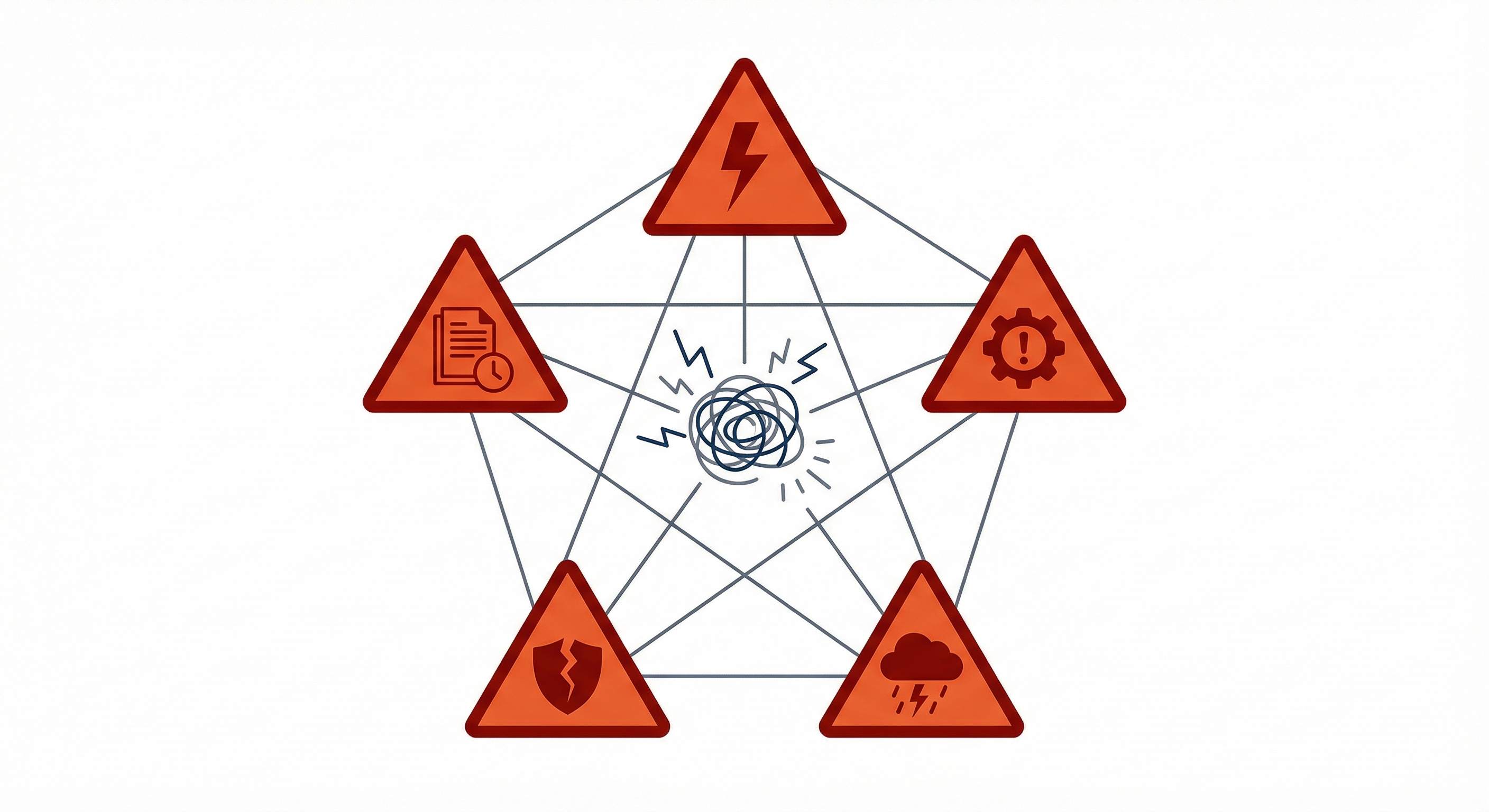
Most founders don't hit one warning sign and immediately decide to migrate. They hit three or four simultaneously, and that's when it clicks.
You're at 500 users. The bill just hit $300/month and you can see where it's headed. Mobile users are complaining about load times. And your investor just asked, "So... do you actually own the code for this?"
That's when "maybe someday" becomes "how fast can we move?"
The Decision Framework
Stay on Bubble if: You're hitting 0-1 of these signs. Bill's under $150. App loads in under 3 seconds. You're pre-revenue or still validating the idea. No investors asking questions, no compliance requirements. Optimize what you can and keep building.
Migrate if: You're hitting 3+ signs. Bill's over $200 and trending up. Load times are losing you users. Compliance is blocking deals. Investors are flagging it in due diligence. You can't hire the help you need. At this point, you're not fixing these problems with optimization.
Why People Actually Migrate
yo11 runs a Bubble agency. Here's what he said about his clients who migrate:
"Clients just want that peace of mind." — yo11, Bubble Forum
It's not really about the money. Or the performance. Or any single thing.
It's about control. You want to know your costs are fixed. You want to own the code. You want to choose where it runs and who can access it.
Migration is an insurance policy. One-time cost, permanent peace of mind.
Frequently Asked Questions
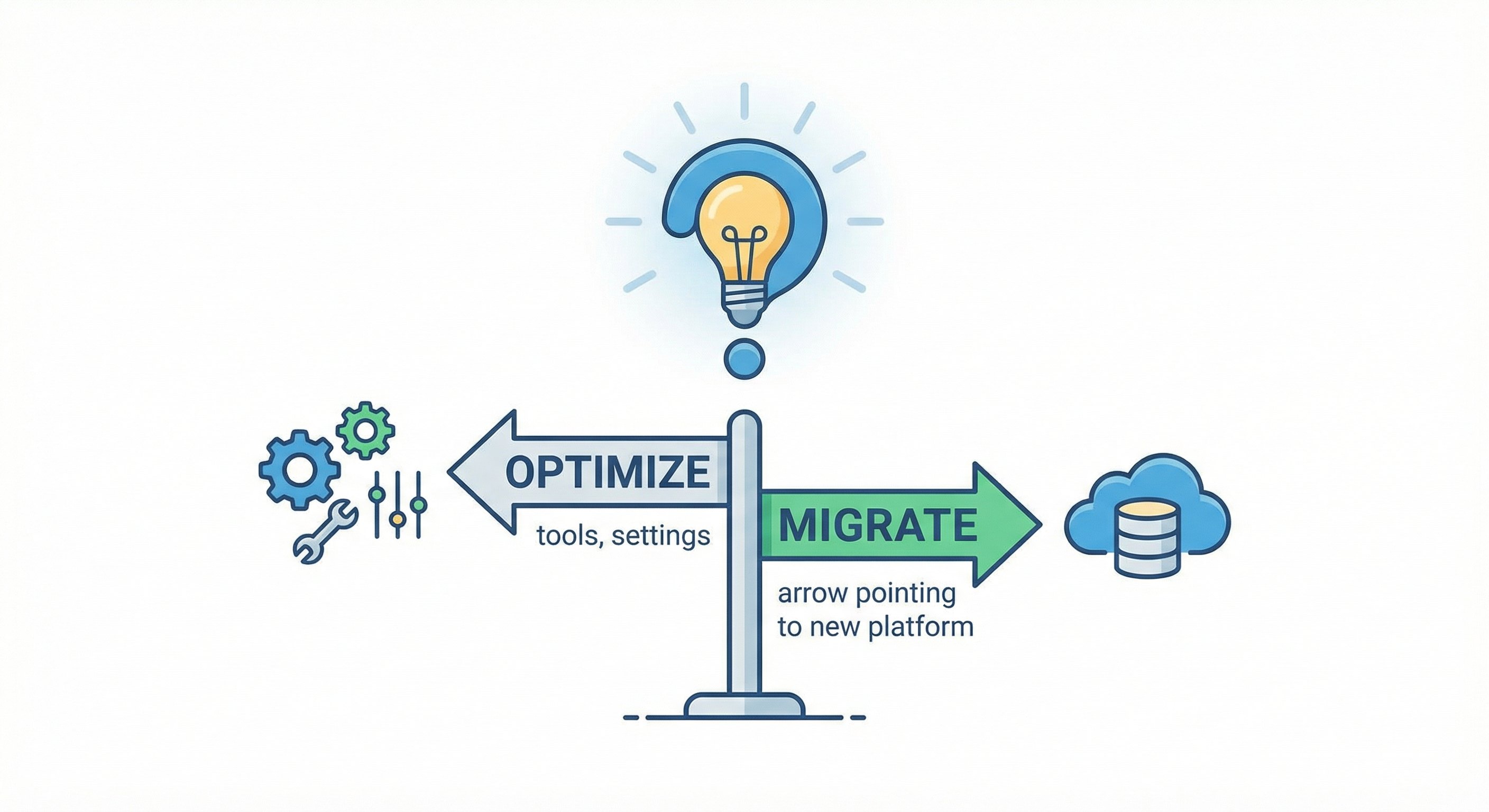
Can I fix these issues by optimizing my Bubble app?
Some issues — workload costs, basic performance — can be improved through optimization. You can audit workflows, cache database calls, reduce redundant searches, and implement pagination.
But optimization has limits. You can't optimize away Bubble's base runtime overhead. You can't make Bubble pass enterprise security audits. You can't hire React developers to work on Bubble.
If you're hitting 3+ warning signs, optimization is a band-aid, not a solution.
How long does migration take?
1-2 weeks for simple apps (up to 5 pages)
2-4 weeks for medium apps (up to 15 pages)
4-8 weeks for complex apps (30+ pages)
This is 5-10x faster than rebuilding from scratch because we've systematized the Bubble-to-code conversion process. We're not starting over — we're converting your existing app into clean, modern code.
What if I'm only hitting 1-2 of these signs?
You're probably fine staying on Bubble for now.
Focus on optimization. Monitor your metrics. Revisit this decision in 3-6 months.
Migration makes sense when:
- The pain is acute (3+ signs)
- OR a single sign is existential (e.g., losing a $1M contract due to compliance)
No need to jump ship early. But don't ignore the warning signs either.
Will I lose functionality during migration?
No. We preserve your features, design, and data.
For Bubble plugins: Most have better equivalents in the JavaScript ecosystem. During our consultation, we audit your plugin dependencies and map each one to its code alternative.
For custom functionality: We rebuild it natively in your new codebase.
For user data: We migrate your complete database to PostgreSQL, preserving all relationships and records.
You pick up exactly where you left off — just faster, cheaper, and with full control.
How much does migration cost compared to staying on Bubble?
Migration is a one-time cost of $1,500-$5,000 depending on complexity.
Staying on Bubble costs $1,500-$4,200/year (Starter to Dedicated plans) — forever.
Migration pays for itself in 6-18 months. Then you save thousands every year after.
Plus: no workload overage nightmares, no surprise auto-charges, no bill anxiety.
What Now?
If you're hitting 3+ of these, you already know what you need to do.
The question is timing. Every month you wait costs another $200-500 in platform fees. You're losing users to slow load times. Missing deals because of compliance. Watching competitors ship faster on modern stacks.
Or you migrate. Pay once, own it forever.
Want to see what migration would look like for your specific app? We'll review it, map out the dependencies, give you fixed pricing.
No obligation. Just a straight answer about whether it makes sense.
Ready to talk migration?
Get a free assessment of your Bubble app. We'll tell you exactly what to expect — timeline, cost, and any potential challenges.