
Bubble.io vs Next.js: Which One Won't Waste 2 Years of Your Life?

A founder named Ryan posted this after his Bubble experience imploded:
"bubble just wasted 2 years of my life and put me out of business before i can even start... it feels like i just got cheated on by my girl and she ran out with another man and my only car"
On the other end, here's what people say after migrating to custom code:
"the best decision I've ever made... custom code is always better...not an opinion, its a fact" — thuto.co, Bubble Forum
"you can't never go back" — hoke, Bubble Forum
Two very different outcomes. The difference isn't luck. It's knowing which tool to use when.
This isn't a "which framework is technically superior" comparison. Engineers love those debates. You need something simpler: which choice will cost less, cause fewer headaches, and let your business actually grow?
The 30-Second Answer
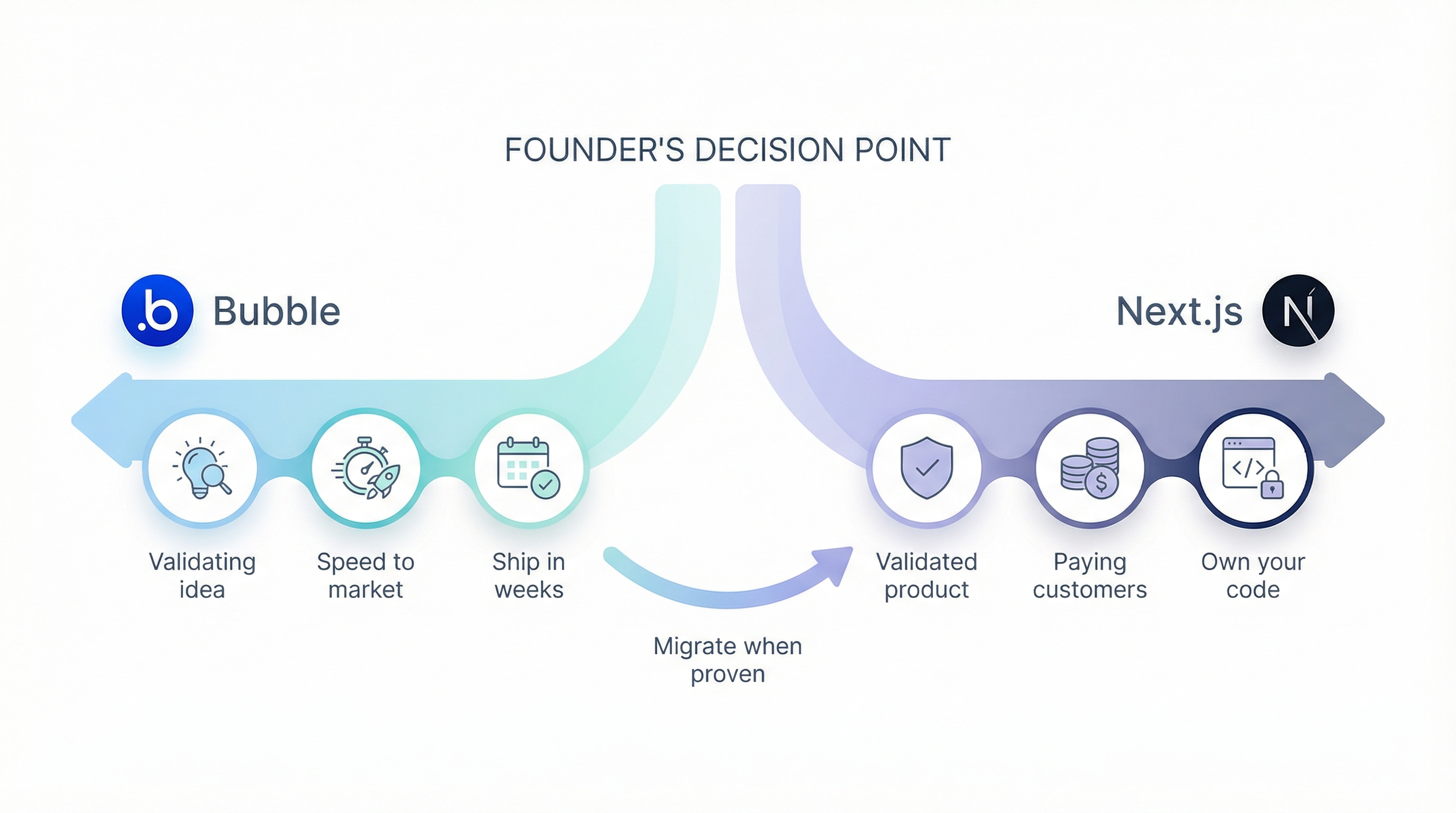
Use Bubble if: You're still figuring out if anyone wants this thing. Speed to market matters more than everything else. You need to ship in weeks, not months.
Use Next.js if: You've validated the idea. People are paying you. Your Bubble costs or performance are causing real problems. You want to own your code and your future.
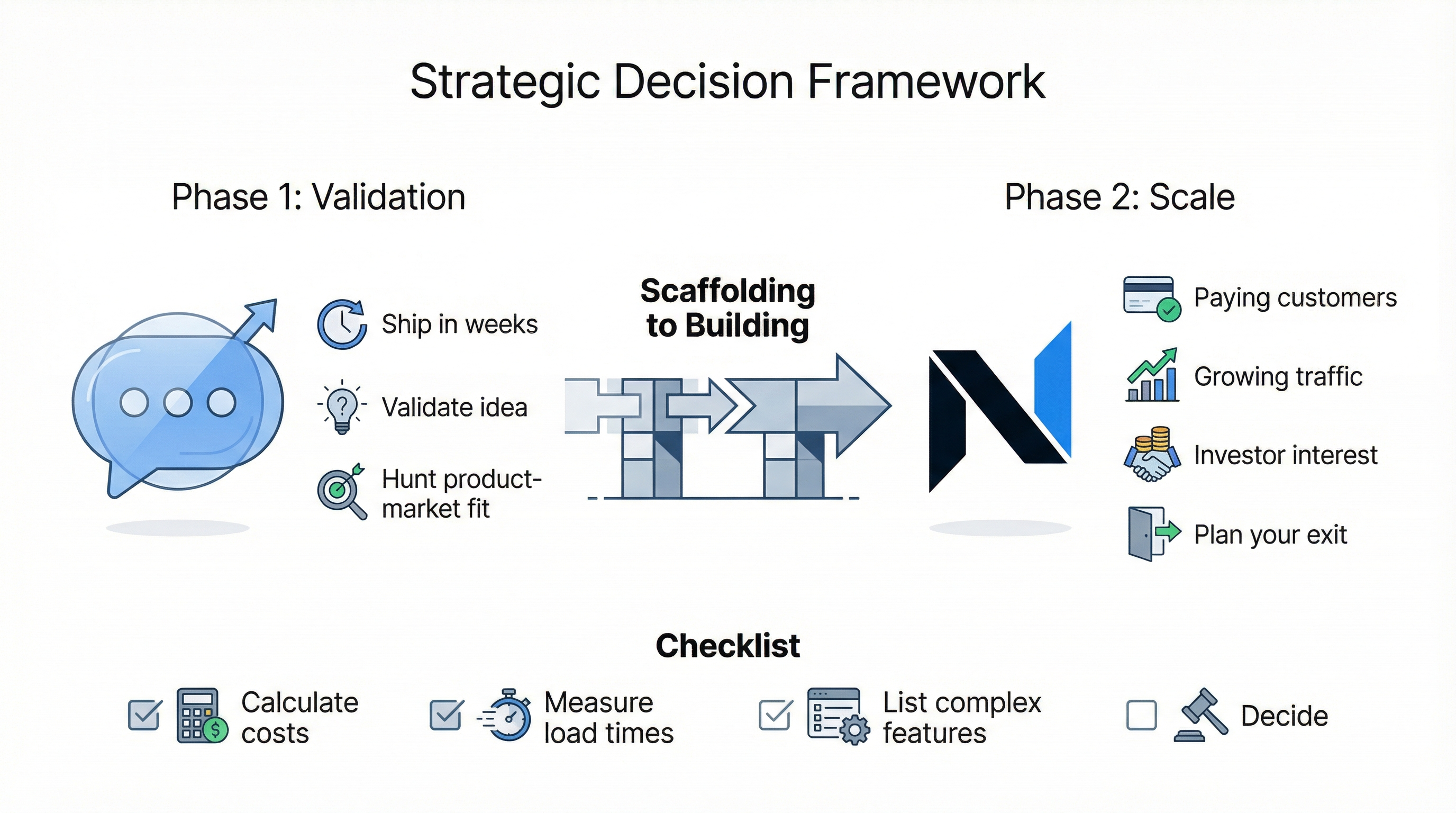
The hybrid path most successful founders take: Build on Bubble to validate. Migrate to Next.js when you've proven the model works. Treat Bubble as scaffolding—useful during construction, removed once the building stands.
Now the details.
Cost: Where Bubble Gets Expensive Fast
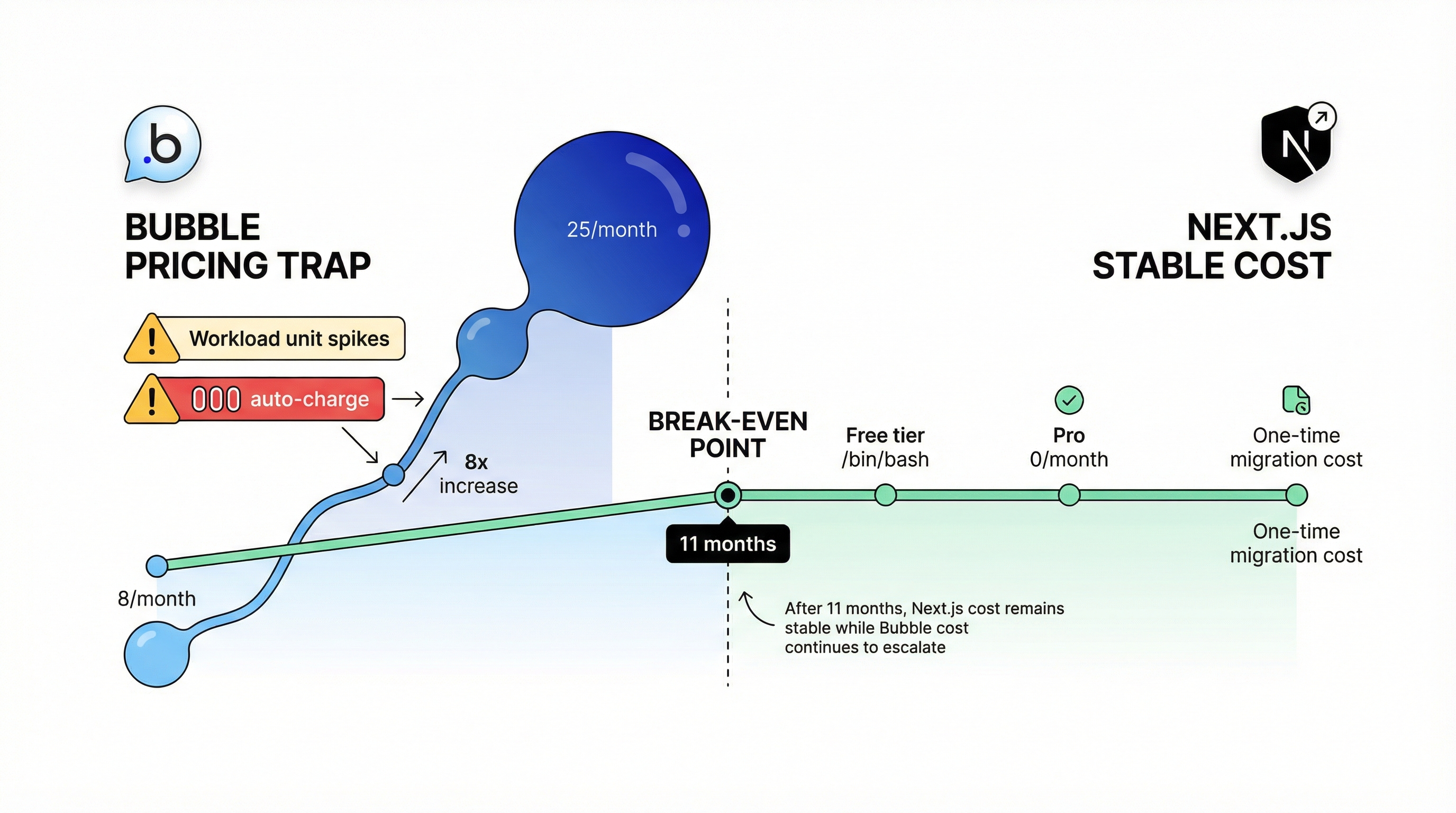
The Bubble Pricing Trap
The subscription looks reasonable. The workload units are the trap.
"I was paying $28/month when I started. Now I'm sitting at $225." — eric10, Bubble Forum (with only 10-15 daily users)
That's an 8x increase for what most startups would call a rounding error in traffic.
The spikes are worse:
"7 million workload units used in less than 12 hours! A big fat auto charge bill on the credit card of $1000." — mitchbaylis, Bubble Forum
"If I'd left the lights on for a weekend I'd be looking at $5k auto charged — that'd be 37x my normal monthly charge."
And the markup is brutal:
"when successful, running on Bubble is 10-100 times more expensive than running on self written code" — sem, Bubble Forum
Realistic Bubble costs:
- Year 1 (small app): $384-$2,700
- Year 2-3 (growing app): $3,000-$8,000+ annually
- Plus unpredictable overage spikes
Next.js Costs
Hosting:
- Vercel free tier: $0 (covers most small apps)
- Vercel Pro: $20/month
- Self-hosted VPS: $5-$20/month
Development (the real cost):
- Migration from Bubble: $1,500-$5,000 one-time
- Freelancer build: $5,000-$30,000 one-time
- Agency build: $30,000-$200,000 one-time
Realistic Next.js costs:
- Year 1: $1,500-$5,000 (migration) + $60-$240 (hosting)
- Year 2-3: $60-$240/year (hosting only)
The Math
If you're paying $225/month on Bubble ($2,700/year), and migration costs $2,500 with $20/month hosting after:
Break-even: ~11 months.
At $349/month Bubble (Team plan), break-even is month 8.
After that, you're saving $2,500-$4,000 per year. Forever.
"no need to worry about costs" — munaeemmmm, Bubble Forum (after migrating)
The psychological relief of predictable costs matters too.
Performance: The Dealbreaker
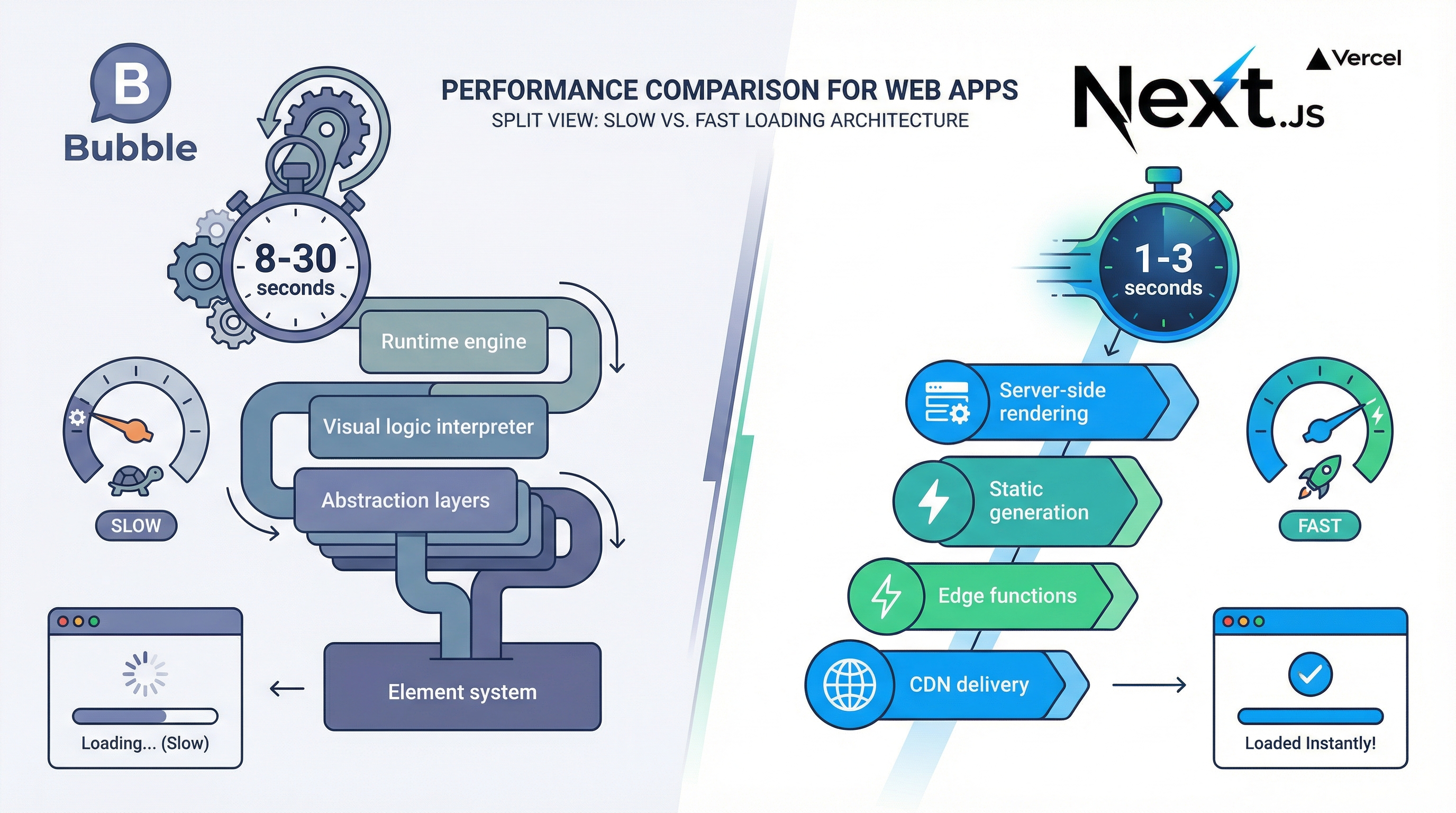
This is where Bubble struggles most. The forum posts are brutal:
"On my iPhone 14 pro, my app takes on average 8 seconds to load" — thibautranger
"on my Xiaomi Redmi A2, my app always take over a minute to load" — thibautranger
"takes a solid 30-40 sec on the splash screen before going to index view" — miracle
"It's dealbreakingly slow." — brenton.strine
For context:
"Airbnb loads in 2.5 seconds, booking.com loads in 1.5 seconds"
Your users are comparing your 30-second load time to Airbnb's 2.5 seconds. You will lose that comparison every time.
Why Bubble Is Slow
Every Bubble page load involves:
- Loading Bubble's runtime engine
- Interpreting your visual logic at runtime
- Fetching data through Bubble's abstraction layers
- Rendering through Bubble's element system
Lots of intermediary steps between "user clicks" and "content appears."
Why Next.js Is Fast
Next.js supports:
- Server-side rendering: Pages render before reaching the browser
- Static generation: Pre-built HTML served instantly from CDN
- Edge functions: Code running geographically close to users
A typical Next.js app loads in 1-3 seconds. Many load sub-second.
One migration case study showed 70% reduction in load times. Operations that took minutes in Bubble took seconds after.
Why This Matters More Than You Think
Every second of load time increases bounce rate by 7-10%. An 8-second load means losing 50%+ of visitors before they see anything.
"I don't see myself releasing my app to my users with these load times" — thibautranger
You're not just losing conversions. You're burning ad spend, ruining first impressions, and never knowing how many people you lost.
The Lock-In Problem
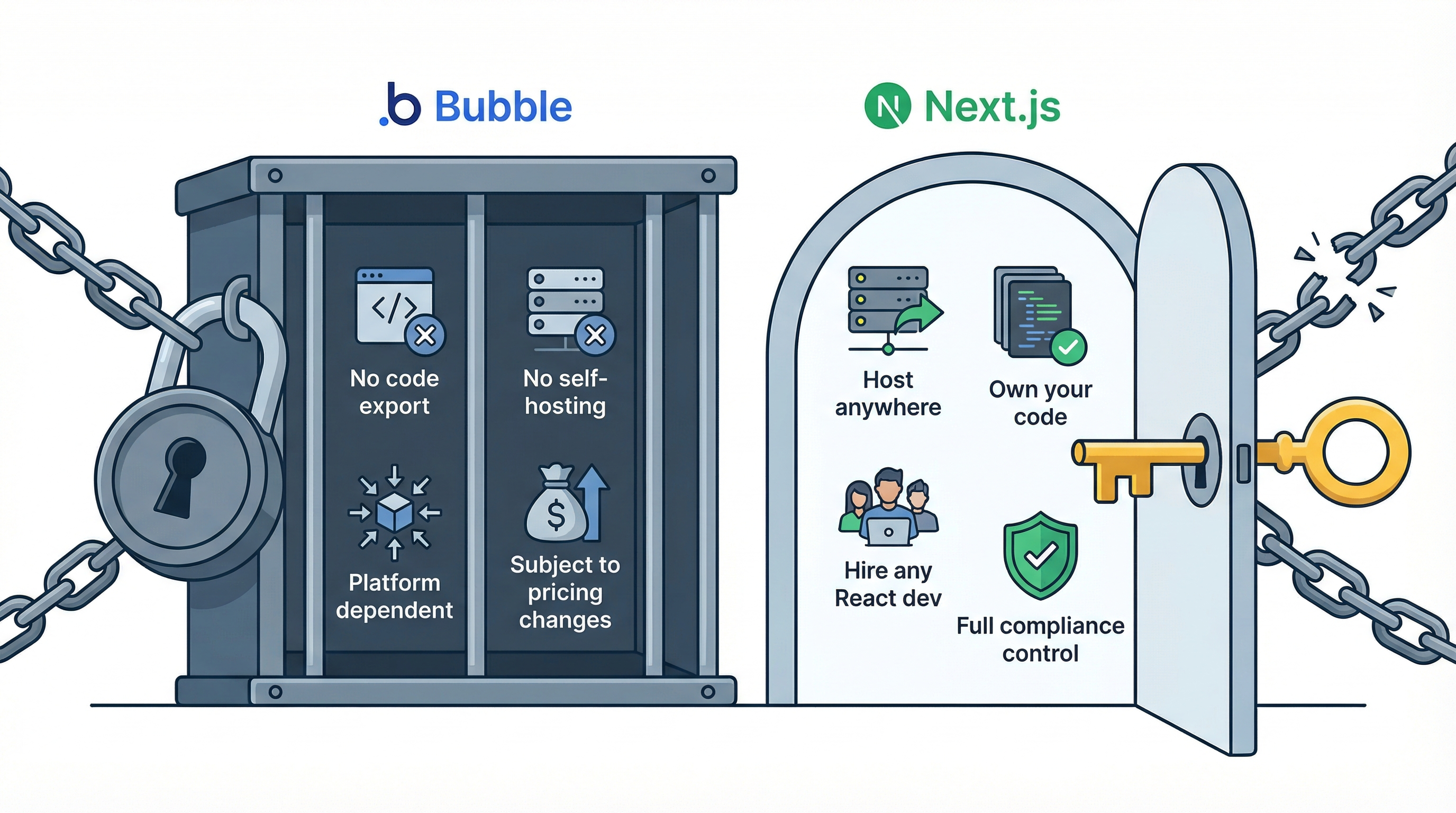
With Bubble: You Own Nothing
"Bubble apps can only be run on the Bubble platform; there's no way of exporting your application as code" — Emmanuel, Bubble co-founder
The co-founder confirming what you suspected: you don't own your app.
And they're not building an escape hatch:
"Bubble has no plans to build an export tool in the next 1-2 years" — mikeloc, citing Bubble co-founder Josh
The implications:
- Can't self-host
- Can't show investors source code
- Can't hire React developers
- Subject to whatever pricing changes come next
- Your business exists at Bubble's discretion
"If you don't own your code, you don't own your app" — vascolucci, Bubble Forum
"what happens if someone hacks your account and deletes your app? Is there any way to recover from this?" — mc3digital
"the lock in that Bubble has on your data is super frustrating" — stuart8 (who migrated 3M+ records)
With Next.js: You Own Everything
You can:
- Host anywhere (Vercel, AWS, Cloudflare, your own servers)
- Move providers whenever you want
- Hire from the largest developer talent pool (React)
- Show investors clean, auditable code
- Meet any compliance requirements
This matters most when:
1. Raising money:
"to attract investors you need code-export it is very important" — aj11, Bubble Forum
2. Selling to enterprises:
"my client lost a multi-million contract because they ran into compliance issue and they needed the code and DB to be run locally" — vascolucci
One lost enterprise deal can exceed your entire migration budget ten times over.
Scalability: What Happens When You Succeed
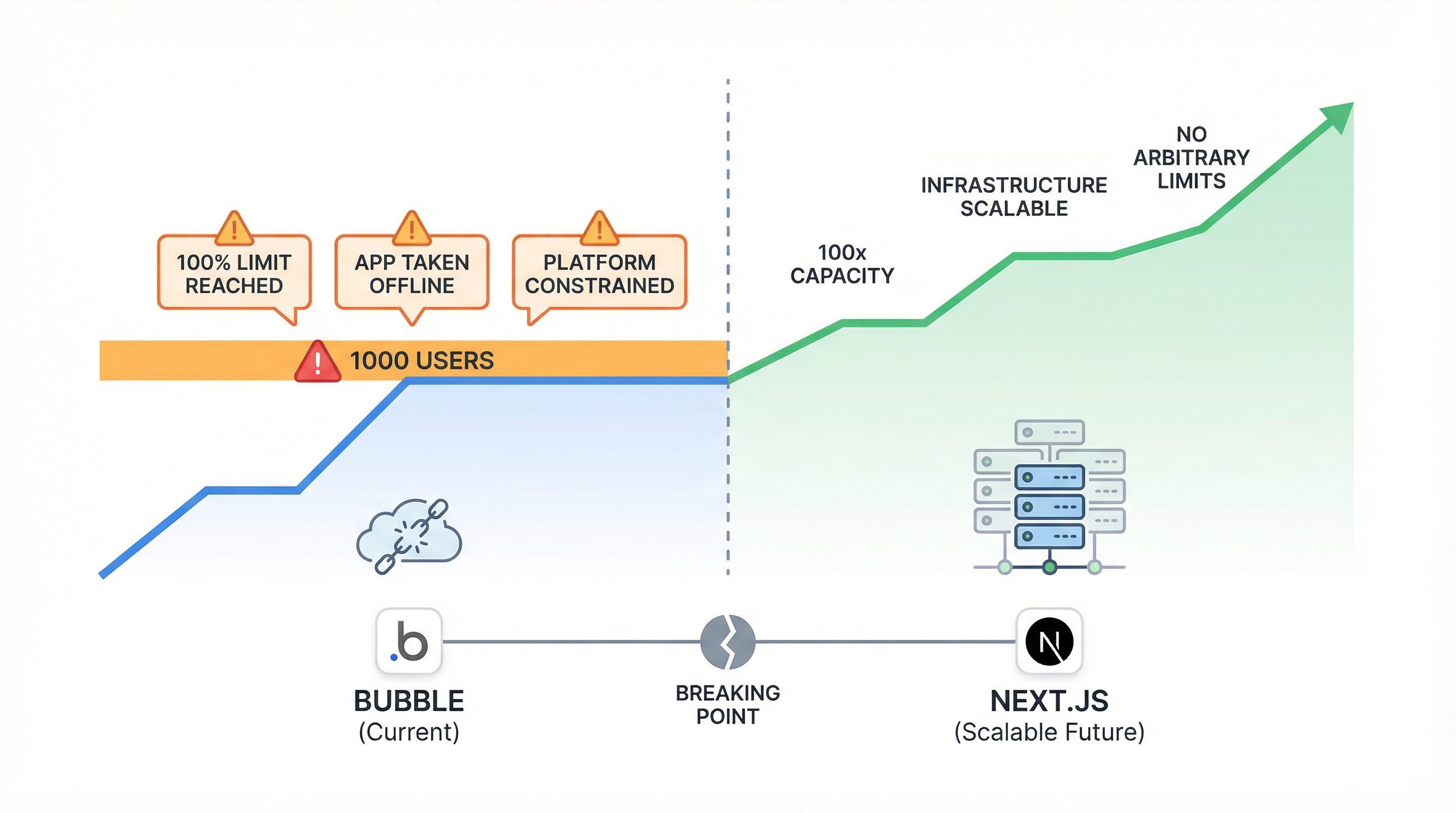
This is the cruel irony. Bubble's problems hit hardest when you're winning.
"within 2.5 hours it reached 100% of the 175,000 WU monthly limit, which caused Bubble to automatically take it offline" — 23acher
Their app got taken offline during launch. The moment they got traction, Bubble shut them down.
"its a joke cos 1000 people is nothing but unfortunately the markup on search/crud operations from bubble is very high" — TipLister
A thousand users shouldn't be hard. On Bubble, it can be.
One migration case study: new Next.js architecture could handle "100x their previous user load with ease."
Development Speed: Bubble's Real Advantage
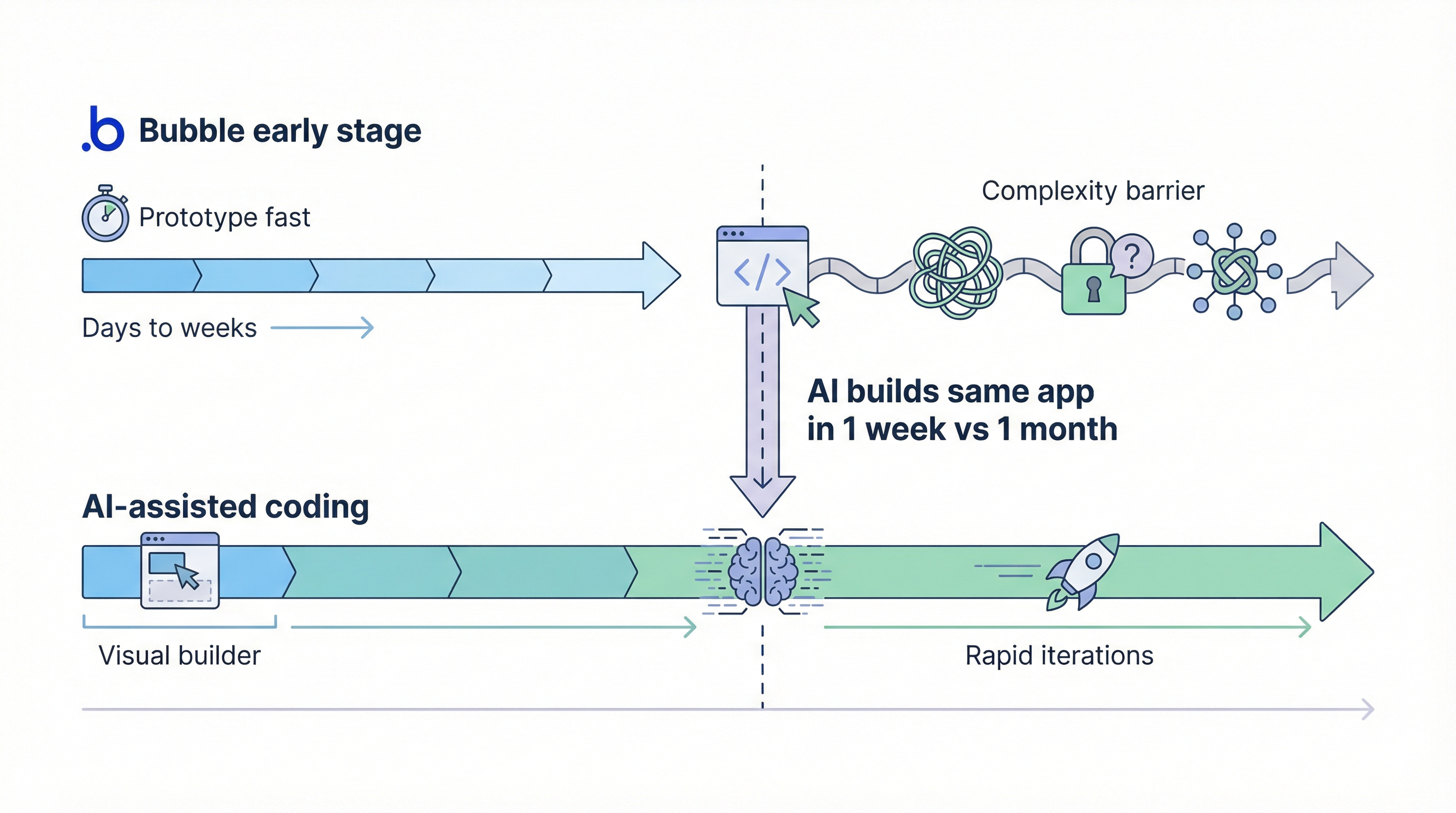
Fair is fair: Bubble is genuinely faster for getting something built initially.
A non-technical founder can go from idea to working prototype in days or weeks. The visual builder and plugin ecosystem dramatically accelerate early development.
That same thing from scratch in Next.js takes longer.
But there's a crossover point.
Early on, Bubble is faster. As apps get complex, Bubble's visual programming becomes a constraint. Debugging visual logic is hard. Optimization is hard. Complex workflows become spaghetti.
And AI is changing the equation:
"friends build the same app in one week that took me a month in Bubble" — Orbit, Bubble Forum
"The speed of development in modern AI-powered IDEs has become too significant for us to ignore." — Orbit (5-year Bubble user's goodbye post)
"If AI can build anything you want in seconds, on a dollar per month hosting plan, why would you pay bubble 10 or 100x?" — sem
The development speed gap that justified Bubble is narrowing fast.
The Hiring Problem
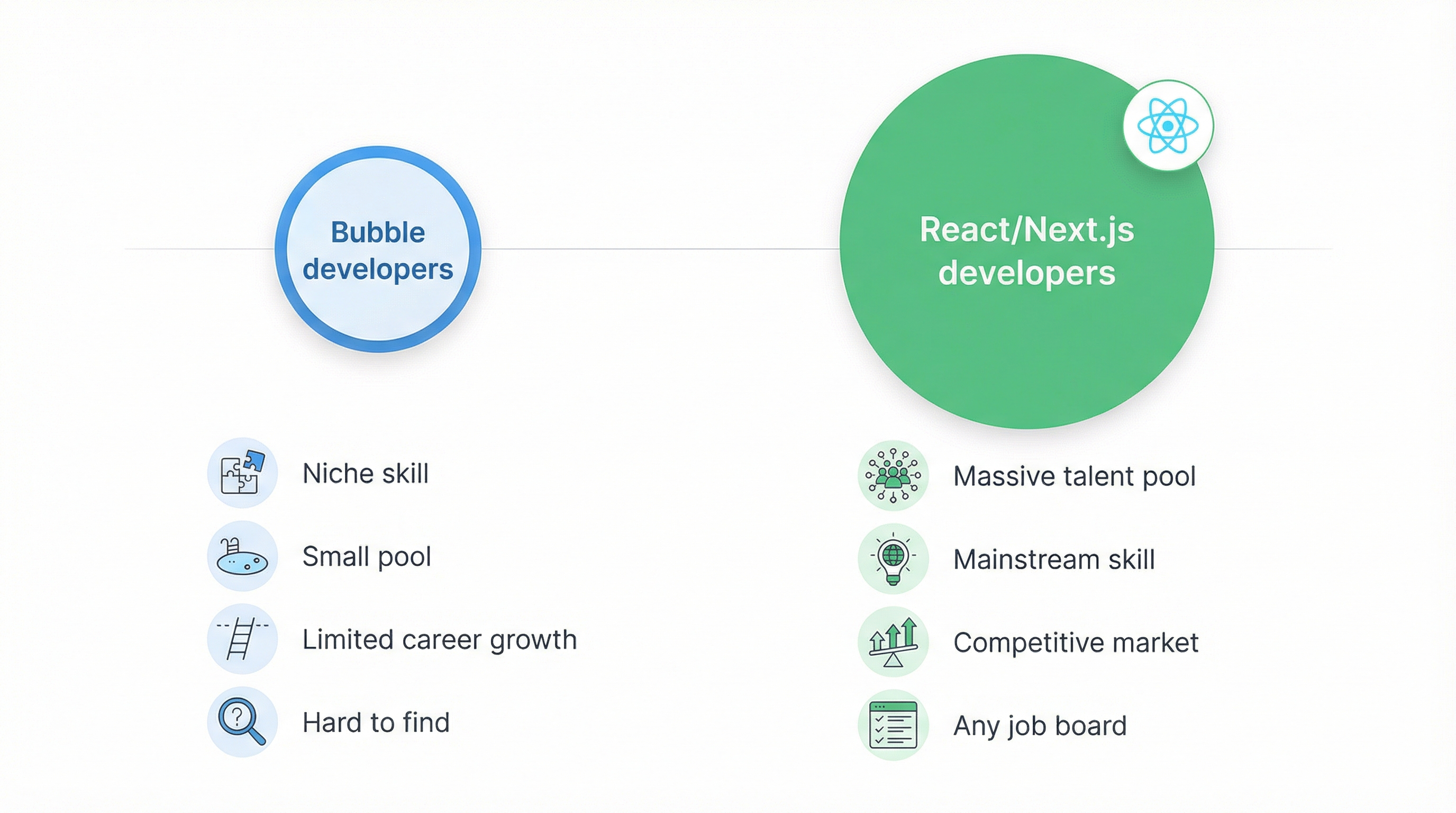
If you ever need to hire developers, this matters enormously.
Bubble developers: Small talent pool, niche skill, limited career growth, higher rates for limited expertise
React/Next.js developers: Massive talent pool, mainstream skill, competitive market
You can find React developers on any job board. Finding experienced Bubble developers? Much harder.
"I've lost over 90% of potential clients because I couldn't offer code ownership." — Orbit (agency owner who eventually left Bubble)
An agency owner—in the business of Bubble development—couldn't close deals because clients needed code ownership.
The Trust Erosion
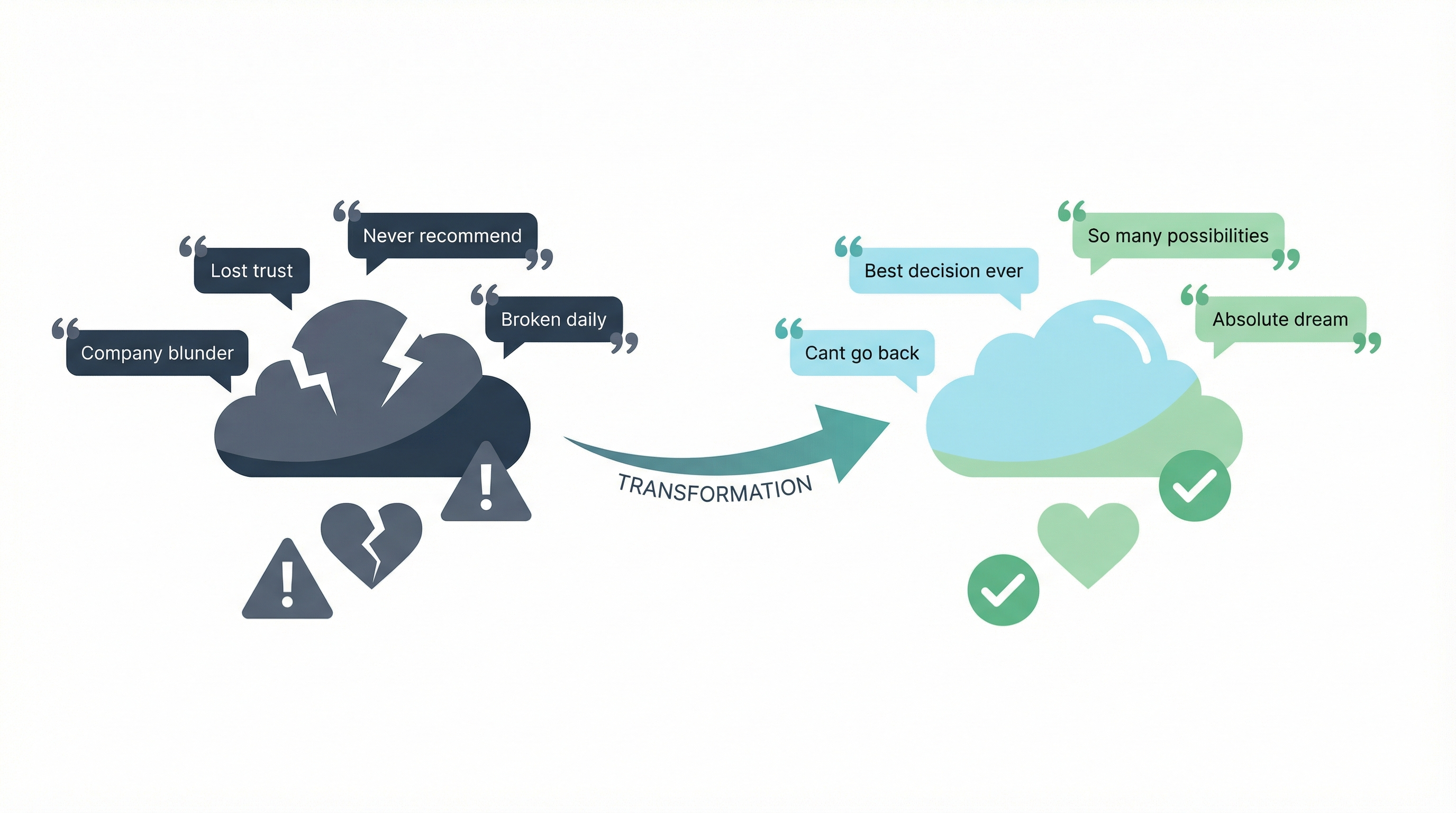
What's the vibe on the Bubble forum?
"I will never again recommend Bubble to anyone. I used to tell everyone about it, now I tell them to avoid it." — eric10
"The amount of lost trust isn't something that just comes back" — viable
"This is one of the biggest company blunders I've seen in probably 5 years" — bdthomas
"You don't make major pricing announcements and walk them back not once, but twice" — viable
"every day comes with something that worked yesterday broken today" — ryan8
"I come back here to remind myself of the chaos that is Bubble" — philip2 (who rebuilt 50%+ of apps outside Bubble)
People who loved Bubble eventually felt betrayed by it.
What People Say After Migrating
"I migrated to code. It wasn't even that difficult to be honest. One month and I had an app ready for production" — hoke
"you can't never go back" — hoke
"I never thought of going back to bubble" — munaeemmmm
"the best decision I've ever made" — thuto.co
"There are so many possibilities when you're coding" — munaeemmmm
"I switched to weweb and xano 6 months ago for all new projects and it has been an absolute dream" — mitchbaylis
Nobody who migrated seems to regret it.
The Comparison Table
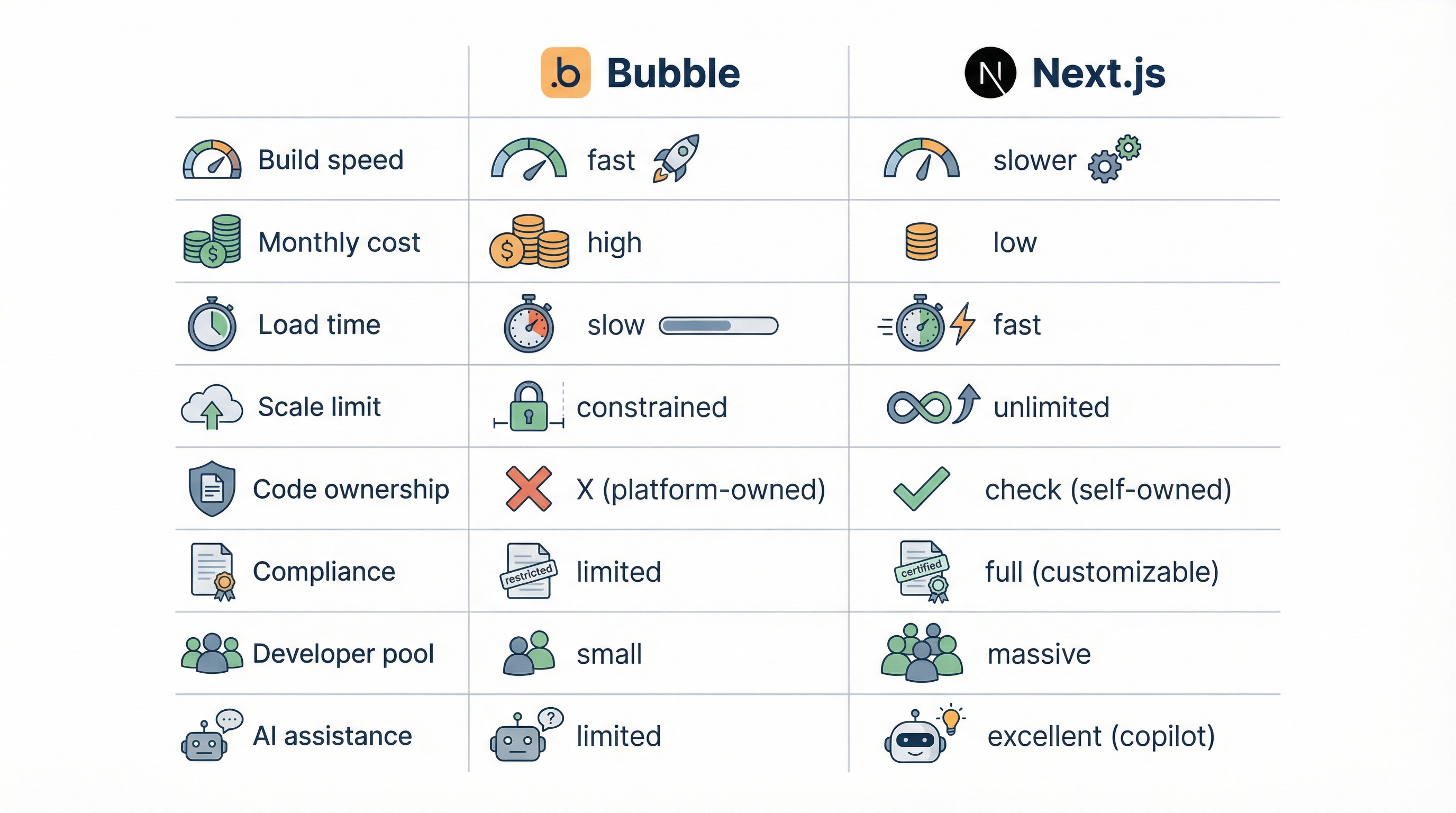
| Factor | Bubble.io | Next.js |
|---|---|---|
| Initial build speed | Fast (days-weeks) | Slower (weeks-months) |
| Long-term development | Slows down | Consistent |
| Monthly cost (small app) | $32-$119 | $0-$20 |
| Monthly cost (growing app) | $119-$500+ | $20-$50 |
| Load time (typical) | 5-30 seconds | 1-3 seconds |
| Scale limit | Platform-constrained | Infrastructure-constrained |
| Code ownership | No | Yes |
| Compliance/self-hosting | Limited | Full control |
| Developer talent pool | Small | Massive |
| Investor perception | Concerning | Neutral/positive |
| Vendor lock-in | Total | None |
| AI development assistance | Limited | Excellent |
The Migration Path
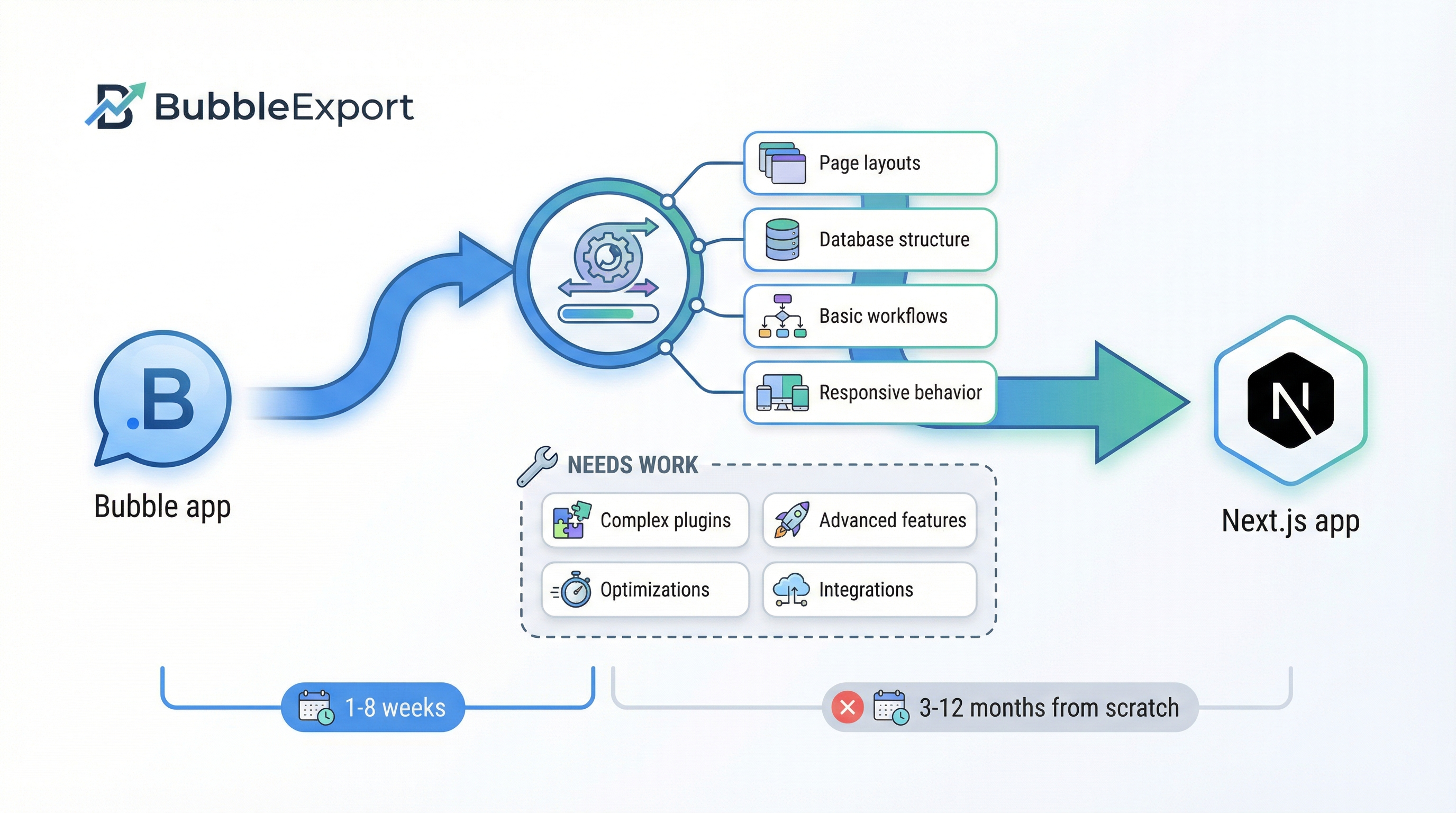
You don't have to start over.
Services like BubbleExport convert your existing Bubble app into Next.js code. Keep your design, logic, data structure. 1-8 weeks versus 3-12 months for a scratch rebuild.
What transfers:
- Page layouts and designs
- Database structure
- Basic workflows and logic
- Responsive behavior
What needs manual work:
- Complex plugin functionality
- Advanced Bubble-specific features
- Performance optimization
- Third-party integrations
Not magic. But much faster than rebuilding from zero.
The Honest Take
Bubble is a tool. Good for certain jobs. Poor for others.
If you're still figuring out whether anyone wants your product—build on Bubble. Ship in weeks. Validate the idea. Speed matters more than architecture when you're hunting for product-market fit.
But the moment you've validated—paying customers, growing traffic, investor interest—start planning your exit.
The founders who get stuck keep optimizing Bubble past its useful lifespan. The ones who succeed treat Bubble as scaffolding: useful during construction, removed once the building stands.
"Bubble is great for some free prototyping but if want to be serious, get out!" — philip2
Harsh. But he rebuilt 50%+ of his apps. He's not wrong.
If you're currently on Bubble:
- Calculate your monthly costs (subscription + average workload overages)
- Measure your load times (use PageSpeed Insights)
- List your most complex features and plugins
- Decide: optimize, or migrate?
If you decide to migrate:
Get a free migration assessment →
We'll review your app, give you realistic timeline and cost, and tell you honestly if migration makes sense. Sometimes the answer is "not yet"—we'd rather tell you upfront.
Ready to talk migration?
Get a free assessment of your Bubble app. We'll tell you exactly what to expect — timeline, cost, and any potential challenges.